

When it comes to learning embroidery techniques, you can’t go wrong with Country Bumpkin’s A-Z series, and they’ve done it again! They’ve released another great book in the series, this time on whitework embroidery. Here’s what you’ll find in it…
A-Z of Whitework, recently republished by Search Press (2015), covers all the basics of whitework techniques, from candlewicking to cutwork and net embroidery. You’ll find hundreds of step-by-step photos for stitch directions and finish work.
What is whitework? Basically, it’s any kind of stitching technique in white threads on white cloth. Normally, it’s associated with embroidering motifs in white cotton on white linen, and often includes spaces in the design that have been cut away, in a technique called cutwork. Whitework is often associated with household linens and smaller items like monogrammed handkerchiefs. The stitches used are various, but typically you see padded satin stitch, stem stitch, buttonhole stitch, lattice work over open ground, seed stitching, French knots, and a variety of filling techniques.
Some techniques of whitework, such as Mountmellick embroidery, rely on relief work, padded stitches, and stitches that provide a lot of texture, so that there’s a noticeable and pleasing contrast between the fabric and the stitchwork.
I thought I’d show you some samples of my whitework pieces that are either (unfortunately) in storage boxes for lack of household space, or that I have here and there around the house.
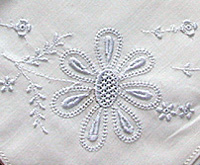
This is a close-up of a handkerchief, which I guess passes for whitework, although some of the stitching, as you can see, is not white, but rather a pale, pale blue. Something old, something new, something borrowed, something blue – you guessed it – it’s a wedding hanky! Most of the stitching is pin stitch, stem stitch, satin stitch, and eyelets. All of these techniques are covered in the A-Z book!
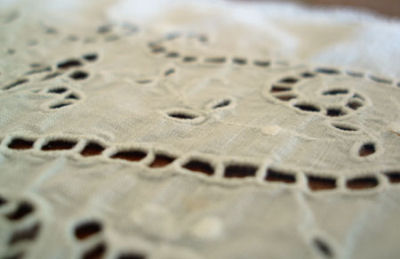
This is an angled close-up on a dresser scarf, which is on top of an old dresser. I didn’t iron it too well last time, I guess. Anyway, you can see here the cutwork and the overcast stitches – all of which are covered in the A-Z book.
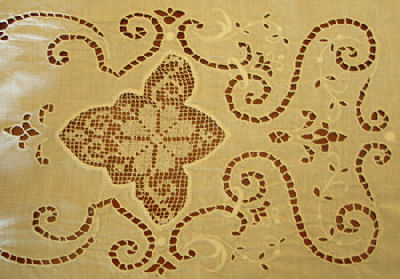
Here’s an overhead view of the same, and you can see the embroidered net insert (filet embroidery), which is also covered in the A-Z book.
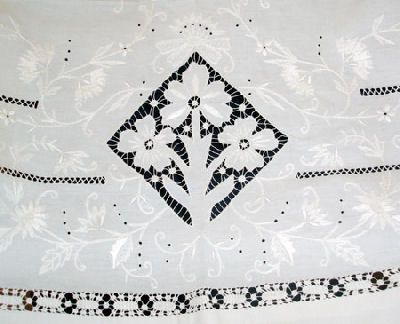
I just love this piece, which I’m keep stored for now! This one is NOT my work – I purchased it through an antique dealer. I can’t take credit for something this gorgeous!! But I do love it! Here’s another close-up:
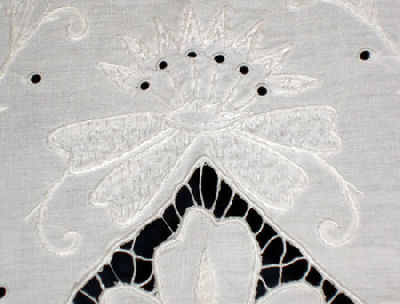
The eyelets are really well done. This is my favorite part of the motif – I love the little ‘crown’ look with the bow at the tip of the cutwork.
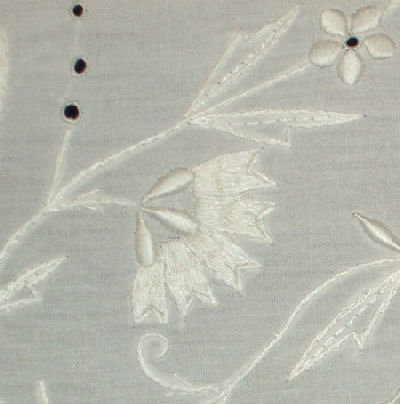
The satin stitching here is very nice, and you can see another close up of it below. The other filling is merely created with long straight stitches in some cases, and rows of stem stitching in other cases. You can see the backstitching down the center of the leaves.
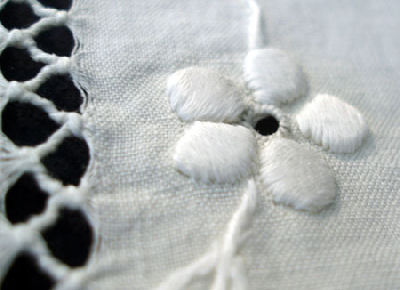
Very nice satin stitching on these petals! The thread looks to me like coton a broder. There’s enough shine to it, anyway, to be certain that it’s mercerized.
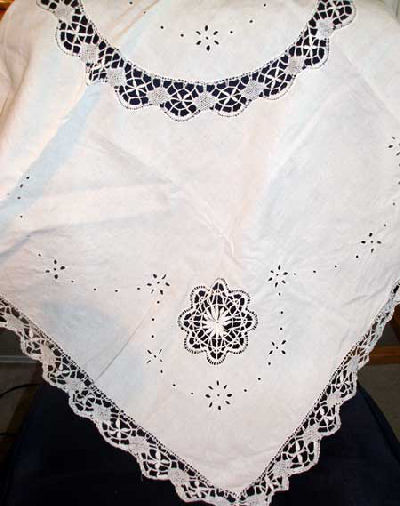
And here’s another example of a whitework tablecloth, edged in needle lace, with eyelet work and needlelace inserts. Another favorite piece unfortunately enjoying storage!
Where to Find A-Z of Whitework
So, if you want to see what whitework is all about, check out the A-Z of Whitework, which is now published by Search Press and is available through Amazon!
You can also find the book available here through Book Depository, with free shipping worldwide.
This article contains affiliate links to the book sources, which means that Needle ‘n Thread receives a small commission for purchases made through those links, with no added expense to you. Thanks!
I’ve checked the Country Bumpkin website to look at the A-Z series, which I’d never heard of until I read your post. Now I’m confused!
What is the difference between their book, “A-Z of Wool Embroidery” and “A-Z of Crewel Embroidery?” Several of the books look like the subject matter would be duplicated – makes me wonder which title to buy and which titles to skip to avoid repetition!
I do plan to purchase this whitework volume because your post is so informative. Is there a summary somewhere of each of the A-Z titles?
Hi, Terry –
The A-Z of crewel focuses on typical crewel work, Jacobian-type embroidery and all the stitches and techniques that go with that. Although often worked in wool and usually associated with wool, crewel work doesn’t “have” to be done in wool. Anyway, the focus in that book is mostly Jacobian in style.
The A-Z of wool focuses on all kinds of embroidery applications with wool, and the projects featured are especially suitable to working in wool thread. So, fluffy lambs in fields of grassy flowers, and so forth… flowers for the edges of sweaters…. things like that. It’s pretty much general surface embroidery worked in wool, with projects that are suitable to wool threads.
When I think of the wool book, I think of designs by Jenny McWhinney and so forth. Rabbits, lambs, mice – and flowers and nature and whatnot – not specifically Jacobian / crewel work stuff!
Anyway, I hope that helps!
Best regards,
MC
As for a summary – look on the country bumpkin website… they usually summarize the stitches covered in the book, and on some books, they give you a “sample” you can “flip” through.
Yes, you’re right – some of the content is repeated from book to book, but generally there’s a fresh perspective on the techniques, with different projects and so forth. So, in the Whitework book, you’ll find satin stitch – you’ll also find it in the Embroidery Stitches book. But the applications are different.
Hope that helps, again!!
I love your site! I’m fairly new at hand embroidery and would like to purchase a book. After reading your reviews it looks like the A-Z books might be right for me. Can you tell me what the difference is in A-Z Embroidery Stitches and A-Z Embroidery Stitches 2? Does number “2” have all the stitches that number one has, etc. Thanks for your help. By the way, your tutorial on lettering is awesome. I hope you don’t mind but I cut and pasted it to a word document, printed it and then had it spiral bound (for my own use, of course. It is awesome and I may not even need an A-Z book!! Thanks, Patricia
Hi, Patricia – Thanks for your comment and your enthusiasm!! No, I don’t mind at all that you printed up the lettering tutorials – I’m glad! I hope they’re handy!
The A-Z books are excellent in all respects. The first one on Embroidery Stitches has all the basic stitches you could want, plus many of the more complicated stitches and techniques, or combined stitches and so forth. The A-Z Stitches 2 does not contain the same stitches – it is an expansion of the first one, with a variety of band stitches, composite stitches, and some of the lesser-used, more complicated stitches, as well as some lesser-used but easier stitches, as well as lots of variations on common stitches. The two volumes together make a very thorough stitch resource, but if you’re just buying one, I’d personally go for the first one. Then, later, if you want to expand, you can pick up the second one. They’re both great books! A-Z of Embroidery Stitches 2 is available right now at Wooly Thread for $15, which is a good price. The first one, though, is still $33. I’m thinking this is the newest edition / reprint. You can find A-Z of Embroidery Stitches (1) at Erica’s for $19.95. You might be able to find it less expensive elsewhere, but I don’t know. $19.95 is pretty good for these books. Of course, you could always look for it used, too.
Well, I hope that helps! Enjoy your stitching!
MC
Hi Mary
Does this book have Projects in whitework?
Thanks
No, it’s not a project book – just instruction!
Your picture of a “white work” handkerchief that is actually “blue” looks like some napkins from my mother’s linens. I think the blue might actually be from a ball point ink pen used to draw the designs on the linen. When washed, the ink bleeds and stains the thread…
Dear Mary,
I have just purchased the new “Search Press Classics” version of this book. Whilst the content of the book is excellent as per your review, the spine is not spiral bound as the original books were. This makes them difficult to leave open on a table while attempting to follow instructions unless you break the book’s spine. I know that books with a spiral bound spine are very much better (I have the RSN Stitch Essentials series) and wish that Search Press had adopted the spiral bound spine too.
Regards,
Allison
I recently lost my husband and had to move into an assisted living facility. Therefor I lost all my instruction books on needle weaving. I am 95 years old and loosing my sight but thought hoping I can see. Well enough to decorate some of my clothes.. The needle weaving I am speaking of. Is the one like. What is on bottom of the pipes. White frock. You make to loome on the garment and weave a pattern by deciding the strings in different patterns. Can you hel me. I bought a book o this about 15 years ago and I thought it for years at our club. I would appreciate your suggestions. Thank you. Louise
Hill Louise – Hazel Blomkamp has a book out on Needle weaving. It is available here on Amazon. The diagrams are large and clear.
Thank you but what I am looking for is you transfer the pattern of the various looms designs and we’ve the thre from center of pattern to make various designs. I uesedto have a heart, butterfly and various sizes and patterns to make flowers etc. these are all made on the Clothing. I encorperated them with Brazilian embroidery and ribbon weaving. Maybe I can sent a picture. Thank you Louise.