



The Embroiderers’ Guild in the UK publishes a magazine called Stitch. They have a good website with a lot of information on it, among which are some “sample articles” from Stitch Magazine in PDF format. The one article that caught my eye and set me exploring was the article on the Litany of Loreto Embroideries.
According to the article on the Stitch website about the Litany of Loreto Embroideries (PDF), their history is rather vague.
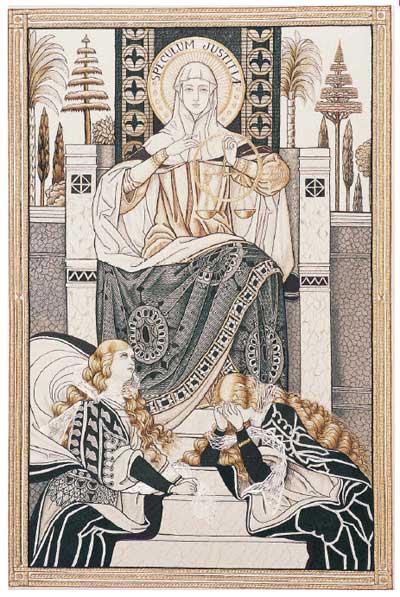
The embroidered panels are worked in long-and-short stitch in muted shades, with metal threads used for accents.
While the style of art reminds me of the pre-Raphaelites, overall, I can’t help comparing the embroideries with the art of William Bouguereau in particular. Take a look:
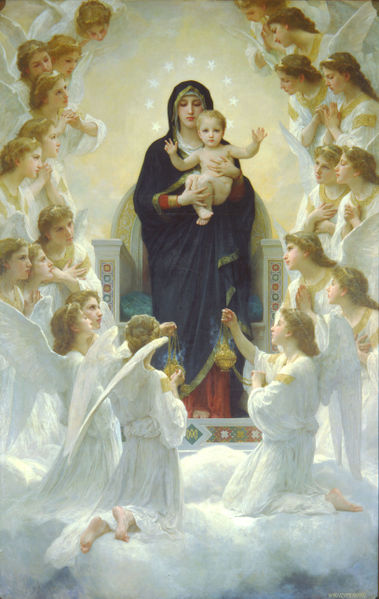
Perhaps it’s just the throne that makes me think of that particular artist – but I think it’s also the motif on the gown in the embroidery and the motif on the throne. The lines in the embroidery are not as “soft” as those in Bouguereau’s painting, but it reminds me of him, nevertheless. It also reminds me of the Beuronese style of art, which I mentioned when speaking of the samples of ecclesiastical embroidery at the Convent in Clyde, MO. The trees in the background and the clean lines are all rather Beuronese-ish.
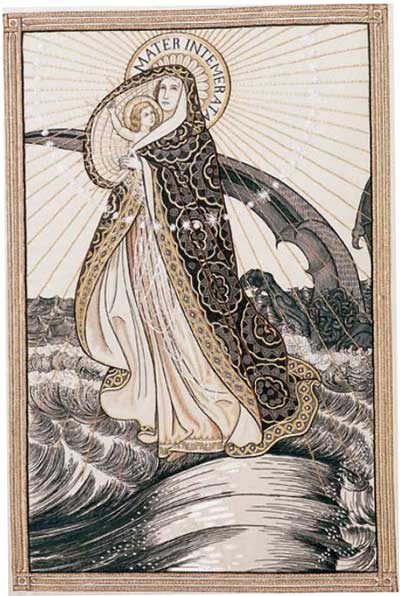
This is another one of the embroideries. In all, there are 12 of the panels. It would have been something to see every title from the Litany of Loreto worked in embroidery – there are around 50. What a project! The Royal School of Needlework sells a pamphlet on the embroideries, if you’re interested in seeing them all.
I have a pretty keen interest in ecclesiastical embroidery, so the article on the Stitch Magazine website was the first to catch my eye. There are other articles on there for the enthusiast – another historical one concentrates on the Bayeux Stitch. The article, Bayeux Stitch Ancient and Modern (PDF), shows the reader how to work the stitch and how it can be interpreted. It’s pretty neat – check it out!
You can find these articles and more at Stitch Magazine online. While you’re there, you might want to check out their projects page, where you’ll find all sorts of inspiring photos of projects, and their stitch page, where you will find illustrations of a heap of embroidery stitches. On their In Focus page, you’ll find a terrific index of the pieces housed at their museum.
Dear Mary
I went to an excellent exhibition at Cumberland Lodge, in Windsor Great Park, UK, today, and I saw 6 of the Litany of Loreto – well, what can I say! They are absolutely AMAZING! The detail on them is the most fantastic I have ever seen. Such fine work, and so detailed. The faces are particularly incredible – they almost look painted! The exhibition is only on once more (17th April) and I’m definitely going back for a second look!
Hi Mary
Thanks for the article on the Litany of Loreto embroideries – all 12 embroideries will be on display at our Ecclesiastical exhibition starting 13 May and here at the RSN. We’re also producing a postcard book of the embroideries so those who can’t make the exhibition can see the wonderful images. More details at http://www.royal-needlework.org.uk/content/8/visiting_the_rsn_royal_school_of_needlework_book_an_rsn_tour
Many thanks and best wishes
Monica
Thanks, Monica! In fact, I was going to drop you a line this week with some questions about that… Will write soon! ~MC