


Once you have an embroidery project set up and ready to go – fabric selected, design transferred, threads lined up – perhaps the most important thing to consider is what embroidery needle to use. There are all kinds of different types of embroidery needles – which one to use depends on your fabric and thread. The thing is, within the “types” of needles, you also have the consideration of quality. Here, I’m looking at embroidery needles from a company called Pony.
Normally, I use “fine English needles” for my embroidery projects. Richard Hemming, John James, Mary Arden, and S. Thomas & Sons are pretty much the brands I’ve stuck with over the years. They’re reliable and fairly easy to come by. You sometimes can find them in hobby and craft stores (in a very limited range), but you will find a better range at your local needlework shop. You can also find them online through almost any needlework or fabric shop, or through online sources such as Colonial Needle.
The problem is, if you’re looking for really fine needle – sizes 11 & 12 crewel needles, for example – they’re kind of hard to come by.
I have a marvelous selection of very fine needles from Wendy Schoen Designs, but I don’t use them as often because they’re wrapped up and my supply is limited. (But I do love those needles!)
So that’s my plug for the needles I typically use.
Recently, though, Michael Cook of Wormspit.com e-mailed me about some needles that he had come upon and finally tracked down. The manufacturer is Pony, from India, and the needles are used by the Chinese in their fine and detailed hand embroidery.
After some contact with the company, he received a shipment of the needles to try. He kindly sent me a selection of #10, #11, and #12 – three each with gold eyes, plus one fully gilded needle in each size.
It was a while before I could work with the needles, but finally, yesterday I took out a small project and used the needles on it. It’s a thread painting project, worked in one strand of DMC in a high count cotton muslin.
I generally use a #9 or #10 needle on these projects, but mostly because I’m too lazy to go through my supplies and get other needles out. I always have 9’s and 10’s on hand.
For this particular needlepainting project, since I had the smaller sizes, I decided to try the #11 Pony, and they were perfect.
They made those meticulously placed little stitches easy, and they are slightly finer than #10, which seemed to make a difference on the split stitching in the long and short stitch in tiny, detailed areas. In short, I liked the #11! I had all four threaded and working on the project at once. There is a slightly different feel to the fully guilded needle, but I can’t really place or describe what’s different about it. It passes through the threads and the fabric easily, but it “feels” as if there’s a coating on it, because there is. It’s not a bad feeling, and in fact, I like working with the needle. But there is a slightly different “something” about it.
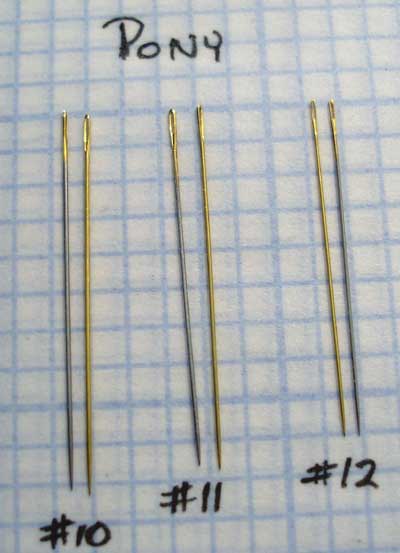
Here are the needles, two of each, one of which is the gilded one. I’ve laid them on 8-square-per-inch graph paper so you can get an idea of the size.
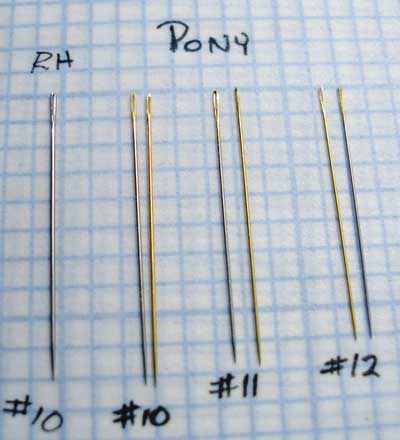
Here they are again, with a #10 Richard Hemming needle (left). The #10 Pony and the #10 Richard Hemming are the same length, as far as I can tell, even though the Pony looks longer (it’s the placement on the paper).
I threaded both #10s (R.H. and Pony) with one strand of DCM and stitched with them, one needle right after the other, to see if I could tell a difference in size or feel. The Pony needle feels slightly finer than the Richard Hemming, which is what Michael found as well.
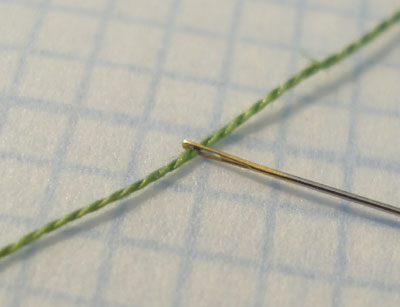
One strand of DMC also fits in the #12 Pony – BUT… it doesn’t work well on tightly woven or high count fabric, as it takes a pit of a tug to get it through. It works fine on something a little looser, though.
The long and short of it:
I like the Pony needles ok. I’m going to keep using them on my present project to see how they stand up. They bend slightly – I don’t know how they will wear over a little more use – but I don’t mind a needle that bends. In fact, I like it. It gets “comfortable.”
The #10 Pony seems slightly finer than the #10 Richard Hemming.
The #11 Pony works ok with 1 strand of DMC on a high count quality muslin.
Most people will probably need a needle threader for the #12 with a strand of DMC.
On Threading Needles
Yes, I have been known to lick my thread now and then. It’s a habit I developed as a kid when I first started stitching, and it’s one that I’ve pretty much broken, but occasionally, yeah, I still like my thread.
However, with these really fine-sized needles – and really, with any needle you’re keen to preserve longer – it’s better not to lick your thread to thread the needle.
Why shouldn’t you lick your thread?
The main reason might not be what you think it is! Especially with needles with tiny, delicate eyes, the wet thread can cause the inside of the needle to rust, which forms a rough spot or kind of burr inside the eye. This wears on your thread, causes breakage, and can lead to stitching with portions of thread that you might not even realize have broken fibers.
Another reason: The habit of wetting thread can work against you when you’re playing with a thread that has been unfortunate enough not to hold on to its dye. In these days of hand over-dyed thread, risking a mark on clean fabric is not really worth it.
Finally, if you work with silk embroidery threads, I’m pretty sure that licking silk is something akin to sacreligious. Silk is weaker when it’s wet, too, so you don’t want the weakened thread taking abuse while it’s in the eye.
Tomorrow, I’ll show you some photos of hand-made Japanese needles. And to top off the whole needle discussion, I’d love to hear how all you non-lickers out there thread your needles! I’ll cover how I do it, too.
No licking?
OK, I’ll get a needlethreader.
Thanks
I lick. oops
I have to admit… I’m a licker. My teacher licks too – I’ll have to check with her and see if that’s how they teach it at Souzhou, or if it’s a habit she learned here. I have found an ultra-fine needle threader will get the thread through even the #12’s (with some squeaking) but I find that I still lick the thread *after* threading, to make it stay on the needle easier. I use my teeth as snips a lot, too – they’re just so handy! I never nip anything that would be tough on them, though. I look forward to reading your thoughts on how to thread!
Mary,
Very interesting on the needles. I would love to try some.
I guess we should all get used to running our thread through some Thread Heaven before we put it through the needle. Thanks for the info!
Mary, thank you for this really informative article. I recently bought a package of #12 crewels from Lacis and they happen to be Pony brand. I haven’t tried them yet; I was just happy to find some #12s. After your article I’m looking forward to trying them out.
A comment on using #12 crewels (vicious little things that they are!)…. I took Royal School of Needlework goldwork classes last year in Iowa where we used both #10 and #12 crewels. Although we primarily used #10 crewels, the #12s were used to tack down leather (it was easier to pass the smaller needles through the leather than the #10s) and for sewing bright check purl #6 chips (#10 won’t fit through the chips).
On threading…. (no licking, of course…oooooo, germs! 🙂
#10 – I fold the thread/floss over the needle eye, pinch it tightly, slide it off the needle and then thread the pinched ‘point’ into the needle.
I can also thread the #10s just by sticking the end of the floss in the needle eye, but I find the ‘pinch’ method works better for me.
I learned another method a few years ago where you kind of rub the eye of the needle over the floss and it just kind of picks up the floss for you. Then you can pull the floss through. This is kind of fun, but I find I have to practise doing it and my other methods work fine for me so I don’t do it this way very often.
#12 – I can’t thread these with the ‘pinch’ method, but can thread them by sticking the end of the thread in the eye. However, I now have a couple of fine needle threaders and they do make life easier. I tried using a garden variety needle threader with a #12 and the threading wire ripped right out of the threader! Also, the threading wire was really too big for the needle so it wasn’t a good working relationship. 🙂
I bought a fine threader from Lacis and it works great. The other threader, which I kind of like better, is by Clover and it is a double ended threader, one side being finer than the other. I like it better, I think, because it’s a little longer than the one from Lacis and I just feel that I can get a better grip on it. I bought the Clover threader at a local craft store. There’s a picture of it here: http://www.shopatron.com/product/part_number=462%20NV/181.0
I really like #10 crewels, but I now want to try #11s. I am not a fan of #12s because I got stabbed by the eye end several times using one to attach gold leather to a project.
I use Pony needles for all my embroidery and crochet and Knitting for the last 20 years
I have been using #10 for Kasuthi embroidery that is done with a single strand of the Anchor skein and I swear by their quality.
When do you use 6 strands? I usually use 2 or 3. I am a novice but really enoy the process and result. Your web site is beautiful. The information you posted was very helpful. If you answer, I’ll stop licking! Thanks Jo Ann
I saw this tip in an embroidery book (if I could remember the author’s name I would give her credit. But here goes…tape the end of the embroidery floss to a piece of paper. Cut out the paper as close to the thread as possible (1/16″ is close enough) and then thread through the needle. I have not tried this yet but I am certain it will work like a charm every time!
Hedgehog doesn’t seem to list them on their website. I did a search and found Pony beading needles on the Beadcats website, where they mention the needles are extra stiff. So perhaps they are not the same as the ones you reviewed? I’ll keep searching.
Joady Gorelick of Hedgehog Handworks now has a good stock of Pony Needles, sizes 9 through 12. Find them on the home page!
I work exclusively in hand dyed silk fabric and hand dyed silk threads. The average thickness of thread that I use is about half the thickness of a single thread of DMC embroidery floss.
I am a huge licker. I do not just lick the ends. I lick the entire thread. Why you ask? Well, licking removes the “memory” from the thread, that is, the kinks that form when you wind the thread onto a storage card. It also makes the thread less likely to snag and knot while you are embroidering with it. After I have licked the thread I pass it through a thread conditioner called “Thread Heaven”. Using thread heaven without licking will not remove the memory from the thread. I find the combination of licking and thread heaven makes the thread easy to handle without having any negative effects on the lusture or texture of the thread once embroidered.
Regarding needle threaders: I have used the kind that is thin metal with a small hook on one end and a larger hook on the other end. They’re definitely not ideal – sometimes I really have to tug to get the eye and 2 strands of floss through them. And they do eventually bend the eye a little. Lately I’ve been using the kind with the pointed wire on the end, and it works much better. What I’m wondering is this: I use DMC and Mary Arden needles (although I’m going to see about getting some Pony needles), and eventually a burr develops at the top of the eye. Is this just the nature of needles after use, or is it the hook needle threader I’ve been using?
All your articles are so informative. I kknow that if I have a question about anything to do with embroidery, I’ll probably find the answer on your site.
However, over the years I’ve collected a goodly amount of needles but they were not put back into their holders so I really don’t know what size I’m dealing with, I just try to see which one will work.
Do you have any charts or where can I find a chart to be able to measure the needle and know what size it is?
I’d appreciate your assistance in this.
Mary Moreland
Hedgehog Handworks has a series of cards that are on a ring that shows the needle sizes and lengths. I believe this is what you are looking for.
I grew up watching my dressmaker mother lick her thread all the time. By the time I took up embroidery the habit was well ingrained in me too, however when I forget and lick instead of using the threader I do cut off the licked end of thread. That still leaves the problem of the rusty needles but as my needles seem to rust on the shaft rather more frequently than inside the eye I am not that concerned.
I have also heard the tip about licking (or damping) silk thread before conditioning it but I have no idea when or where.
I…promise…I…will…truly…and…faithfully…use…a…needlethreader…from…this…day…forward. (Well, I’ll try.)
While working on a project I tried the Pony needles after noticing the floss was fraying I switched to Bohin needles. Oh! The difference is remarkable. The needle flows through the linen and the floss glides. The stitches are easier. Just my opinion but I’ll stick with the Bohol brand for now. The Pony brand is not bad, it’s okay.
I know what you mean about fully guilded needles feeling different. They way I describe it is they “squeak”–not an audible squeak, but a squeak that can be felt in the fingers or hand or body, depending on how well the needle fits the fabric or canvas. It’s not a feel that I like so I don’t use them.