

Erin, a reader in Michigan, sent me some photos of an embroidery project that she inherited from a friend. I bet many of us can relate to receiving a partial embroidery kit from friends or relatives, and not knowing where to find the missing elements. In Erin’s case, she has the fabric stamped with the design, and nothing else. Some stitching has already been done on the project, and she would like to finish the rest.
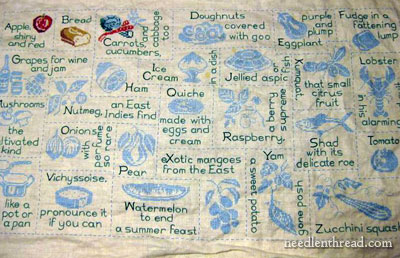
The whole piece is a kitchen-related rhyming sampler. I think it looks fun!
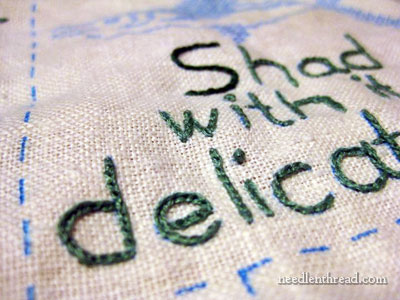
The fabric is linen, and it is stamped in blue with the design. The stitch requirements for the design include at least cross stitch, French knots, and chain stitch, though others might be required to complete the project. The whole thing measures 35″ x 22″ (so it isn’t small!).
Would you happen to know anything about this embroidery project? Have you ever seen it anywhere? The idea is to track down the manufacturer, or maybe someone else who has the same project with the instructions. Erin has looked all over online for it, and has also taken it into several local needlework shops, all to no avail. So if there’s anyone out there who could help her, that would be great!
In the meantime, what would you do if you inherited a piece like this and you wanted to finish it? Have you ever been in a similar situation? How’d you solve the problem? Suggestions, comments, and so forth are quite welcome!
I don’t have info on the pattern, but I did find a completed version for sale in a thrift store once. I didn’t buy it and have since regretted it. It is a great design!
Hi,
My mother and I worked this sampler together when I was a teenager. In the last block, there is space to stitch your initials, so we did P.P. May 1976. (It worked out well since we are Pat and Pam Patton.) I treasure this piece, and it is a constant reminder of my mother, who has been gone 28 years. I have posted photos of it on the gallery page.
I’d just finish it in the colors of my own choice. What’s the problem?
I have one and want another. It was made by Paragon.
If it was me, I’d just finish it in a similar style, using whatever is already there as a guide, but using my own creativity to figure out the colours and stitches.
Rather than use a myriad of colours, I would try to limit myself to my own choice of set colours (using what’s there as a guide and some of my own choosing), to create cohesion across the whole piece.
How nice that all the tedious lettering has already been stitched, leaving all the fun pictures to do!
I would get pictures of the relevant objects and make up my own colours.
I agree with #2 and finish it in the colors of my choice. And then hang it in the kitchen.
Not just a rhyming sampler, but an alphabet sampler!!!
A is for apples, shiny and red
B is for Bread
etc…..
I would definitely finish it. Since the text is already started (or done?) in green, match the shade of green & continue. The pictures – those I would do in colors suiting the individual items – deep purple for the eggplant, pink & green for the watermelon, etc.
I too would stitch with my own colors or with what I have on hand. Is my monitor screen off or is that a red carrot and a blue cucumber?
Don’t know if it would do any good but if its that important to you you might ask someone who collects vintage patterns. like here http://stitchybritches.blogspot.com/2008/02/note-on.html
They might be able to recognize the style.
I agree, I would just follow what has already
been done, using my own choices.
As many times as I’ve boasted “I can find anything by googling” (one of my friends has even started calling me Queen of Google), I of course had to find something about this after getting the newsletter.
Found a woman, Donna Ellis, who’s done the sampler and writes about it in an article about eggplants. There’s no picture of the embroidery, but maybe Donna can send a picture/information to Erin?
Here’s the link to the article:
http://www.explorehoward.com/news/64353/front-burner-eggplant/
And here’s Donna’s e-mail address (found in another article in the same newspaper):
grifellis@comcast.net
The trick of finding something online is to always try to find more uncommon words about what you’re looking for, so that the search engine will eliminate billions of (for example) embroidered food/alphabet samplers for you.
In this case I used the words “embroidery” and “fudge in a fattening lump”. Only got (surprise!) one hit, but hopefully it will be enough!
Mary, I well understand why she would want to find out more about this piece of stamped embroidery. Taste in colors and choice of stitches changes over the years and she wants to do this piece as it was intended to look when designed. Please indulge me by letting me tell you a personal story. When I was a young girl my mother would take me to the local Needlework store owned by her childhood friend Margaret. Over the years Margaret and I became close friends, even though there was some 35 years difference in our ages. As an adult I had moved 1,200 miles from my hometown and Margaret would often fly to spend a week with me doing our needlework. One day a huge box came in the mail and a note that just said – finish what you like and pass down the rest. Six month’s later she died. I so miss her and cherish our time together with needles in hand. Over Margaret’s 90 plus years she had collected dozens of pieces of undone needlework from shop patrons and her older friends – some dated back to the last quarter of the 1800’s. The point of my story is that when you look at these pieces of leftover needlework, spanning over 100 years, the first thing you see is the change in style and fabric. Most of the pieces are undone so there is no hint as to what colors or stitches the purchaser intended it use. Surely the linen towel with beautiful hand knotted fringe was intended for redwork – the Royal Society doilies were intended to be done in silk long and short stitch – the 1950’s tablecloth with roosters and cherries was ment to be done the colors of the 50’s and so on. If I do these pieces in colors popular today I loose the style they were intended to have. I guess that brings up the subject of yesterdays post about discontinued threads and how the look changes when done with a substitute.
I agree with making up the colors, but I would like to know the manufacturer and see what the original instructions are. I think it’s adorable.
It is a lovely pattern. If Erin is uncertain about choosing the colours (in the event the rest of the directions are not found), perhaps she could have a friend who stitches help her select colours. Maybe keep the embroidery simple and use the stitches already in place throughout the rest of the sampler to provide some consistency of style. It may be a bit more work this way, but the end result will be beautiful!
I have a UFO that I received from another stitcher and will be finishing this as shown in the directions and with the thread provided.
This one actually strikes me as straightforward. For a stamped project done in chainstitch, I’d just buy a set of DMC and jump right in, filling each section with whatever pleased me. It’s a fun pattern, and would be a great opportunity to set your fancy free.
That sampler is framed in narrow red wood and hanging in my kitchen now; I did it probably 30 years ago with my mother as a gift to her; I did all of the stitches except the French knots on the raspberries – she did those – she did exquisite needlework. It was a kit with all of the threads included; I don’t have the instruction sheet anymore, but I could describe the colors of the items, if Erin would like. I thought that I had “followed the instructions” when I did the sampler – my sampler uses outline stitches on all of the letters and I notice the photo displays chain stitching. The colors used were pretty natural – I still like the sampler and so did my mother when I gave it to her. We had fun working on it together – she taught me to embroider when I was a pre-teen; I’m now 62 and she is 92. I’m sure it was an inexpensive kit at the time – I surely had very little money to spend, even on a gift to my mother.
Mary – you have my permission to give Erin my email address, if she is interested in me writing out the individual colors for her. They won’t be DMC numbers, I’m not that skilled – but I think I could give a decent description of each color. And if it means that much to her, I could find a DMC card and do my best.
I have inherited half-finished projects, and never actually considered tracking down directions. I just “winged it”, finishing it as I saw fit, just trying to mimic the work as best I could. I’ve never seen this project; good luck with it.
My first instinct was to just suggest finish as she sees fit, but after reading some of the other comments, I see the value in trying to finish it as it was designed. I think I saw this kit in a Herrschener’s catalog years ago; late 70s or early 80s maybe; that jives with Alma’s time frame. That means there’s a high probability the thread that came with it would not be DMC but possible Anchor or Coats. Good luck! Let us know how it turns out!
Hello! Thank you all SO very much for your comments and suggestions (keep them coming please!) regarding my mystery project – it’s not as much of a mystery now! From Alma I’ve learned that this was part of a kit that dates to around 30 years ago, and I plan to look into the Herrschner’s connection as Angie suggested. Paula hit the nail on the head when she described wanting to match the original intents for the piece in colors and stitches. The problem with guessing on the colors to use, as many have suggested, is that the partially finished squares indicate “shaded” areas of varying colors which are indiscernible from the surrounding areas, which is why I’d love to have a “map” of the project to work from. Also, though I thought I had thoroughly exhausted my internet research, I followed Heli’s example and actually found a photo of a completed piece (if anyone is interested it can be found here: http://meganwoodardjohnson.blogspot.com/2010/03/old-and-oldbut-new-now.html ). I’d love to hear more from anyone that can share more information. Thanks very much to Mary for her help in getting this identified!
Don’t have any knowledge of this project, but it looks like so much fun to work!
Hmmmm…. I would feel very tempted to go on, but I don’t think you would … I wouldn’t have the courage … but you’re an artist at the height of such a feat! Go on!!!! :o)
SO SORRY FOR MY MISTAKE! I’m Brazilian, so forgive my broken english.
Here is what I would like to have said:
Hmmmm…. I would feel very tempted to go on, but I don’t think I would finish… I wouldn’t have the courage … but you’re an artist at the height of such a feat! Go on!!!! )
I couldn’t agree more with Paula! I am the recipient of many of my great-grandmother’s unfinished projects which span from the 1890’s through the 1960’s-there are many that I can’t find the thread to complete it with (esp. whitework-she used a gorgeous thread I have yet to find). I’ve noticed that our concept of what “matches” or “goes together” in colorways is different from the past. A big help to me has been Singer sewing books/decorating books from the past – IF you can get color plates in them. Also, old home needlework magazines with color plates helps with trying to get “that feel”. Good luck!
One thought I had later (after a trip to my neighborhood craft store)you may want to check some web sites for the bigger kit brands like
Bucilla. They often have “contact us” buttons where you can ask a question.
Hi! I recognized this sampler, as I have one in my UFO stash. It’s called “Gourmet Alphabet” kit and was one of the “Exclusives” by Paragon Needlecraft. It is kit #0653 with a copyright date of 1972. It included the sampler stamped on 100% Belgian linen and “Peri-Lustra” filo (100% cotton embroidery thread. The cover references matching tea towels (kit #0654) which I didn’t order.
I would be most happy to copy this cover (which has the instructions on the reverse side) and send them on to you should you want.
I forgot to mention that I ordered the kit through a women’s magazine; if I remember correctly, it was Woman’s Day.
JudyJ
I have a few suggestions, this does look like it is an iron on print maybe from The Workbasket Co. They are still in business, try emailing a picture to them they may know the manufaturer.
Other company’to contact are Vogart this company may still be in business, Paragon is another company to try.
Bucilla is still in business, Frederick Kerrschner co. used to be in Chicago, maybe they are still in business.
Good luck to you I will show this picture to many friends and maybe they will have a hint.
Hi everyone – I just wanted to thank you all again for your help and suggestions. I am making great progress on this sampler, thanks to two readers in particular. Alma VERY generously GAVE me her completed sampler that she and her mother worked on years ago and it has been a huge help to me. It will be given to my mother-in-law for her to enjoy on her kitchen wall when I’m finished, per Alma’s suggestion. I know she will love it. Judy Jones helped to complete my project needs by photocopying the directions and sending snippets of floss colors for me to match. I just wanted to recognize these two wonderful ladies for their much needed help. Thank you!
Also, I would really like to thank Mary for posting my sampler on her website. I had been trying to research this for months to no avail. Little did I know how many responses would follow! I had a feeling if my problem got out to all you “experts” I might have a chance.
Thanks everyone!
I have this sampler in my ufo stash, also. I started it at least 30 years ago, and it sat, buried in a basket, until 2 years ago when I dug it out. As someone else noted, I ordered it from a women’s magazine (maybe Family Circle or Women’s Day). This conversation is inspiring me to keep plugging away on it (even though I really don’t like doing cross-stitch work!)
I bought this completed project at a yard sale a few years ago. I am going to list it on eBay, as I have no room on my kitchen walls to display it. At least mine had Paragon Needlecraft stamped on the bottom, so I didn’t have such a difficult time to find out where it came from !
There is a kit like the project you have on ebay It is called Paragon Gourment Alphabet Sampler if you would like to sell yours, I would love to have it!
There is one for sale on E-bay right now, I just saw it. Or search Paragon Gourmet sampler and you’ll find it. It’s not that rare.
Not sure if you still need info on this but I happened to just buy this kit from an estate sale. It came with the instructions and thread. I would be happy to get you a copy of the instructions.
Hi, this is for Erin from Michigan. I have the same sampler, bought at a thrift shop. I do not have picture of finished project but I do have instructions. If she still wants instructions with a pic of the embroidery floss colors, I would be happy to email.
I realize this email is way too late but I just bought this and settling in to doing it. I was looking for a finished picture to see if embroidery floss colors were accurate.
Hi Jo-Anne,
I live in a small community called Scappoose and there is a wonderful young lady looking to finish this kit she purchased without instructions. Would you be willing to send me the instructions for her? I know it has been a few years since you posted this. 🙂 Any help would be appreciated.
I am searching for the correct floss numbers for the following pattern: Paragon Neddlecraft “Whig Rose” #01153. It says it uses Peri-Lusta filo floss, but I have never heard of them.
I have this sampler; did it when I was 19. Happy to take a photo and send it via email, if that would help. My sister is looking for a kit, so if anyone messages you that they have one for sale, please let me know! Thank you. Natalie
If anyone has this sampler as an unfinished project and would like to get rid of it, could you please contact me? I know this is an old thread, but I’ve just discovered it.
Pam
i need the instructions on pattern 01182 paragon quilt embroidery set
It is five years later but I just found this link. I did the sampler in 1980 and was just looking at it and wondering who the designer was. If she would like a photo, even at this late dat, I would be happy to send one. I also love old needlework and have one hall covered with these pieces.
If anyone else has this kit and would be willing to sell it I would love to purchase it.
Hi Fillo threads are a branch of J. P. Coats as is Anchor and Susan Bates brands. And can be interchanged on your design. As far as the design goes look on the border for a kit or design number. The brand may also be there. Key in all information you find into your search engine as you may find an example of the kit or directions on line. I do this when I get abandoned projects that I find in thrift stores etc. I have finished baby quilts this way. Choosing your own colors is always an option cause there is no law that says you must use a certain brand or color. There are also conversion charts for Anchor J. P. Coats to DMC just be aware the finish on DMC is more shiny or glossy than Fill and J.P.Coats Theirs is more of a Matte or flat finish. Hope this is helpful. I would love it if you could send me a picture of the entire design including any numbers or words you find on the edge. I collect patterns.
Thanks Sharyl
I have this completed sampler. I would love to show it—but I can’t figure out how to upload a photo.
I have worked this kit and it hangs in my kitchen. I could photograph details and send. I’d REALLY like to be able to stitch it again as both of my kids want to inherit it someday. Please let me know if you have access to it. Thanks!
My mother is very sick and in the hospital. If anyone has this and no longer wants it, I would love to buy and hang it in her room. This was her favorite thing we did together before her house burned down.
thanks
This sampler my mom did in 1977. The rasberry is french knots ..if you send me your email. I can have her send you a picture of the completd project. Its delightful
Erin,
I’m in Michigan, and I know your post is old, but if you e-mail me I will send you photos.
Pam
This hung in the wall of our family kitchen in the years I grew up. It was a project that our mom completed before I was born. I think she had said the pattern was in a magazine. I can ask her about it tomorrow when I call. I googled hoping to find a pic of it as I couldn’t remember the whole rhyme and needed to find it!
I know this is an old article, but I had to laugh. I’m looking at this piece on my Kitchen wall as we speak. My Mom completed it, and it hung by our Kitchen table growing up. I always told Mom, that I someday wanted it for my house. 20 some years later my Mom and Dad moved to Florida to retire and somehow this piece was sold at a yard sale. ( I literally cried when I discovered it was gone a year later). By some miracle, my Mom remembered selling it to a local Woman who owns an antique mall in town. I went to visit her, asked her about the piece and a full 15+ Months later was able to purchase it back from her at her store. She told me just the week before another couple walked around the mall with it, but decided in the end not to buy it. I was MEANT to come back to me!
Hello if Erin, your reader in Michigan, is still looking (after ~8 years!) for this sampler it was made by Paragon Needlecraft and was called “Gourmet Alphabet Sampler,” Kit # 0653, 1972. It shows up every now and then on ebay or etsy!
Looking for the Paragon Kit #0449 “US State Flower / Vintage — embroidery/crewel .. Help!!! Would like to order -3- kits! ****At least 1 kit would be wonderful…..at least the stamped fabric .. !!***
In the mid 1970s I started crosstitching a quilt top for a double bed using a stamped Paragon Needlecraft kit – No. 01176 “Floral Medley” Quilt. I had finished about half of the cross-stitch. Unfortunately I must have lost the “Peri-Lusta Art. 2-Six strand (100% cotton) Filo Thread” that is required. I have the package insert showing the finished quilt and the required colors to cross-stitch it. It seems that the Paragon Co. may have gone out of business. What should I do? I’d love to have the original thread to finish the quilt. But if I can’t buy that now, should I just find current thread that matches as closely as possible?
Did you ever find the pattern? I’m looking for the same one.
I found a stamped tablecloth and thread in my late mother’s house, but no instructions.is there any site where I might find them. The pattern is by Paragon needlecraft #0502K.,
“Elegance”
Thanking you in advance
Elaine
I have a completed piece just like this from 1976. My mother bought it for me at a yard sale. I’ve been trying to find out who manufactured this pattern.
I have the same sampler with no color guides or instructions, could you share the instructions with me.
I purchased The 59 x 90 Christmas Greenery tablecloth a few years ago and am now just getting around to working on it. I opened the sealed package and no instructions were inside. Would it be possible to have you send me those? I was all excited to get started on it.
My address in:
Thank you for your help. Very anxious to hear from you.
Jan Altman
Hi, Jan – I’m not sure what project you’re referring to, because I’ve never produced a Christmas tablecloth kit – or any kits that have numbers on them for reference. However, a Google search brings up a Paragon cross stitch tablecloth kit on eBay. It’s marked as vintage, so it’s probably been around for a while. If it’s the Paragon cross stitch kit, you probably don’t need instructions – you can go by the colors of the floss included and just work the cross stitches according to the design. If you want instructions, though, you’ll have to reach out to Paragon or try to find the person you initially bought the kit from.
I worked on this sampler in the 70’s and gave it to my mother. She hung it in her kitchen and all of her grandchildren pretty much memorized it while sitting at her table. My niece currently has it.
Nov 2023 I’m just finishing mine. It’s stained from many years of working on it,putting it away and bringing it out 2 years ago. Paragon needlecraft is the maker and I would like to know how old this is 70s or 80s. Would like to know how to clean it before I put it in a frame. It has stains probably from oil from my skin. I have the directions with color code. The thread is peri-lusta filo but I’ve had to use dmc and just going by the color it says.
It’s Paragon Gourmet Alphabet sampler. I’ve been looking for it too! My Aunt made it for my grandparents and I saw it everyday of the summer for years!!! We lost track of it when they died… so pretty, simple, humble but fun!
This is by Paragon Needlecraft Co. The “Goutmet Alphabet Sampler”. The fabric is Belgian linen.