
The colonial knot is used in hand embroidery in the same applications as the French knot. Here’s a video tutorial to help you get the hang of the colonial knot.
For ideas for application, check out these flowers made from French knots. There’s also this filled flower, which is (incidentally) also French knots:
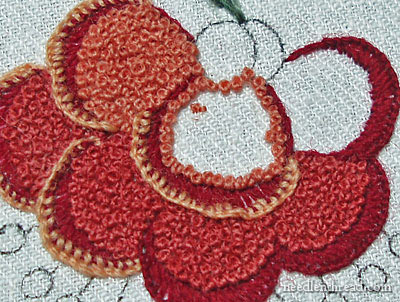
I tend to use the French knot more than the colonial knot, but both stitches can be used interchangeably. Anything you can do with a French knot, you can do with a colonial knot! Some stitchers find the colonial knot easier than the French knot, and visa-versa, so it’s really up to you which one you use.
Here’s the Colonial Knot Video:
If you’re looking for more instruction on embroidery stitches, feel free to check out my whole collection of hand embroidery videos here on Needle ‘n Thread.
Looking for inspiration & information on hand embroidery?
There are all kinds of reasons to sign up for the Needle ‘n Thread daily newsletter! Check them out and sign up today!
If you like what you see on Needle ’n Thread, if you want to be a part of keeping the website thriving (and free of annoying network advertising), why not become a patron on Patreon? Check out my Patreon page here, where I’ll occasionally add special needlework bonuses for patrons.
If you shop on Amazon, you can support Needle ’n Thread without any extra expense to you by visiting my Amazon Recommendations page here, where you’ll find books and sundries for the needleworker available on Amazon.
This is a great new stitch, thanks!
Thankyou this tutorial was the only one that helped me understand the colonial stitch!! Heather.
Thank you for producing these videos! I needed to learn how to do some basic stitches for showing Brownie Scouts how to decorate their clothes. Thank you for helping me put together a quick 3 stiches the Stem Stitch, Lazy Daisy and the Colonial knot made a wonderful flower on a pair of socks! An ambitious project made easier. Thank you Thank you Thank you.
I’m so glad it came in handy and helped you on your Brownie project!
Thanks for an excellent video on this stitch! I can’t wait to check out your other videos when I have more time.
Thank you so much for making these videos! They are very well done and I find them so helpful. I couldn’t figure out the colonial stitch until I saw this video. Thanks again!
Thanks for the great video! Finally, after 22 years of stitching, I can make a knot. Seeing it done helped me so much. 🙂
I have not embroider since I was a child and I needed a refresher on the basics. Your videos are wonderful and it has all come back to me. Thank you so much.
Jennie in VT
Very clear and easy to follow. Thanks so much!
very good and clear but would like to see a video as a left handed person like myself do it. I had to watch over several times because I had to reverse it.Thank you.
I have tried so hard to learn Colonial knots from books and diagrams and alwyas failed. For the first time I really understand what to do – thank you, I am now off to practice.
I could not get the flow of this stitch until I saw your video. Fantastic! The repetition is so helpful also.
Thank you!! I started to do a Christmas lamb w/colonial knots. As time has gone by I forgot how to do it. Thank you.Dale Coe Schultz
I had a hard time understanding the paper directions. So I did a search and found your site. I thank you so much for this site. I have a much better understanding of stitches.
MUCHAS GRACIAS, AHORA SOY FELIZ AL FIN PUDE ENTEDER COMO SE HACE EL NUDO COLONIAL. LOS FELICITO, SUS VIDEOS SON MUY CLAROS Y LOS ENTIENDO A LA PERFECCION. SALUDOS Y BENDICIONES
Your site and your tutorials are priceless. Thank you so much for sharing your expertise.
Thanks so much. The tutorial on the colonial knot and wheat stitch were so easy to follow.
Thanks much–very clearly described and shown, and exactly what I was looking for. You have a real talent for instruction.
Hi, Rebbecca – thanks for your comment! Glad the video came in handy – I’m actually in the process of re-filming this one and updating it, but I’m glad to know the “old” one works! 🙂 ~MC
I learned to embroider as a child. My Grandmother and Mother also embroidered. I recently became interested again. My plan is to embroider gifts for the holidays! Your tutorial and website will certainly help me to do that. . .so much easier then reading written directions.
The tutorial was awesome! Thank you!
SWEET new video thanks!!!
Hi Mary! I posted a few days ago about my French Knots pulling through and I’ve been trying to get them to stop pulling through, but about half of them still are. I’m pretty bummed about it, but I think I might just replace all of my future French Knots with Colonial Knots, since it accomplishes the same thing, but the manner in which the Colonial Knots are created virtually guarantees that they won’t pull through! Thank you so much for all of your amazing tutorials! I keep your page open on my tab at all times since I just got into embroidery and you have an extensive collection of tutorial videos! Your site is amazing and I love your free patterns! We are so blessed that you understand all of these stitches and pass along the knowledge! Thank you for all that you do!!!
Thank you Mary. This looks so easy. I’m off to practise now.
Good Afternoon Mary..!!
Its amazing for me to go through your how to videos from which I am learning a lot. Now a days in this generation the tradition work and embroidery had lost its importance but you have kept it alive.
My grand Ma knows the old traditonal stiches but due to the age problem she is unable to teach me. But you did it for me in learning this art. Honestly its like Blessing for me..
Thanks Mary
Mary I finally got the colonial needle….it does make a tighter neater knot…thanks so much for a great tut….why do they call it colonial?
Is the Colonial knot the same as a double-twist knot stitch?
Barbara
Your collection of tips & videos is perfect. What I’m curious about is how one anchors this knot, or the French knot, to the fabric. Say I was using this for two eyes in a face, do I need to make any knots on the backside or is there another way to secure it?
thanks so much – have been trying to find out how to do this stitch for ages. thanks again
Whatever would we do without you, Mary?
I’m participating in an international project called Torah Stitch by Stitch. The work calls for knots. My french knots often disappoint. The colonial knots you demonstrate seem fail-safe. I’ll be proud to submit my bit to the project with these knots in it.
Colonial Stitch
Mary, I just wanted to send you a big hug.
I went through several of my embroidery books and was struggling learning the Colonial Knots. Finally I said that’s it. I’m going to Mary’s site. Sure enough you had a video for this stitch. Guess I’m a visual learner.
Initially I kept taking the time back to watch you do the stitch in detail. My first one came out great. Second one I obviously wasn’t holding the threads together and one thread looks loose. Third and fourth stitch looks fantastic.
I love the fact that you did more than one. I tried to do that right along with you and I must say they are looking so good.
Now back to my project.
I’m working on a doll dress quilt from a book called Sweet Memories by Brenan Karon Shade.
Thank you.
Eva
So glad it helped, Eva!
Thank you so much for this wonderful video! I had never heard of a colonial knot until I read that it could replace a french knot. I’ve actually avoided cross stitch patterns that include french knots because I just have such a difficult time with consistency (and think a bead would look silly or too big)..so this has just opened up a whole new set of patterns for me! You have many excellent videos on here, I love it all! 🙂
I don’t see much about what are the best fabrics to use as the base of stitching. Can you provide some specificatins? Thank you….am learning.
Hi, Selma – I normally use linen, occasionally use silk, and sometimes use cotton or wool or wool felt, depending on what I’m embroidering. In my stitch tutorials, I use linen. Here’s an article on ground fabrics for hand embroidery that might help: https://needlenthread.wpengine.com/2013/01/ground-fabrics-hand-embroidery.html
Thanks for the reply. I can tell the fabric I am using is not the best. This is so helpful.
Selma.-
Thank you so much for sharing your expertise with us Mary.
It helps me a lot. Thank you once again.❤️
I had never seen this stitch before until my pattern called for it. So much easier than the French knot. Love it! Thanks!
Like your video and want to join you so I can get e-mails and go on your site!
Thanks, Linda
Hi, Linda – glad you like the videos! You can sign up for the email here: https://needlenthread.wpengine.com/newsletter-signup
Dear Mary I am 82 and have always had a mental block about colonial knots. Watched your video and
“By George I got it” Thank you very much.
Regards Val
Dear Mary I am 82 and have always had a mental block about colonial knots. Watched your video and
I thank you very much.
Regards Val
This is fantastic! I like it better than the french knot, actually.
Your whole site is just terrific and I appreciate it so much! How fortunate we are that you are so generous with your knowledge and time.
excellent.
this is a new knot for me, thank you!
wow, never saw this knot before..cool!
Love your site, thank you for tutorials. I have your site on my phone’s home screen for quick reference!
Thank you! I can’t get the french knot to stop slipping through the fabric to safe my life but this worked for me! I can finally do the patterns I want now <3
Thank you for a wonderfully clear and instructive video
I’m 66 and have been embroidering since 15 yrs old. It’s been my joy and relaxation. I tried cross-stitch once but hated it. Although the results of cross-stitch are beautiful – like tapestry -I got tired of counting tiny threads and doing nothing but x-es. A while ago I just lost enthusiasm with embroidery. I knew nothing of your website until today and have been sooo encouraged and inspired once again. And you’re right – this kind of needlework was jut NOT popular for as long I know. I got so tired of pattern options that I had seen for decades but your blog has opened my eyes to so many more beautiful options. Thank you so very much. BTW, where does one find jewelry that would contain tiny embroidery projects? Yours Sincerely, Laura
Hi, Laura – thanks for your note! I find it very encouraging! I’m glad you’re finding some interest in needlework again. Yay!
I would check Etsy for embroidered jewelry. I know I’ve seen makers on there over the years, but I haven’t looked lately. I’d check there first!
Rather late given the time lapse but were you asking rather for jewellery you could put embroidery into? Mary has a post on that somewhere for the jewellery bits from Nunn’s designs. Pickings are slim on the other side of the Atlantic, though. The trays are easy to get but not with inserts and probably rather shallow. Some people use mini-hoops as a basis for jewellery, which are easier to find.
I’m very happy to become a Patreon. Whenever I need clear concise directions for a stitch, I turn to Mary Corbet. Thank you so much for sharing your knowledge and making it seem so easy.
Thank you so much! 🙂
I find the colonial knot easier when I’ve just looked up how to do it but harder to remember and less versatile. With French knots, I can use 1 wrap or 2. The colonial seems more one-size-fits-all. I also like Chinese knots, which are versatile in a different way, but those obviously look completely different.
You are a great teacher! Not only are you clear in your directions, but, you also demonstrate your method repeatedly at a pace that is easy to follow. Thank you for this tutorial.
Awwww, thanks Dawn! Your comment made my day! 🙂
Thank you so much, Mary. You have saved my life so many times with stitch guides. I’m not a total beginner but clearly not very advanced and count on your help often. I sew only for fun and to keep me entertained as I am stuck in bed and have little to do to fill my time. Embroidery is my life saver. Keeps my brain and hands busy. Thank you again