

In the liturgical year, the “Sacred Triduum” is made up of the three final days of Lent: Holy Thursday, Good Friday, and Holy Saturday. These three holy days are the pinnacle of Lent, followed by the grandeur of the Resurrection on Easter.
Around this time of year, I like to highlight beautiful and / or interesting ecclesiastical embroidery that focuses on the Crucifixion.
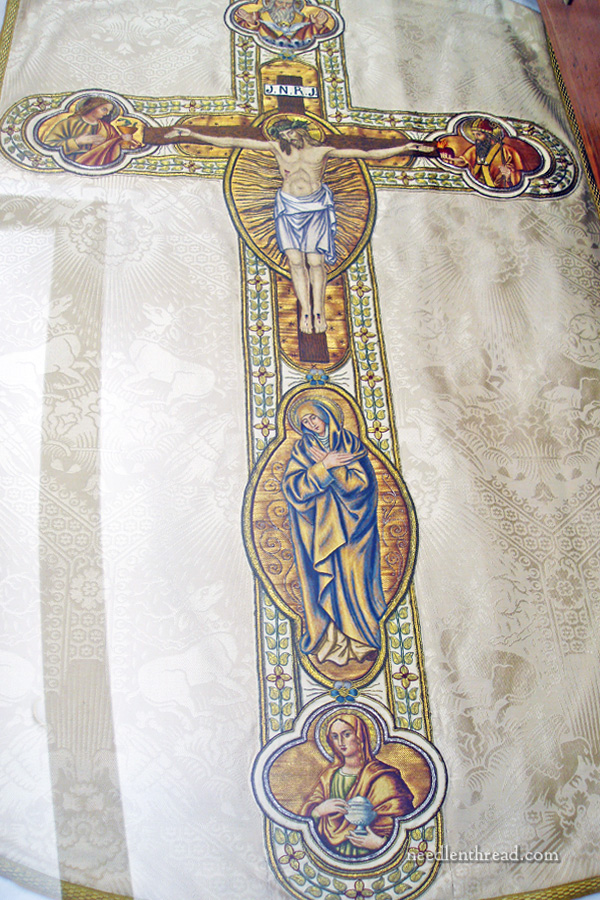
Starting out with something relatively local and close by, there is a lovely Crucifixion chasuble located in Clyde, MO, at the convent of the Benedictine Sisters of Perpetual Adoration. They have a relic chapel there that also houses a vestment museum of sorts. The collections features vestments made at the convent before the mid 1900’s. Some are remarkably beautiful.
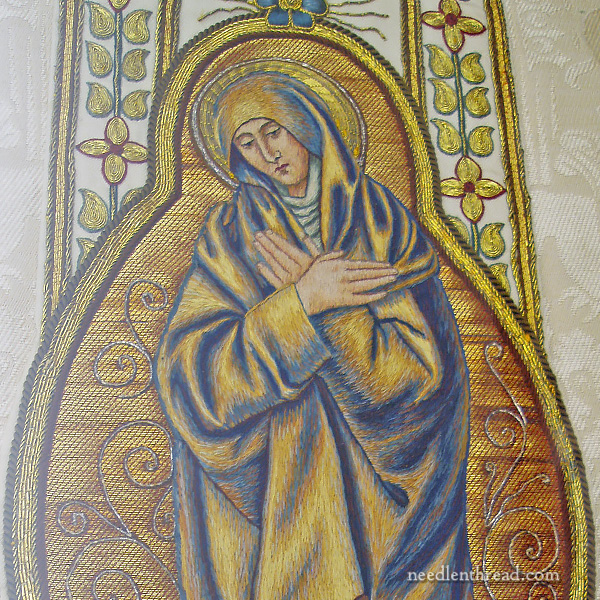
What I particularly love on this chasuble is the shading, especially on the robes of the Mother of Christ at the base of the cross. I also like the detailed faces of the various figures on the chasuble. You can see more of this chasuble here, with close-ups on faces so you can really see the details of the stitching.
At the time I visited, the vestments were behind glass (and my camera was “old technology”), so the photos are not the best.
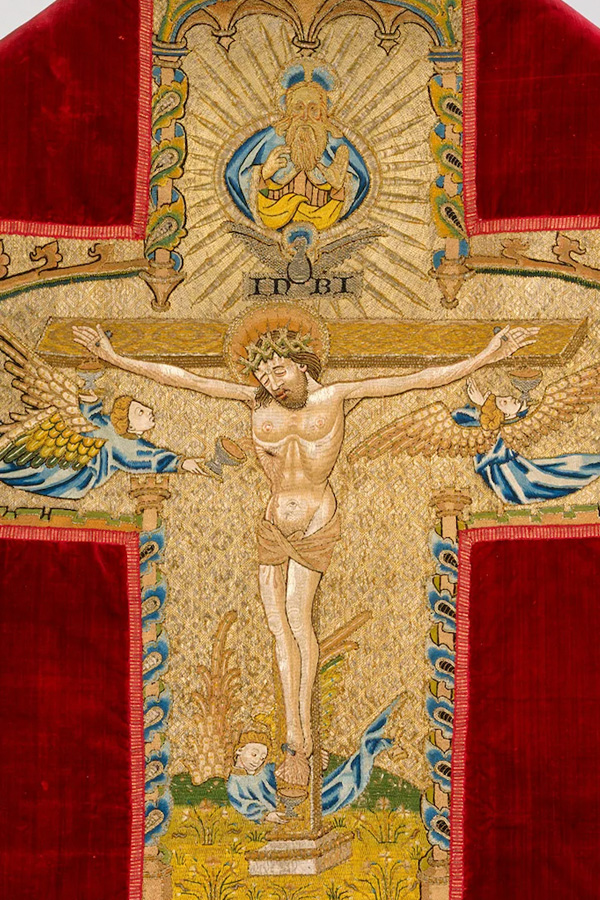
Going further afield, in the collection at the Abegg-Stiftung (in Riggisberg, Switzerland), you’ll find an exquisite example of 15th century English embroidery in gold and silk on the orphrey (or decorative banding) of this chasuble above.
This is a fabulous example of English embroidery, in remarkable shape. The colors are still vivid, the embroidered scene is clear and sharp.
Above the crucified Christ, you can see God the Father and the Holy Spirit (the dove). There are angels on each hand and at the foot of the cross.
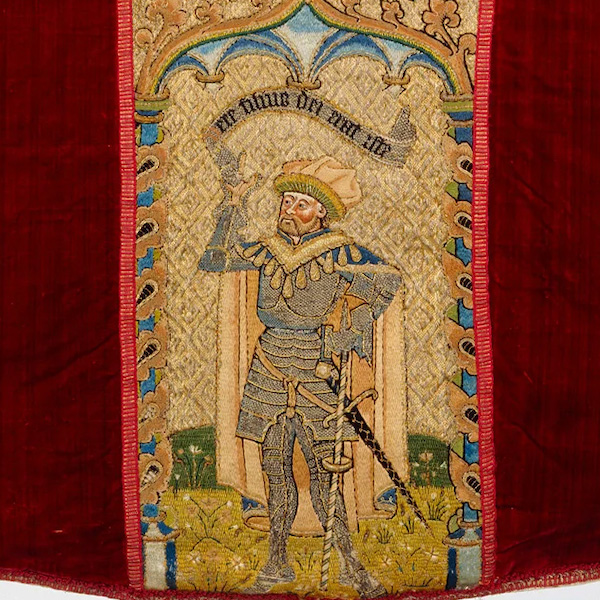
What I really love about this orphrey is that, at the base of the crucifixion, you’ll find the centurion of Matthew 27:54, declaring Vere Filius Dei erat iste (Indeed, this was the Son of God).
The centurion is oh-so-15th century! He’s wonderful!
This is a phenomenal piece of ecclesiastical embroidery just by virtue of the fact that it’s English and 15th century and in such magnificent shape. While we do have some ecclesiastical embroidery from England that pre-dates Henry VIII’s dissolution of monasteries (so, before the 1534 Act of Supremacy), given the amount of ecclesiastical embroidery and other ecclesiastical art produced in that country before then, in the scheme of things, we don’t have much. So this is a real treasure. It figures up there as one of my personal favorites reflecting this subject.
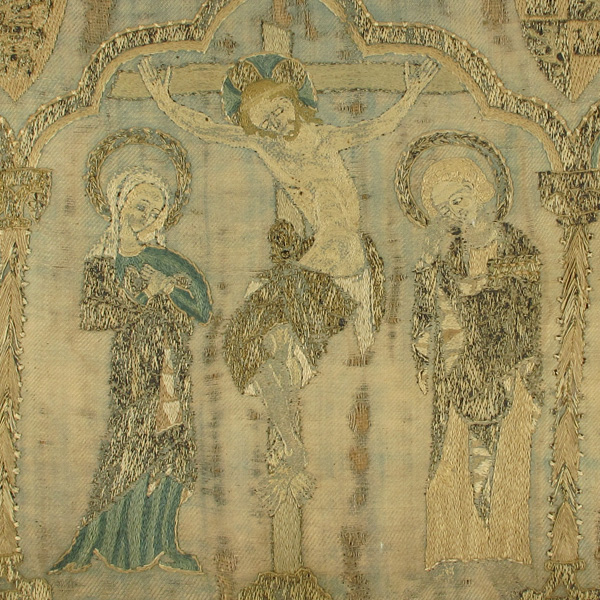
Another example of English embroidery – this time, late 13th century Opus Anglicanum – can be found at The Met in NYC.
The image above is an excerpt from a small altar panel featuring the Crucifixion in the center, flanked by various saints on each side.
In the image above, right next to the cross, you’ll find Mary the Mother of God on the left and St. John the Apostle on the right.
The panel also features St. James the Greater (as a pilgrim, with a staff and scrip), St. Peter (holding a key representing his authority given to him by Christ), St. Paul holding a sword (he was beheaded with a sword), and St. Andrew with an x-shaped cross (he was crucified on an x-shaped cross or “saltire”).
You can also see a variety of heraldic emblems on the panel. If you visit the link I supplied above, you can zoom in on the various parts of the panel and see them all very clearly.
Now, this panel is super old. But while the colors are no longer vivid, and some of the embroidery is no longer there, the details that you can see are worth looking at – especially if you have an interest in Opus Anglicanum. It’s a good example.
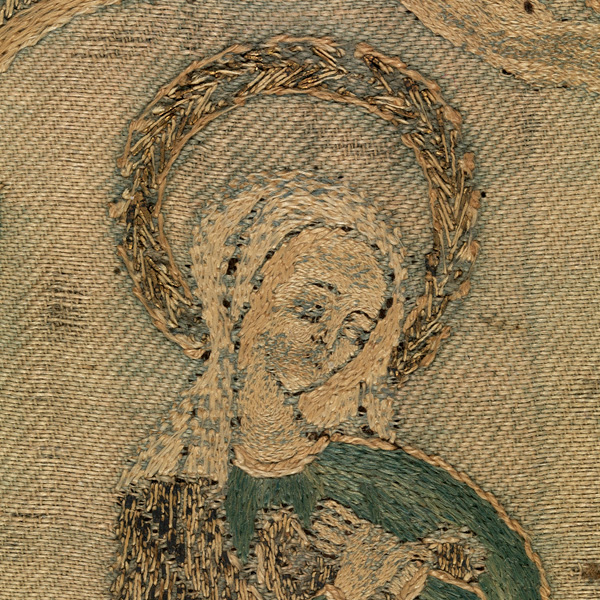
What strikes me most is the expressiveness or “eloquence” of the figures. In Opus Anglicanum, the faces of figures often tend to impress modern viewers as being “juvenile.” Despite their seemingly “cartoonish” look, the figures are very expressive, and I think this is especially evident on this piece.
For example, you can see the sorrow on Mary’s face and in the position of her hands clutched over her heart – that same heart that Simeon said a sword would pierce (Luke 2:35: And thy own soul a sword shall pierce, that, out of many hearts, thoughts may be revealed).
And yet, there is still calm and willing acceptance in her downcast face. She is sorrowful and in anguish, certainly – but she is not engulfed in an emotional, resistant tirade. It’s a heroic face.
What a beautiful image! You can tell that artists behind the work knew the scene, understood what was being portrayed.
It was not merely a “fill in the blank” coloring book exercise for the artist, but a real understanding of the scene, depicted in needle and thread.
So those are three worthwhile examples of ecclesiastical embroidery that focus on the Crucifixion.
Reminder of Upcoming Break
We will be off today (Thursday, April 2nd) through Tuesday, April 7th.
The online shop remains open, but we won’t ship orders again until Wednesday, April 8th – which happens to be my birthday, so we’ll celebrate with a shipping party rather than a birthday party.
But hey, if you bring cake, you can come join us and we’ll have a birthday party, too!
I’ll do almost anything for cake, after all…
Happy early Birthday Mary.
Wishing you a Blessed Easter for you and your family
Theresa ( Nebraska neighbor)
The expressions truly are poignant, but yes, with understanding and knowledge of the hope to come. Thank you for posting this today!
I was a bit surprised to see on the close-up of Mary that the background fabric is a twill. Twill sometimes tends to pull in a diagonal direction. I’m curious to know how the weave of background fabric could affect embroidery stitches during the stitching process and if it affects the wear over time. I suppose, since that is an ecclesiastical embroidery piece, the extensive embroidery work negates any directional pull in the fabric.
It’s actually some form of cloth of gold. It may be a twill weave, but the embroidery wasn’t done directly on it. It was likely done on linen, mounted with a firm felt-like back or similar, and then appliquéd onto that background fabric.