

Historical ecclesiastical embroidery is a pet fascination of mine. Have you ever seen magnificent pieces of embroidery or goldwork in museums and wanted to get up close to them to check them out? I have! But we don’t often get the opportunity to handle them and to get up close with a camera, and even if we did, it’s not always likely that we’d be allowed to photograph the piece.
This is a chasuble from a sacristy at a Catholic church, and the goldwork is stunning! It’s still in use, actually, so it isn’t in a museum, but rather serving its intended purpose.
I was able to photograph it a few weeks ago for a presentation I put together on pieces of historical church embroidery. I thought I’d share some of the photos with you so that you can appreciate the beauty of this work of art, and to inspire you to think about the type of work which must necessarily have gone into such a glorious piece, created for a glorious purpose: worship of God. They just don’t make ’em like they used to!
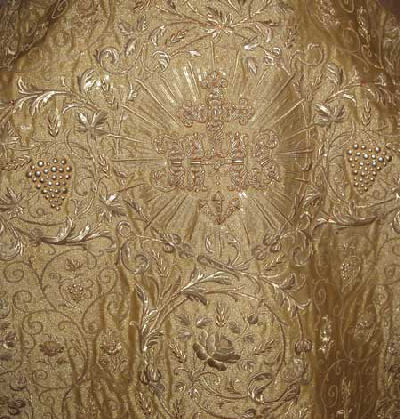
Above is a view of the majority of the back of the vestment. The design includes the central motif, which is the IHS surmounted by a cross, and then the rest of the vestment is worked in scrolls of grapes, wheat, and roses.
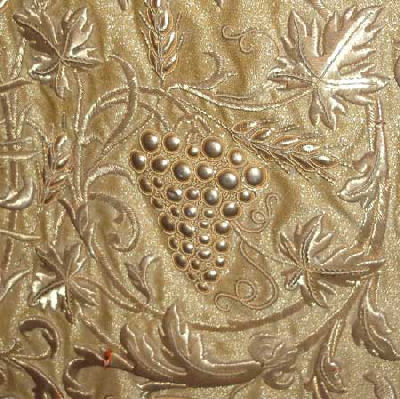
Here is a a relatively close-up shot of a bunch of grapes. Notice the sheen in the leaves at the top of the photo. Also note the damaged area on the acanthus swash at the bottom of the photo, where you can see the brick-colored padding under the gold. It would be difficult for anyone but the most skilled professional to repair a piece like this, especially considering the coloring of the gold.
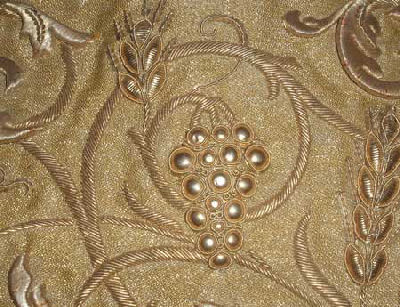
Another close-up on a bunch of grapes – the vine is worked in gold purl, and the inside of the wheat kernels is worked in folded gold plate.
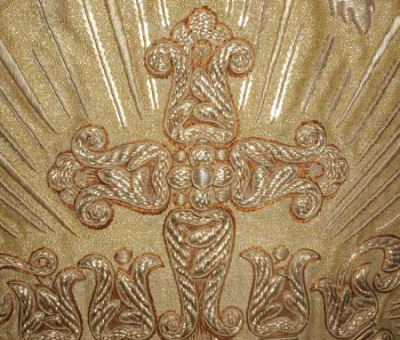
The goldwork here is fantastic! This central motif is mostly worked with gold passing, couched over padding in such a way to create this texture. I cannot imagine the skill it takes to create something so precisely stitched as this part of the design. The gold looks liquid and catches the light beautifully.
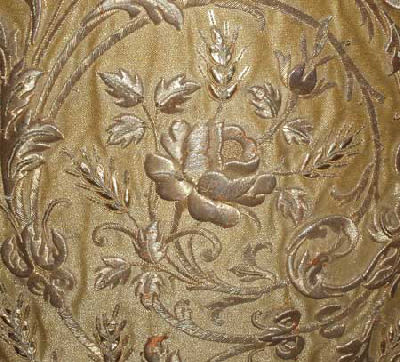
This goldwork rose is lovely, as is all the surrounding embellishment. You can see the wear on the goldwork fairly clearly in this photo – note the area on the top, back petal of the rose.
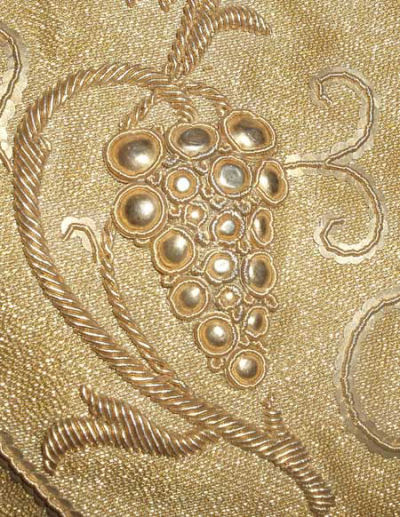
And finally, a very close-up shot of one of the bunches of grapes. Note the precision in the purl work on the vine, and the purls that surround the individual grapes. Also note the spangles – how smooth and flat they lay, and that the purl used in attaching them looks fluid. Absolutely incredible!
I think this is a stunning piece, and I could spend quite a bit of time pouring over different elements to study the goldwork on it. In the relatively short amount of time I spent studying it, I could not find a flaw in the stitching. It is absolutely precise. The ground on which the goldwork is worked is cloth of gold.
So, what do you think? Amazing, isn’t it?
Amazing! Thanks for sharing.
This is indeed glorious. How were the flowers embroidered? It looks like they were done over card to make nice crisp edges, but what fiber is used? Is this silk or more gold? Is the gold taken thru the fabric, or couched on top?
BTW, what exactly IS cloth of gold?
Marilyn
Hi, Marilyn – I posted an article on cloth of gold, to answer your last question. Hope you enjoy it and the links.
Yes, they stitch them over card to get a crisp edge – well, it depends, sometimes it’s actual card, sometimes it’s a kind of hard wool felt-type material. The gold is either couched or it is plunged, but it is not usually carried from one stitch to the next behind the fabric, like you normally would in satin stitching, for instance (takes too much thread to do that, and it would wear the gold).
Glad you liked the photos!
MC
It’s remarkable that this kind of thing can be done by hand. I like the fact that it is still being used, too, not in a museum.
They DO make them like they used to; YOU do! I was just looking at your Agnus Dei and am still breathing hard. I almost asphyxiated when I saw this on top of the other. Oh my, oh my.
Your site is exactly what I’ve been looking for since last spring. (when I first tumbled upon Opus Anglicanum and some heavenly pictures of ecclesiastical embroidery.) Where have you been?
Christiana
Well, I’m glad you found me! Welcome aboard!
Glorious! Fabulous work.
Mary,
Its hard to believe that human hands can do this beautiful work of Art. Eva
This is a fantastic site. I love it. Very few people do this kind of work nowadays. Thank you for posting. I am really interested in experimenting using real cloth of gold or silver fabrics. Can you still buy them? If so, any leads as to sources. Thanks. Any info appreciated.
Hi, Murvyn – There’s a source in the UK for real cloth of gold: Watts & Company. They are a liturgical vestment design & manufacture company. I found a source in Australia a while ago, but the company never got back to me, so I don’t know if it’s defunct or not, and I can’t find the link now! But I think Watts & Co. is a good way to go….
Hi Mary! Thank you so much for your speedy response. I went to the Watts and Co. website at http://www.wattsandco.com and found that they do carry Cloth of Gold. However, I’m still on the lookout for the Cloth of Silver. Thanks a bunch for the info. Very very useful!! =)
Amazing! That’s all I can say. I would like to know is: is the actual material gold, somehow, or is the embroderiery thread gold thread?
Can it be purchased or is it accessed only by the Church? And where from. I’m in Australia but don’t know the address of the suppliers. High regard from Silvana.
The work can only be described as an exulted piece of human endeavour. It would have taken an immeasurable time to complete and at what cost. I am not just thinking money but human endeavour.
I am having a rest day and I thought as newy to your site I would have a look at other pages. I must say you are most generous with your information and also and superb craftsperson from what I have seen. I say to my ladies, it is practice that will make you better. Having a gift or an eye is all very well, but is only part of gift, putting them together in a pleasant way is the hard part.
I have advise them to go to your site and other places to see what other people do.
Mary visiting your site is eyecandy and tonic for the heart.
Best wishes and great respect.
These are beautiful examples of some of the cloth of gold. I lived in Italy for three years,and aw some. In my medieval history of Lucretia Borgia; there is mention of “curled” cloth of gold. I am trying wrap my mind around that,and have tried to find references to that “curled” cloth of gold looked like.
Can you shed some l
ight on this?
Thanks
Linda
This is gorgeous! I might have missed it — you say that this piece is still in use, but about when was it made?
I don’t actually know. It is certainly pre-1900’s, but how far back, I wouldn’t know without being able to take the back apart.