

Sometimes, it’s hard to make a decision about what embroidery or needlework book to buy, so in my needlework book reviews, I try to give you enough information to make an informed decision so that you’re not disappointed. There’s nothing worse than getting all excited about a new embroidery book, then getting it and finding it lacking!
If you’re looking for an embroidery stitch dictionary – one of those handy reference books on how to do this stitch or that – here’s a review for The Embroidery Stitch Bible.
You can be assured, when I review an embroidery book, that it’s a book I own. I try to give the pros and cons of the book, and specify what’s different about it that makes it especially useful to the embroiderer.
The Embroidery Stitch Bible has several great features, the primary one being a section at the front of the book called the “Stitch Selector.” This is a pictorial guide to each stitch in the book. If you don’t know the name of a stitch, you can browse through the Stitch Selector to identify it.
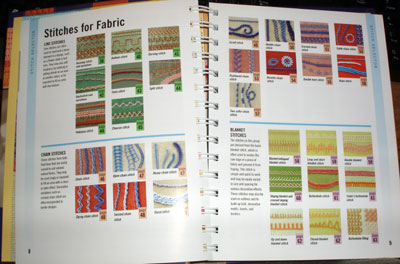
In the Stitch Selector section, you get little photos of each stitch as it really looks – it is worked, not just sketched. The stitches are arranged by types – satin stitches, couching stitches, laid filling stitches, and so forth.
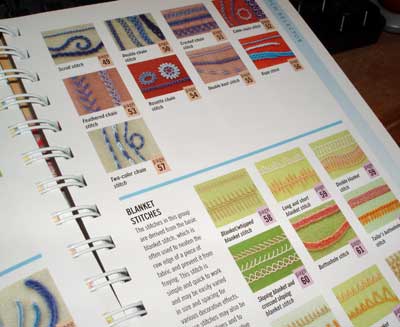
Set in each little picture is the reference number for the embroidery stitch so that you can flip right to the instructions.
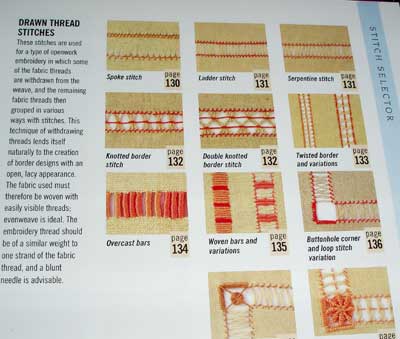
Each category of stitching is pretty thoroughly covered, as you can see by this page of the Stitch Selector showing drawn thread stitches.
This pictorial “table of contents” at the front of the book is perhaps my favorite feature of the book!
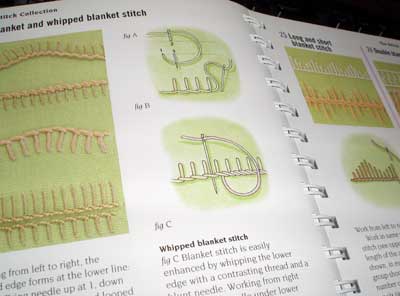
When you want to learn a stitch, there are three aspects to each instructional page or spread of pages in the Embroidery Stitch Bible: 1. a photo of the stitch worked in several variations; 2. a chart of how to work the stitch (this is a drawn diagram); and 3. text that takes you through the stitch and some variations step-by-step.
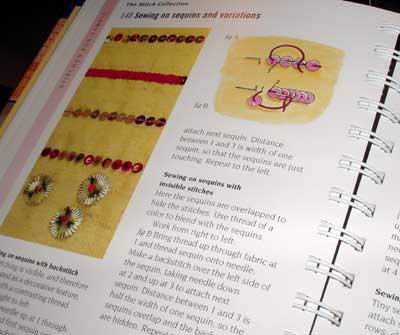
Techniques besides strictly “embroidery” are covered, such as sewing on sequins and other embellishments.
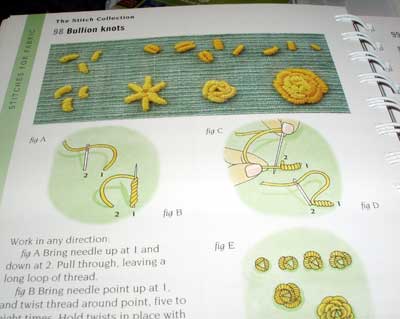
You can see here on the bullion knot page the three elements of instruction – at the top, the photo of the real stitching, then the diagrams (there are two two-part diagrams), and then the text. You can also see the variation on the stitch, which, in this case, is a bullion rose.
The one element that some may consider a “disadvantage” to this book is that the stitches are demonstrated in drawn diagrams, often in two diagrams, but sometimes only in one diagram. Compared to other books such as the A-Z series on Embroidery published by Country Bumpkin, or their Embroiderer’s Handbook, this can be seen as a bit chintzy in a way. Country Bumpkin generally gives you a step-by-step series of photographs of each stitch as it is being worked. But in a book that covers over 200 stitches (as the Embroidery Stitch Bible does), it would be quite a feat to fit that many stitches into one book with step-by-step photos!
So you have to weigh what you want: a lot of stitches, with a visual representation of the actual stitch worked and a diagram to show you how, OR fewer stitches, with step-by-step photos of the stitch in progress.
A word on diagrams: in this book, I think they’re pretty clear. In some older pamphlets for embroidery, or in older books, the diagrams are not as well done, so don’t judge “diagrams” in general by older publications. The diagrams here are clear, and if you are even just a little bit familiar with embroidery, you shouldn’t have too much of a problem working them out.
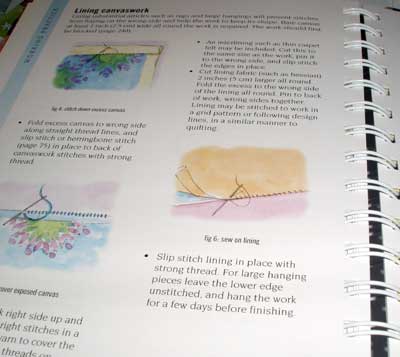
Another nice feature: most embroidery books begin with a section on basic materials and setting up a piece of embroidery. This book does, too. But most books don’t include finishing tips. You will find a short section on basic finishing tips in the back of the Embroidery Stitch Bible. They are illustrated, not photographed, but still very clear.
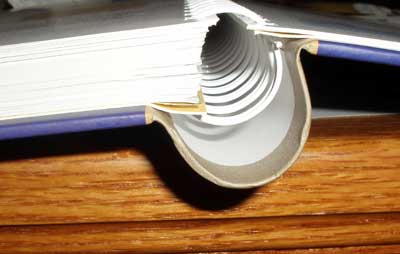
This, to me, is one of the finest features of any how-to book, whether it’s needlework or any other craft: a spiral binding! I wish publishers would take this aspect into consideration more often! When you’re teaching yourself from a book, it’s great to have a book that rests flat on the table! So the spiral binding on the Stitch Bible is a huge plus!
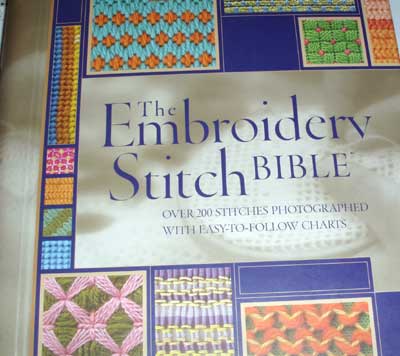
I like the cover, but don’t let the background photo or the majority of stitches on the front throw you off – it looks like it focuses primarily on canvas or counted work. It’s not the case, really. Yes, canvas work is covered. But so is everything else!
I like this little book, and I think it’s an excellent reference for beginners and beyond. It’s small enough to be easily portable, it’s well-made, and thorough.
Where to Find It
Update, 2021 – there’s a new edition out!
You can find the (new edition of) Embroidery Stitch Bible through the following book affiliates:
In the US, Embroidery Stitch Bible is available here through Amazon.
Worldwide with free shipping, Embroidery Stitch Bible is available here through Book Depository.
This article contains affiliate links to book sources, which means that Needle ‘n Thread receives a small commission for any books purchased through those links, at no extra expense to you. Thanks!
My best wishes for you dear friend Mary, by this New year 2008!!
Really I enjoy each article that you write
A hug from Alicante Spain
Thank you for your reviews! I've found several books I want to buy thanks to you.
Having such a BIBLE would be like winning another BIBLE ..to make my life more meaningful and colorful.
I have done plain embrodery but I am just starting to learn the other stiches. This book looks like the ticket to give me a great start. I will be keeping my fingers crossed I will be the luck one. Have a great holiday everyone.
Gostaria de compra a Bíblia do Bordado,moro no Brasil-Recife -PE por quanto fica .
Hi Mary, I would so love this book. I have done historical samplers and crewel work in the past as well as needlepoint and want to get back into it and this book is just the ticket to refresh my stitiching techniques. I love your website and enjoy the lovely things you make and find it so inspiring and I believe you are the one who got me interested in embroidery again. Its so lovely.
Thank you!
Hi,this book would be very useful to anybody interested in embroidery it would seem. My sister does some embroidery and told me about your website, since I was interested in doing embroidery as well. I did embroidery as a young girl around age 9 to 19. My mother always made sure we had something to do with our spare time.So I do have an idea.I’m 40 now.
Hi,this book would be very useful to anybody interested in embroidery it would seem. My sister does some embroidery and told me about your website, since I was interested in doing embroidery as well. I did embroidery as a young girl around age 9 to 19. My mother always made sure we had something to do with our spare time.So I do have an idea.
Hi Mary,
which book do you recommend,
A dictionary of Embroidery Stitches or
The Embroidery Stitch bible?
Are both in hardcover format?
I have a small knowledge in Hand Embroidery, I am confused, please help me. I prefer a lot of DIFFERENT STITCHES to refer to….
Does Mary Thomas’s book have anything about Couching and Laid work?
THANKS
Shaz
Hi, Shaz – well, each book has its own merits. If you’re looking for a lot of stitches in one book, I like the Stitch Bible for that. Mary Thomas’s Stitch Dictionary does have information on couching and laid threads, too, and it’s a good stitch dictionary, too. Both books show the stitches in diagram form. Of the two, I prefer the stitch bible. I like the way it is laid out, and I like the index in it. As far as binding, the stitch bible is hard cover with a spiral binding that’s hidden – it opens easily and lays on the table easily. The in print edition of Mary Thomas’s stitch dictionary is not hard bound, and it does not lay flat when opened as easily. If I were choosing between the two, I’d go with the Stitch Bible, personally…. MC
Sou uma apaixonada pelo bordado em ponto livre, gostaria de aprender mais sobre essa maravilha, e esse livro irá me ajudar muito.Amo bordar.
Dear Mary,
Thank you so much, you are the very reason I have started to learn this wonderful art. Your love for this art has inspired me greatly I have purchased the Embroidery Stitch Bible and hoping to try my hand on this.
i would use satin stitch if i could only use one for rest of my life