

Are you interested in adding some random threads and so forth to your embroidery stash? Here’s your chance – at no cost to you. Each month this year, I’m doing a little give-away from my own needlework stash. Better late than never, here’s the one for May!
There are a couple types of needlework threads here, a bit of silk ribbon, some buttons (not just any buttons, mind you…) and a snippet of waste canvas!
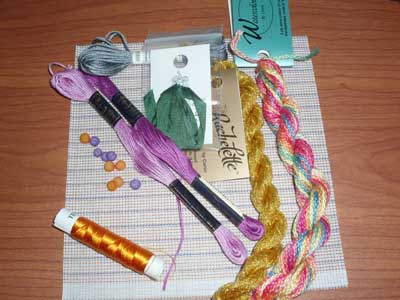
That’s the little heap. It’s all bagged up and ready to mail.
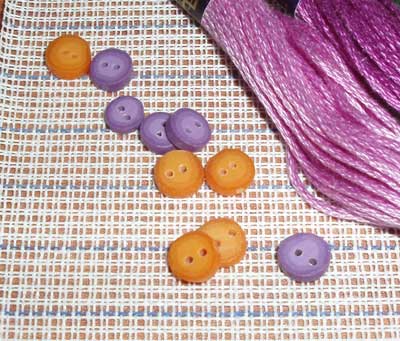
Here are the buttons. They’re tiny little hand-painted buttons. Cute, aren’t they?
Waste canvas is used over a plain weave ground fabric. It helps you manage even stitches in counted techniques (cross stitch, blackwork, petit point, etc.) or on lines of surface embroidery stitches (like herringbone or fly stitch or whathaveyou.) You stitch over the waste canvas, then carefully pull the canvas out from behind your stitching, strand by strand.
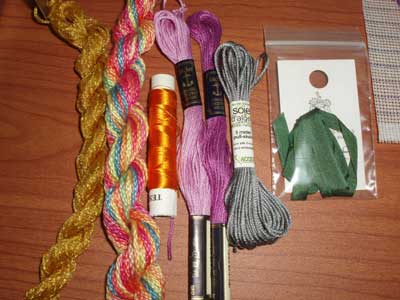
These are the threads. There’s Rachelette, which is a kind of sparkly gold meshy thick thing, with a gold cord running through it, that makes a kind of bunched-up looking stitch. You can use it for couching funky designs, for ribbon techniques with a twist, or for needlepoint. Actually, I’m not really sure what it’s used for – but I imagine it could be used in those ways. I bought it on a whim when I was at a little shop in Florida. I’m not sure what possessed me at the time. But it’s kind of neat stuff. I’m sure there are ingenious people out there who know exactly how to use it!
Then there’s a skein of Caron Watercolors – multi-colored and pretty. There’s a spool of silk in orange. This is Helen Stevens’s TESS silk, which is the same as Piper’s silk. It’s flat silk, and very fine. If you haven’t stitched with this kind of silk, it can take some getting used to, but once you try it, I think you’ll like it! There’s nothing like flat silk for shine. You can use several strands at once to thicken it up a bit.
Next are two skeins of Anchor cotton, in shades of purple.
Next to that is a skein of Soie d’Alger, which is Au Ver a Soie’s stranded spun silk. It’s great stuff to work with, and has a beautiful soft sheen to it.
Finally, there’s a little bag with a leftover, good-sized length of Glorianna silk ribbon, in a forest green.
Now, what do you have to do to be a part of the contest? You have to follow the “question” directions below, leaving your answer in the comments section on this post. If you use the “anonymous” feature to leave a comment, please sign a name, so when I draw names I know who’s who.
The give away is open to anyone, anywhere. I’ll ship via least expensive air mail. You’ll have to be responsible for any customs or anything like that (if that’s an issue), and I’m not responsible for lost or damaged packages. I hate having to say that. But that’s that.
Question:
Ok, it’s not really a question. Pick one technique from this list of embroidery techniques (that’s a link, click it to get to the list), define it, and give one online resource (other than my site!) for that technique. You can use the list in the post, or pick a technique listed in the comments below the post!
I know, I know… it’s work… but this way we can all learn something!
Don’t think of it as work – think of it as fun! (I sound like my mother!)
Have fun!
(I’ll post the winner on Monday, May 19th).
Crazy quilting is my passion, so I’m happy to suggest the following: http://kittyandmedesigns.blogspot.com for all sorts of eye candy and ideas. For supplies I like: victoriancottagetreasures.com and http://www.Ribbonsmyth.com . OH, and http://www.vintagevogue.com too!! Hope these will help someone and be of interest.
Cheers
Mary Anne
I chose bead embroidery. I love the blog of Robin Atkins http://beadlust.blogspot.com/ She has also started the Bead Journal Project which has over 250 people participating from around the world. The work has been absolutely beautiful. I find for unusual bead supplies and for tiny beads http://www.beadcats.com Enjoy!
Needle lace is something I know many people are interested in. the following site is of interest:
http://lace.lacefairy.com/International/Turkey.html
Melisa
It’s goldwork for me.
Goldwork is a form of embroidery that uses metal threads. Goldwork does not necessarily have to be worked in gold. There are other metals available (copper and silver) as well as some coloured metal threads.
Typically, the metal threads are laid on top of the fabric and couched down with some sort of sewing thread. Some types of metal thread are cut into pieces and sewn onto the ground fabric like beads. Goldwork has been used in the past to adorn ecclesiastical pieces and specialty garments for wealthy patrons including royalty.
Give it a try; it’s a lot of fun!
Now for a web site… well, I couldn’t settle on just one so here are a handful:
Berlin Embroidery
Alison Cole Embroidery
Royal School of Needlework
Benton and Johnson
Golden Threads
Goldwork Guild
Hedgehog Handworks
I choose Stumpwork and define it as a form of raised embroidery from 1650-1700, which has had a resurgence in popularity. One online resource is http://www.egausa.org/html/free_wild_cornish.html. hopefully i havent had this bookmarked becuase i saw it on your blog!
Hardanger – traditional work over 22 count even weave fabric with same coloured thread. The class I attended used #8 Perle cotton and I used mid cornflower blue material and thread. Varigated rainbow thread on white material looks quite stunning!!
Technique – using satin stitch blocks (Kloster blocks) 5 stitches on a 4×4 thread measurement, the embroidery can be completed in many variations. Gaps between the embrodered threads maybe cut out to give a cutwork appearance.
It can also be known as white work, but to avoid confusion with the ‘other’ whitework (classic embroidery stitches worked with white stranded cotton over cotton material) it is generally referred to as Hardanger.
this link will give you more info (incl history) and a picture:
http://www.nordicneedle.com/tips/har101.shtml
My technique is Blackwork, the technique that got me back into embroidery after a long absence.
I define it as a counted stitch technique, usually worked in (Duh) black thread on evenweave white fabric, in Holbein (double running) stitch so it looks the same from both sides, though various fill stitches are also used. Scarlet or Redwork is closely related, but is worked in (Duh) red thread. Some designs incorporate both colours. It first became popular in Tudor and Elizabethan times where it was used to embellish clothing, particularly undergarments and personal linens. Modern Blackwork can be used to create monochrome pictures of astonishing complexity.
OK, on with the linkage!
A short history of Blackwork
http://www.blackworkarchives.com/bw_cost.html
From a site with lots of free patterns!
http://www.blackworkarchives.com/index.html
An article on blackwork
http://www.skinnersisters.com/stitch/issue1/index.html
Blackwork eyecandy
http://www.extremecostuming.com/reproductions.html
I choose Crazy Quilting, the use of embroidery stitches to embellish seams as well as using embroidery motifs, silk ribbon, beads, buttons, charms, crochet, tatting and much more.
History: http://www.caron-net.com/featurefiles/featmay.html
Silk Ribbon:
http://www.threadart.com/shop/
Ideas:
http://www.antiquepatternlibrary.org/completelist.htm
http://cqmagonline.com/
http://gatherings100.blogspot.com/
http://honeybeesbliss.blogspot.com/
http://inaminuteago.com/index.html
http://nzjo.blogspot.com/
Is Redwork a technique? What would it be called? An embroidery style, maybe? Anywho, I love it! So that’s what I picked!
Redwork, so named because it is embroidery worked using only red thread; some say goes as far back as 14th century Spain. I the U.S. its hay day was late 19th – early 20th century. During this time it was popular to embellish useful household items such as quilt tops, tea towels, dresser scarves, et., with simple designs, using very basic embroidery stitches, done in redwork.
You’ll find lots of sites if you Google “redwork”. Here are two…
A good bit of info here; a book list; a number of links – some are broken tho’ 🙁 …
http://www.prettyimpressivestuff.com/redwork.htm
Lots of free patterns here…
http://www.ladiesinred.org/designs.html
– Jeannine
Hi Mary! My mom started me with Crewel work when I was only seven years old and I have been in love with thread and fabric ever since. Phillpa Turnbull has wonderful information and a forum for crewel work. go to http://www.crewelwork.com/Crewel/DVD.aspx to see her long and short soft shading video technique (this is where I learned to lock my tails!).
I find french knots to be relaxing-I guess from the repetition and no thinking-so back in the 1970’s Candlewicking was a favorite of mine. I am recently drawn back to it. Candlewicking was used by the colonial women when they substituted the cheap cotton threads used for candle wicks from the highly taxed threads from Europe. In my research I found candlewicking comes from whitework and another form which interests my creativity is called Mountmellick. Check out this lovely site: http://www.vettycreations.com.au/index.html
Whitework is ageneral term that covers embroidery techniques as diverse as the exquisitely fine, delicates stitches of Ayrshire work and the bold, vigorous knots of mountmellick andcandlewicking.
Despite their differences, all share the identifying characteristics of white threads stitched onto white fabric, the texture of the titches crating wonderfully subtle patterns acrosss the surface of the fabric.
I chose Assisi work as it is something I have never done, but like the look of. Assisi embroidery is a form of counted-thread embroidery based on an ancient Italian tradition where the background is filled with embroidery stitches and the main motifs are left void i.e. unstitched. The name is derived from the Italian town of Assisi where the modern form of the craft originated.
I found mention of a website on your site Mary, that ha lots of free assisi patterns. It is called Embroidery and Embroider, and may be found at http://www.stitchstitch.info/index.htm
I love your site Mary and have found immense pleasure reading the articles and studying the pictures – especially the ecclestiastical ones!
Best wishes,
Penny
I chose stumpwork too, it is such a beautiful form of raised embroidery. I would love to try it sometime if I knew how.
http://www.white-works.com/stumpwork.htm
what a wonderful site you’ve got Mary! I’ve been looking for some tips on stitches to use since I haven’t embroidered anything for a while and your site has helped me a lot, especially the videos to refresh my memory!
I chose Bargello because I’ve never heard of it as a technique and wanted to learn something new.
Bargello, also known as Florentine embroidery, is needlework where typically only straight stitches are used, often in geometric shapes. It is generally very colorful.
Not on your list, but one for my evangelism: Opus Anglicanum. OK, so it falls under “goldwork” and under “silk embroidery”.
Opus Anglicanum is a style of embroidery that was practiced most intensely during hte 13th and 14th centuries in Europe. It’s characterized by silk embroidery worked in split stitch to create detailed figures, with a background of goldwork embroidered in an underside couching technique. Very very pretty.
Embroidery on paper:
I’m trying to make more homemade cards ahead of time… I’m exploring embroidery on paper and it is fun!
How to begin: http://sharyl64.blogspot.com/2008/04/latest-trend-in-embroidery-embroidery.html
a few basic patterns: http://handcraftedgreetings.com/embrinst.html
LOVED your paper embroidery pattern!!
Yep, sure does, Laura!
Wow, there’s heaps of good information building up here!!
The give-away doesn’t end until Sunday’s over (May 18), so feel free to keep adding!!
Thanks, all, for participating and sharing such a wealth of information!
Hello Mary, A technique that I love to do is called Passementerie or Soutache Embroidery. It uses either soutache which is very skinny military braid in swirled patterns on top of clothing for embellishment. Stitched down either by hand using slip-baste or catch-stitch; or using machine in a meandering method. Passementerie can be any kind of trim, most often self-fabric on the bias or contrast bias which has been steamed into design shape and slip-stitched onto garment. Passementerie as opposed to soutache can be used as edging in the same way scallop embroidery is used to edge a sleeve or hem. The terms are confusing when doing a search but a good source of info are books by Jane Conlon, who has perfected the technique.
So , Mary , does this entry to your list qualify my for the May Giveaway? Say yes!
I’m definitely technically challenged – this is the third time I’m trying to post this. Let’s see if it works this time.
I’ve chosen Kutch work because it’s something I’ve just learned more about and want to try out soon.
Kutch work comes from the Kutch region in Northern India. Specifically, Kutch is in the state of Gujarat, bordering onto Pakistan.
In Kutch work, one embroiders an outline, frequently a herringbone or Maltese cross shape, and then fills this in by means of interlacing between the outline, working only at the front of the cloth.
Interestingly, it is identical (or almost identical?) with Armenian embroidery from Marash, which is in present-day Turkey. It’s not really known if there is actually a historical connection between the two, or whether the similarity is coincidental.
Here is a tutorial on Kutch work:
http://kutchwork-tutorial.blogspot.com/2006/06/lesson-iii.html
And here is a tutorial on Marash embroidery:
http://armenianembroidery.tripod.com/sketches.htm
The technique I chose is : Jacobean Embroidery: Jacobian embroidery is a form of crewel embroidery. The motifs of Jacobean embroidery are based on the Tree of Life.
Boy did I have a hard time finding one that showed technique. This one has the picture and if you click on the different highlighted areas it show you the stitches to use and how to do them. The other links are links for pay downloads, just wanted to share the pictures some are stunning. I think my first project when I get back into embroidery here soon will be something mauve/pink on a chocolate brown background.
http://www.embroiderersguild.com/stitch/projects/crewel/crewel.html
I looked for years for a bed set that I liked and found one at a company call Domestications that was gorgeous , I went to purchase it and they were out of queen size, I was devastated. I have been hooked on the brown/pink combo since, but alas, am having no luck finding a bed set with these colors.
This one has kits that will show you the technique and I thought was a good one:
http://www.berlinembroidery.com/traditonaljacobean.htm
This one has some beautiful designs to purchase for download, but you may be able to incorporate them into hand embroidery. I just had to share because I think these designs are absolutely beautiful!
http://www.berlinembroidery.com/traditonaljacobean.htm
Thanks for doing this little give away! It gave me something to challenge my mind while having my morning coffee!
Michelle
I just wrote the comment on Kutch work, and realized that not only am I technically challenged, but forgetful as well – as I didn’t leave a name.
To make up for that 🙂 , here’s another Indian embroidery definition.
Chikan/chicken/chikankari/chikan work
This originated in Bengal, but is now associated with the city of Lucknow in Uttar Prudesh (in central India).
Fairly coarse white thread is used to embroider on muslin cloth that is most frequently white or in pastel shades. Various stitches are used, but the most frequent are stem stitch, herringbone stitch done as shadow work, and back stitch. Meshlike designs (jaali) are also made, with the embroiderer using the needle to tease apart threads of the cloth and then embroidering between them.
Motifs are usually Muslim inspired, and are highly detailed. Common motifs are vines and flowers.
Finding a tutorial was impossible. The best I could find was a close-up of a couple of typical motives:
http://www.webindia123.com/craft/needle/chicken/chicken.html
And a name this time round!
Andrea
I like free style embroidery e.g. as addition to needle felting. I enjoy being able to stitch without counting threads, although I also do other techniques, too. Here in Germany we have Anne Lange, who does a lot of stitching.
http://langenadel.de/
I also love the stitch site of the Embroiderers’ Guild, where you can find all kinds of stitches. And of course I enjoy your blog and those wonderful videos, which helped me to learn the oyster stitch and the different ways of couching.
The following is for the Stash give away for May.
Chicken Scratch:
Chicken Scratch embroidery technique is usually work on any color gingham fabric. Using the squares on the fabric as a guide, work either straight stitch, cross stitch (X), a double cross stitch ( a X with a + over it) or a circle ( thread woven through four straight stitches to form a O)to create beautiful patterns, such as the heart patterns noted on: www. pegasusoriginals.com
The effect is both lacy and delicate. And can be used for aprons or baby clothes or anywhere you want a pleasant and gentle design.
Enjoy.
Georgia
Hi, I picked blackwork, my favourite technique. The following website has lots of information on how to do it and lovely patterns as well.
http://www.needlework-tips-and-techniques.com
Carol
I the stumpwork the best! its embosed effect gives it an extra beautiful picture. I get awesome ideas from this site:-http://www.windflowerembroidery.com/catalog/stumpwork-raised-embroidery-c-476.html.Keep stitching!!