


Over the years, I’ve written a lot about hoops and frames for embroidery. If you’ve been following along for a while, you know that these wood hoops with sturdy brass hardware are my favorites. I combine them with this fine cotton twill tape for wrapping the inner ring, resulting in a life-long tool that I can use again and again and again.
My hoops haven’t failed me yet!
But there are all kinds of hoops on the needlework market, and there have been all kinds of hoops in the past, too, that we don’t necessarily see today.
When I wrote about Belding’s Revised Needle & Hook last week, I highlighted a passage in the booklet about hoops, where they specifically mention Duchess hoops.
Are you familiar Duchess embroidery hoops? I’ll show you what they are. Or were.
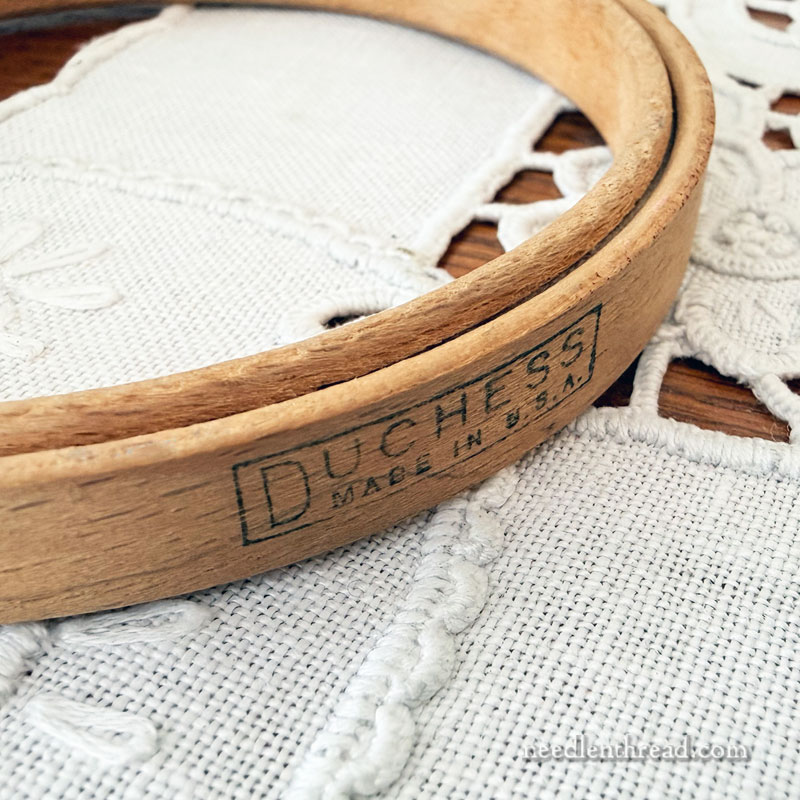
Duchess hoops were “embroidery rings” produced by the Gibbs Manufacturing Company in Canton, OH.
Although the hoops produced by the Gibbs Manufacturing Company belong to the turn of the 20th century, the company was in existence until 2001, when it went bankrupt. For the majority of its years, Gibbs Manufacturing was a toy company, but it first served a stint as a farm implement manufacturer, and also as a manufacturer of sewing notions.
Lewis Gibbs registered this patent in 1897 for an Embroidery Ring (links to a PDF of the patent), for this item as described:
An embroidery-holder comprising two concentric rings, the inner one of which is provided with a flexible fibrous band partially countersunk upon its surface, and the other provided with a smooth face to engage and clamp the goods thereto, substantially as described and for the purpose set forth.
The Duchess hoop is essentially the object of that patent, although the Gibbs company also produced a “Princess hoop” (which is not as highly favored, I think, by collectors today).
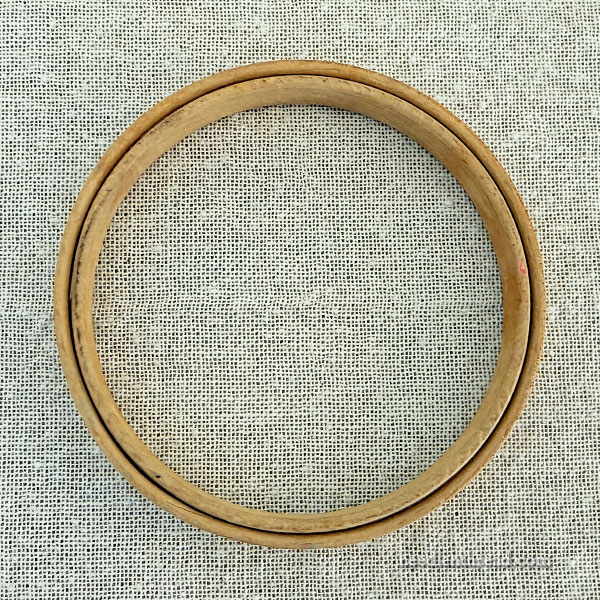
The Duchess hoop differs notably from wooden hoops of today in two aspects, the first of which is pretty obvious: there’s no hardware.
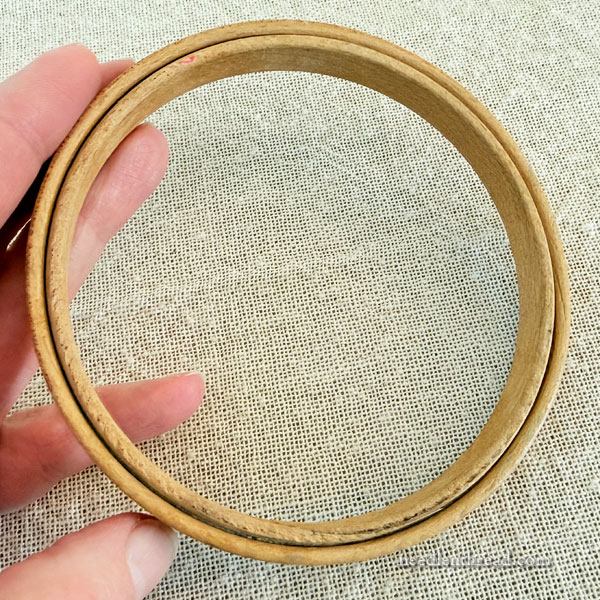
No hardware?! you say!
No. None.
Aha! I think this hoop was an invention before its time! If it existed widely today, it would be highly favored for “hoop art,” don’t you think?
While there are hoops out there that don’t have hardware on them that are used for finishing “hoop art,” they lack the grippiness – the holding power – of the Duchess hoop… which is the second different aspect of this hoop.
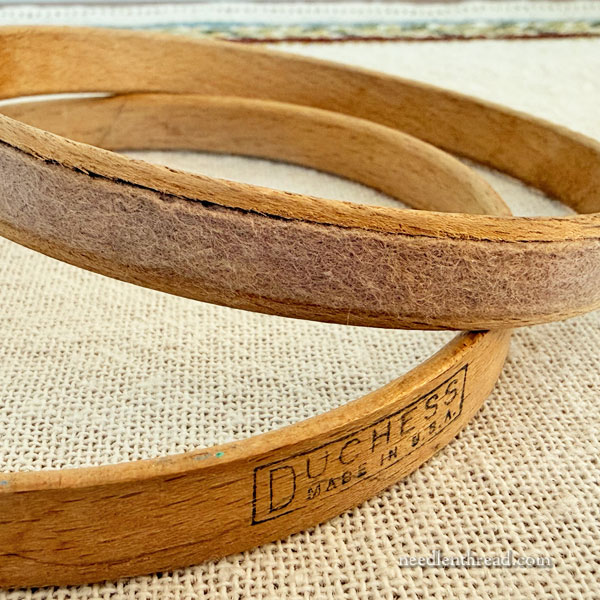
The inside ring of the Duchess hoop features a strip of felt or felt-like material (pretty sure it’s felt!) that is embedded in a channel in that inner ring.
This felt strip, coupled with the snug fit of the two rings, provides the tensioning “mechanism” for the fabric in the hoop, without the need for hardware.
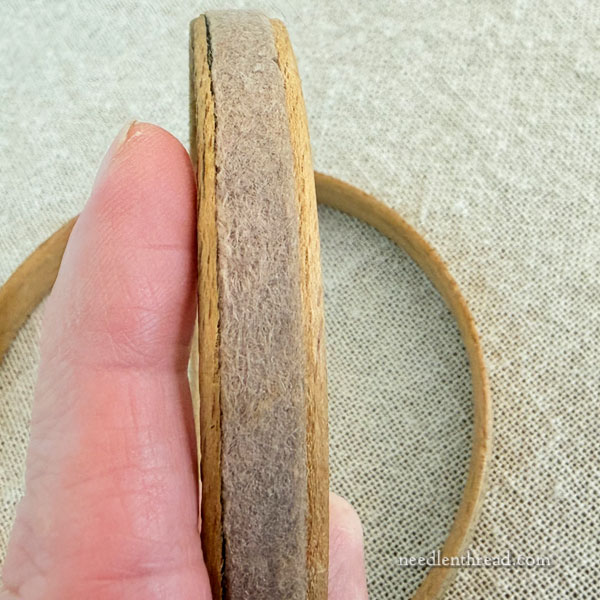
It just so happens that this particular little Duchess hoop I have has a really nice, intact felt strip. It’s obvious the hoop was used, but it was well cared for and it hasn’t suffered the deterioration that you sometimes see on these antiques.
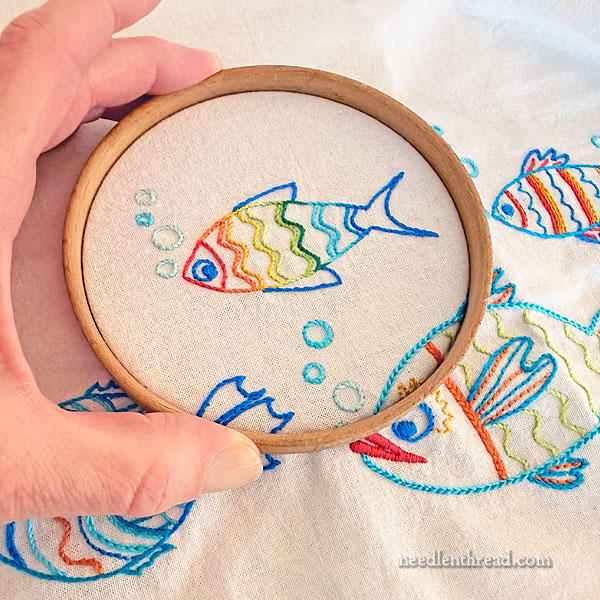
Looking at this hoop of antiquity (it is, after all, over 100 years old), two questions probably spring to mind:
1. Does it work?
and
2. If so, how well does it work?
To use a Duchess hoop, you set it up like any hoop. The inner ring goes down on the table, the fabric goes over the inner ring, and then you situate the top ring over the inner ring and fabric, and you push straight down.
You can further adjust the tension by going around the hoop and gently pulling the fabric.
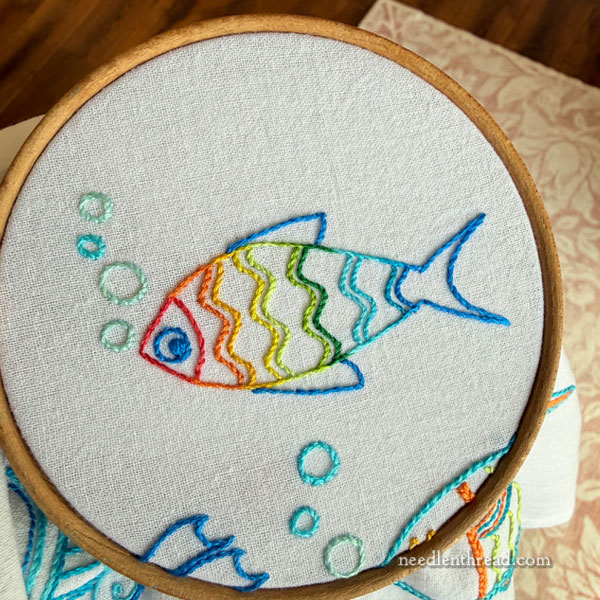
I’m demonstrating this with my Something Fishy towel set, so the fabric in the hoop is cotton toweling (flour sack toweling). It’s a high quality cotton toweling, so it’s somewhat thick and it has a nice firm weave.
It works quite well in this hoop – the fit is snug and it holds the fabric well.
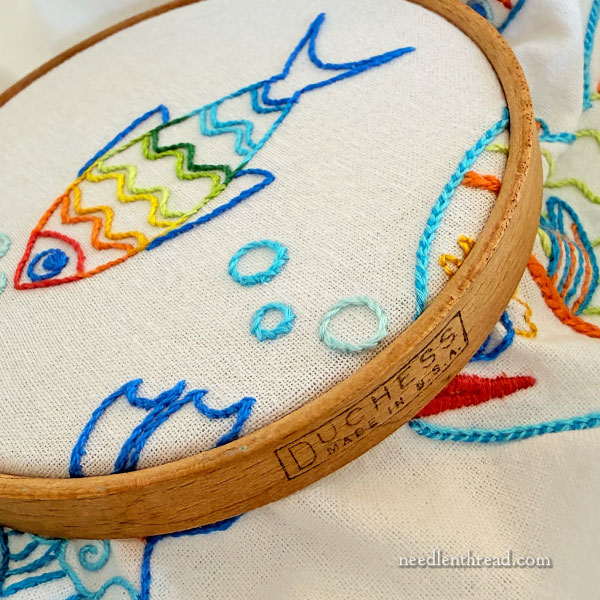
The hoop slips over the previously stitched areas, too, without apparent disruption. I would likely not leave it on the fabric between stitching sessions – but that holds true for any hoop.
So, yes, the hoop works. And it works pretty well!
BUT…
Does it Work as Well as the Hoops I Regularly Use?
Does it work as well as good-quality wooden hoops that we see today, that have solid brass, sturdy hardware, smooth wood, and close-fitting rings?
No.
Using the Duchess hoop, I find that I have to adjust the tension on the fabric more frequently while I’m stitching. For some folks, this is considered the norm when using a hoop – every now and then, they readjust their fabric as if it’s part of the process of stitching. Sometimes, depending on the tools you use, I guess it is.
When I use a hoop, the inner ring is always bound with cotton twill tape. I go through a two-step set-up process: I push the outer ring over the fabric that’s over the inner ring, tightening the hardware just slightly so I get a nice, even pull across the fabric, and then I tighten the fabric all around and tighten the hardware one more time using a screwdriver.
Rarely do I have to adjust my tension during a stitching session with this method. And yes, I have been known to leave a hoop in place between sessions, and I haven’t had to adjust the tension over multiple sessions, either.
With the Duchess hoop, I like the ease of its use. And I like the decent tension it supplies at first, but I don’t like having to adjust tension during a stitching session.
So… while I appreciate having a couple of these antique hoops because I love their history, they wouldn’t be my go-to for my stitching. I prefer today’s hoops (specifically, these) bound with cotton twill (specifically, this).
Besides, a new hoop and cotton twill are a heck of a lot more affordable than buying these antiques, some of which are pretty pricy! Apparently, they are Collected. The more you look for them online, the more the algorithms kick in, and the higher the prices go.
Are they worth those high prices? If you’re looking for a tool, I’d say no.
If you’re history-collecting, it depends on how avid a collector you are!
And that, my friends, is the Duchess hoop and my take on it. It’s a lovely little tool in the history of needlework, kind of cool to have, interesting in concept – and an ideal concept for finishing “hoop art” if you don’t want hardware on your hoop frame – and usable, but perhaps not as job-efficient as new hoops.
Mary, thanks for that little walk down embroidery history lane. It’s always interesting to me to hear about tools and supplies which (sadly, in most cases) simply can no longer be had. Considering this hoop as a practical matter, I can see the obvious advantage to NOT having hardware attached to your hoop because there is nothing upon which to catch your thread no matter at what angle you hold the hoop. However, having to constantly tighten the fabric in the hoop as you stitch is a definite down-side. I’ve become greatly spoiled by the wrapped Hardwicke Manor hoops which rarely require tightening during a stitching session, but I do find that my thread tends to find that hardware and wrap around it no matter how carefully I try to place the fabric in the hoop to keep the thread and hardware on opposite sides of my working area. Is it just me?
Hi Mary!
Yes, the duchess hoop has it defenders, its admirers and its……..shall we say detractors. When I was a girl…when dinosaurs roamed the earth…I used a set of duchess style hoops for all of my embroidery. The embroidery was usually pillow cases, tea towels and other sorts of useful linen. (toaster covers and such). I embroidered on American cotton. Ach! They were wonderful back then! Smooth regular durable……I digress. I loved my embroidery hoops one was about 7” and round and one was oblong 9” x 4” . I used that one less. I had a little bag of embroidery things that went everywhere with me. I became quite proficient. It was a happy thing. My hoops, as I mentioned in a previous note, were metal with a sturdy spring. The inside ring was lined with cork and yes I had to re-tension the fabric now and again but it broke the tension in my shoulders and neck and it gave me a chance to look.up for a moment. I have tried to use the hoops with the brass tensions and I keep getting the thread caught in the brass. I gave them up. In a recent domestic home renovation I found a few more blank linens. I think I will dust off my hoops and take them with me for appointments. It’s useful and a darned sight lighter than my iPad. Thanks for a wonderful trip down memory lane
Be well my friend
Margaret
I was so pleased to see your article on Duchess Hoops! I have a small collection and I just love them. I use them for all my cross stitch. I like a slightly looser tension so I can use the sewing method in a hoop and since they are a little looser they don’t mark the linen. I do have some they are very tight though and save those for when I do need a drum tight hold. I’ve found that each set is unique and I select the right one depending on the project and linen thickness. And some I do wrap with a few go ’rounds of twill tape to make them tighter if necessary. I love that they don’t have hardware, and the felt is gentle on my fabric. So thank you so much for highlighting one of my favorite stitching tools! It was nice to read up on their history!