


Have you seen DMC’s new fine-tipped, water-soluble embroidery transfer pen?
When it came out earlier this year, I grabbed a couple of them so that I could try them. I figured you might be curious about them and might want to know what they’re like.
So today, we’ll take a look at this new transfer pen and chat about it.
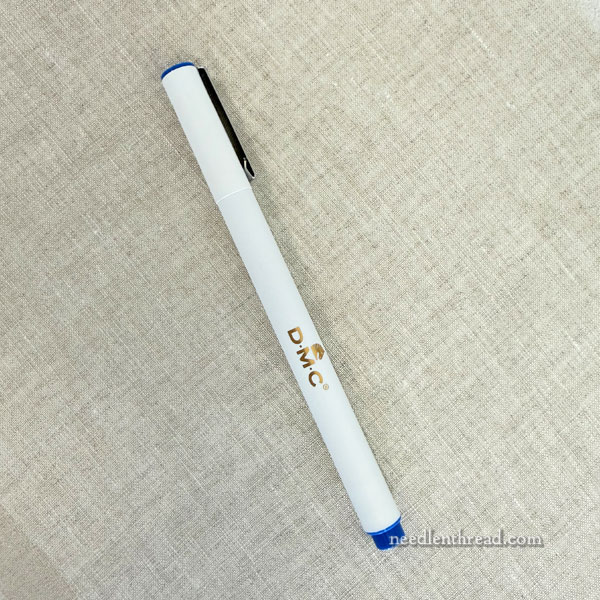
That’s a nice looking little pen, isn’t it?
And it is nice-feeling, too. It might sound weird, but I like to “feel” a pen – to see how it feels in the hand, what the barrel feels like and whatnot. Of course, this applies mostly to writing pens, not transfer tools!
But this little transfer pen does have a quality feel to it, and it looks nice.
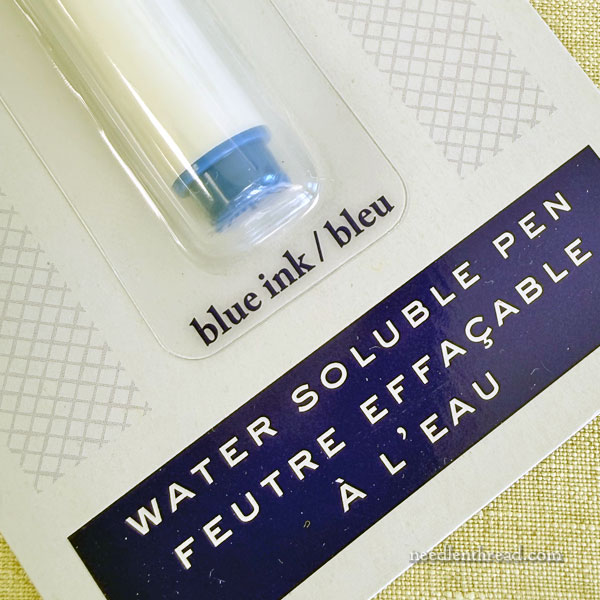
It is a water-soluble transfer pen.
As such, it has pros and cons, which we will talk about below.
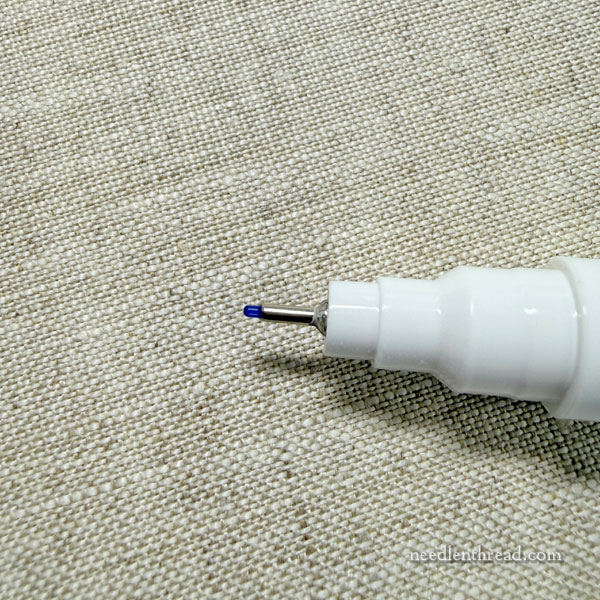
In my mind, the primary focus the tool is the tip of the pen.
This is a fine tipped pen (0.4mm). It does not create a thick line. And this point (excuse the pun) bears keeping in mind when we discuss pros and cons of water soluble pens, below.
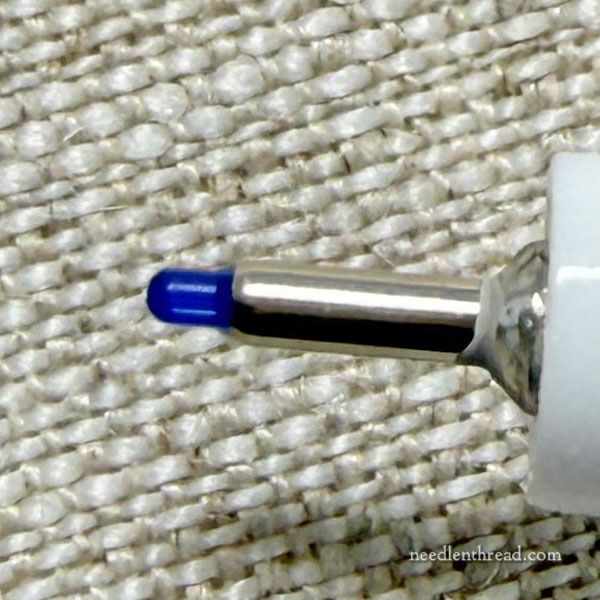
It has a precise, hard tip, not a brush-type tip or a softer marker-type tip, which goes a long way to keep the transfer lines fine.
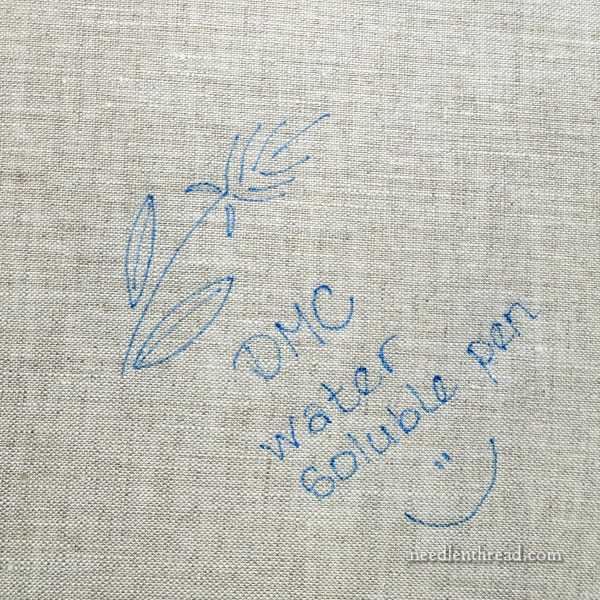
It’s pretty easy to write with on fabric. I’m using a high count linen here, with a smooth surface. There is a little “pull” on the surface – just a tad bit of that friction you expect when using a pen on fabric – but nothing really noticeable or troubling. It writes well.
The pen writes best at a slow and steady pace. If you go too slow with it, or hesitate with the tip on the fabric, the line may darken more than you’d prefer.
I found if I moved at a slow and steady pace, I got a very nice line from it. If I tried to write fast with it, the line was much fainter and a little skippy – not skipping badly, but the ink just doesn’t have a chance to “pull” into the fabric if I tried to write fast.
If I hesitated and held the pen in one place, there was some heavier ink-pull between the fabric and pen, causing the ink to be much darker, to feather a little more, and, if left in one spot, it could create an undesirable drain on the pen’s ink.
The answer, then, is a slow but steady movement with the pen, and it will wright just right.
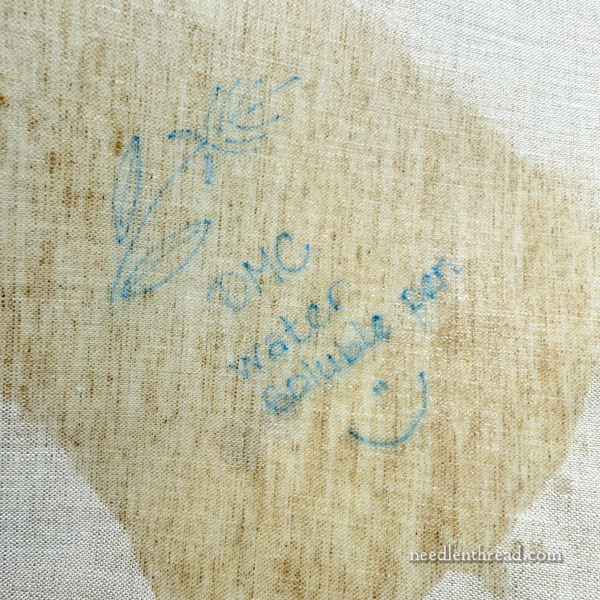
Now, the thing about a water-soluble transfer pen is that the ink disappears with the application of water.
And to that end, I applied water.
This was just a quick splash – I didn’t expect it to disappear right at the time of applying water like this. I dropped the fabric in a bowl of cool water and got busy on other things.
Eventually, I remembered the fabric, took it out of the water, and laid it on a towel to air dry. At a glance, the ink was gone, as I expected.
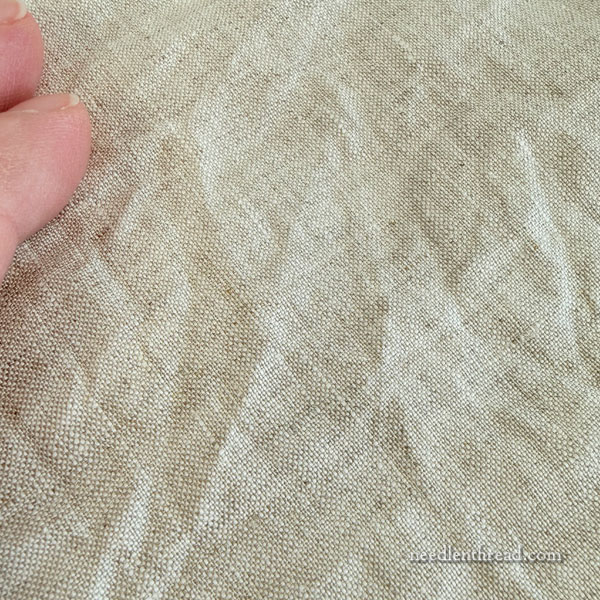
Here’s the dry fabric, and for all practical, visible purposes, the ink is gone.
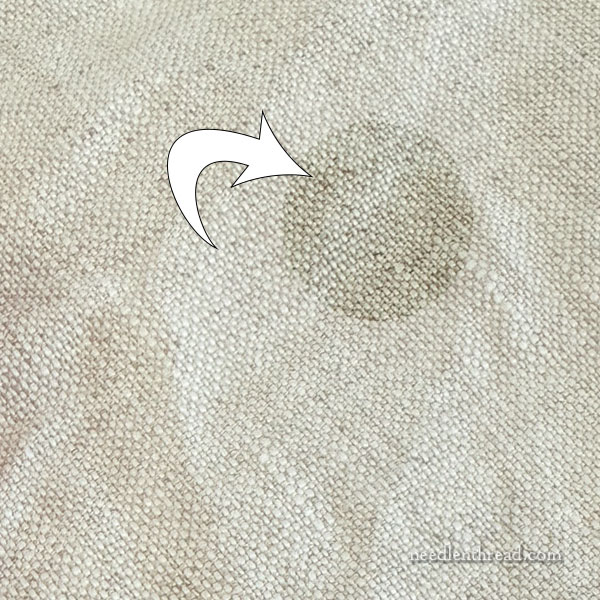
It’s not entirely gone, in fact, but gone enough for most purposes. You can see in the circled area above the vestiges of the “C” of DMC.
Still, for all practical purposes, I think we can say that the ink certainly “disappeared.”
Pros and Cons
The pros of this pen are several:
1. The fine line and ease of use.
2. The line disappears with water.
But there are cons of all water-soluble transfer pens:
1. Although the line disappears, the ink itself is not necessarily gone from the fabric. Over time, “ghosting” can appear on the fabric from the water-soluble ink. That is, the design line reappears slightly, usually in a kind of very light brownish-tinted line.
For this reason, I’m not generally a huge fan of water-soluble, heat-soluble, and air-soluble transfer pens. The fact that they can all leave ghosting, or that their lines can re-appear, indicates that the ink or the chemical compounds in the ink don’t really leave the fabric. But still, these pens have their uses and I can see why they appeal. While I wouldn’t use them for some of my projects, I might use them for more casual embroidery projects.
2. The thread and fabric you’re using must be colorfast in water. Never use a water-soluble transfer pen with fabric or thread that is not certainly colorfast.
The Advantage of the Fine Tip
When considering the cons of water soluble transfer pens, I think we can safely say that fine-tipped pens like this one counter the visibility problem with “ghosting” for the most part.
Because the tip is so fine, it is easy to cover the ink line completely with embroidery, so that it would be less likely that any “ghosting” would be evident if the line re-appeared with faint ghosting over time.
Longevity
One consideration with any type of ink pen used for transferring is how long the pen lasts. Just how many uses can you get out of one transfer pen?
It’s important to note that, besides the ink usage, other things may affect the longevity of this type of transfer pen: age, environment, storage. Pens like this tend to last longer if they are stored flat. They probably should be stored away from light and heat, and it makes sense that they’d probably last longer in a dry (non-humid) environment.
How long does this particular pen last?
That, I cannot tell you. I would have to “use it up” and gauge how much I wrote, how long it was stored, and so forth.
I would imagine that, if you are doing a lot of smaller projects over a relatively short period of time (not years, more like months), you could likely get good use out of this pen. And for the cost (they’re around $6), it would be a relatively cost-efficient way to achieve your design transfers.
Where to Find It
According to the folks at DMC, this particular pen is not priced for wholesale distribution, so your best bet is to order it directly from DMC’s retail website. There may be other retailers who carry it, but I haven’t come across any. No affiliation – just letting you know where it’s available in the US if you’re interested in acquiring one.
Drat — it looks like DMC has already sold out of this pen. I was hoping to try it out for marking quilting designs, as the other blue water soluble fabric markers I’ve tried have such fat tips and make thick lines that aren’t really suitable for precision of marking designs like grids or evenly spaced lines.
I have always just used graphite pencil or fine tip permanent pigment ink pens. I’m going to stitch over the lines and if any show that’s okay, they are provenance of my process. You can sometimes see pencil lines in watercolor paintings. No one is stressing over that.