

The buttonhole stitch (which is actually the blanket stitch, technically, but both terms are used interchangeably today) is used in many types of hand embroidery – general surface embroidery, crazy quilting, whitework and cutwork, Mountmellick embroidery, needle lace, filet work – you name it, buttonhole stitch fits in somehow.
It’s a super versatile stitch, and once you have the basic stitch down, it’s just a matter of applying it in a variety of ways.
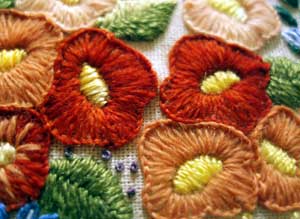
The length and pattern of the stitch can change, according to what you want to do with it. You can use the buttonhole stitch effectively to create filled flowers and leaves, by spacing the stitches very close together.
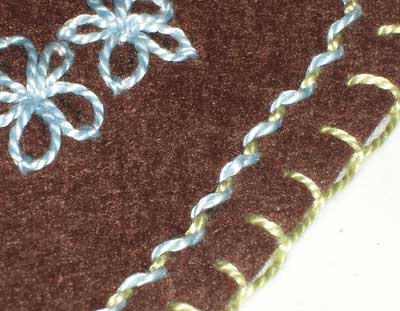
The stitch can also be used to edge raw blanket fabric or felt, as in the photo above.
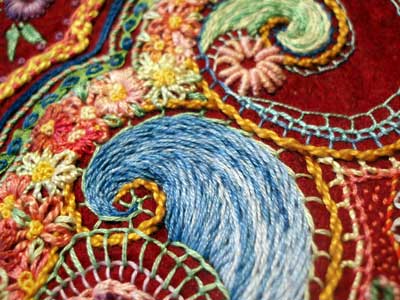
In the photo above, all those open, “spiky” lines are created with buttonhole stitch.
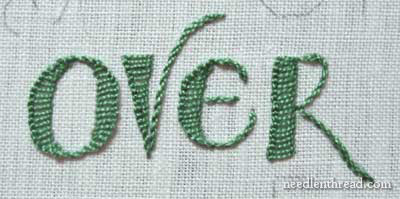
And in this photo above, you can see that buttonhole stitch can be used effectively for lettering. Here, it’s combined with stem stitch to create some embroidered text.
Here’s the video:
If you’re looking for more embroidery stitch instruction, you’ll can find many more hand embroidery stitch videos right here on Needle ‘n Thread!
Looking for inspiration & information on hand embroidery?
There are all kinds of reasons to sign up for the Needle ‘n Thread daily newsletter! Check them out and sign up today!
If you like what you see on Needle ’n Thread, if you want to be a part of keeping the website thriving (and free of annoying network advertising), why not become a patron on Patreon? Check out my Patreon page here, where I’ll occasionally add special needlework bonuses for patrons.
If you shop on Amazon, you can support Needle ’n Thread without any extra expense to you by visiting my Amazon Recommendations page here, where you’ll find books and sundries for the needleworker available on Amazon.
Hi, Laren –
Thanks for the tip on the name of the stitch. The buttonhole stitch has an extra little loop at the top that definitely makes a sturdier ridge. I use the “real” buttonhole stitch often in certain pieces of cutwork that I want to be extra-sturdy. In my illustrated buttonhole stitch, I went into the difference a little bit. Mostly, people associate blanket stitch with buttonhole stitch, and many books illustrate them as the “same” thing, unless they also add what is called the tailor’s buttonhole.
Thanks again for the tip!
Hi There,
Two things, firstly, I LOVE the videos, a great help for any embroiderer.
Second, you’ve titled this video Blankt/Buttonhole Stitch. These are two different stitches. What you are demonstrating is blanket stitch, but buttonhole is done slightly differently, and in many ways is a much stronger stitch than blanket stitch. The reason I point it out is that I use the true buttonhole for doing eyelets on bags, and they are much more robust and last alot longer tan just the closely placed blanket stitch.
Cheers,
Laren
Wow, what a great tutorial! Very helpful when learning to make a buttonhole stitch!
Bev
OMG! Thank you so much for the video on the blanket stitch, I have tried frustratingly to use this stitch time and again and your tutorial was so easy, I completed an appliqued block for my quilt this evening. Thank you so much for doing this for all of us that are just learning to embroider! I appreciate you very much!
hello mary, love your videos! thank you so much for them.
I am having terrible trouble doing the Blanket Stitch around corners, i just can't get it right.
Please could you help?
Do you have that in any of your videos?
thank you so much 😀
For corners, I think I'd end the stitch on the one line, the start on the other, with a 90 degree angle for the lines and a 90 degree angle where you stop and then start, if that makes sense. You would work the last line a stitch length away from the end of the line your stitching. I'll see if I can demonstrate it in a photo tutorial for you – but it'll be a bit before I can get that done!
thank you so much mary for that!
i'll keep an eye out 😀
really grateful
x
hola
excelente trabajo amiga las puntadas estan super bonitas, gracias y saludos.
Thank you so much for this video tutorial! I was searching for how to do this, and your guidance is just perfect. Thank you.
Hi Mary,
Thanks your videos are a great help. I cant do it well like you but I wish I could sew better.To be Honest i am a very very poor artist.
You rock MARY .. I just wish i were you
Es lo que estaba buscando, he tardado unos años en encontrarlo. Muchas gracias.
Un abrazo,
Carmen
It would be helpful to have instructions on how to start when the interlocked side of the stitch is on the edge of the fabric.
Is there a Video showing how to turn a corner using the blanket stitch?
I keep reading that buttonhole and blanket are actually not the same, and it does seem that there are a couple of different ways to do this, so that there is one way where the knot is more complex than in simple blanket stitch, where you just catch the thread and make that ‘L’ part of the stitch. So in blanket, yes, you catch the thread, but in buttonhole you actually tie a little knot there. I can’t say that I’ve actually conquered this version of the buttonhole stitch, but I’m trying. If you watch videos of tailors doing it, they pass the thread over the needle an extra time, it seems…
Hi, Ellen – you’re right, in the tailor’s buttonhole, you catch the thread and make an extra loop and knot before moving forward to the next stitch. Blanket and buttonhole, though, have become synonymous in most instructional books these days (and even as far back as the first half of the 1900’s). To distinguish between the two now, you’ll find the knotted version listed as tailor’s buttonhole.
Hi, I have some questions regarding the blanket stitch that you used as an embroidery stitch. Can you please let me know which thread you used in the video is that perle cotton? To edge the blankets this stitch is also used in that case how we make the stitch please let me know and to edge the blankets which thread is perfect to use, or of the normal cotton embroidery floss or the perle cotton are used for this? Waiting for kind reply.:-)
I’m using pearl cotton in the video. If you’re edging a blanket, it makes a good thread for that, too!
Thanks for the great help :-), how to make the blanket stitch on the blanket edges , have you uploaded any video for this? Or you can upload some pictures to show, or you briefly explain it? I have some confusion if it requires the same method that is used for blanket stitch in embroidery?
Hi Mary, when doing blanket stitch on edges, is the same method applied? On many websites they stab the whole needle back of the fabric when making this stitch on edges, is that correct method? Please let me know.:-)
Either way works!
i have watched and learned from your tutorials and wish to thank you for many hours of stitching
Es muy bonito los trabajos que han realizado los videos me sirven de mucho les agradesco por compartir bendiciones desde madrid
Thank you, Ana Maria – I am glad they are helpful!
Thanks for the video on the blanket stitch. I was looking for a small, simple stitch to do knee socks on a very small doll pattern. The blanket stitch will be perfect I think!
What would I do without you? Thank you for your wonderful videos and website!
Would you please explain and or show more on needle lace. I would like to add on to sleeves on bishops dresses.
Thank You in Advance,
Rae Magin
I need to know how to join a new thread when working blanket stitch. Do you have a tutorial for this?
Hi, Fran – I don’t have a tutorial for joining a new thread for blanket stitch, but I have a similar discussion for chain stitch, and the same concepts can be applied. I generally use a small stitch to end the buttonhole (just over the loop) and start the new thread inside that same loop, over the little holding stitch. You can’t really see it – the new loop covers the tiny anchor stitch. Here’s a similar discussion about chain stitch: https://needlenthread.wpengine.com/2010/10/chain-stitch-switch-adding-a-new-thread.html
Buttonhole Stitch – Punto Smerlo.
Once again your video has been such a help. I was trying to follow a set of instructions and it just wasn’t sinking in. After checking lots of my embroidery books I thought why not just go visit Mary’s video. Tada!
Thank you so much.
Eva
Mary – I’m surprised at you! You’re calling the buttonhole and basket stitch the same thing and they are not. The buttonhole stitch was used to make buttonholes and leave a little knot on the edge. The blanket is an “L” connected to the next “L”. Please show the difference to n your stitches.
Sorry – that should have been ‘blanket’ not ‘basket’ stitch.
Hi, Beverly – yes, there’s a distinction between the tailor’s buttonhole these days and just buttonhole. What I’ve shown here is the common instruction for what’s called the bunttonhole stitch these days, and found most frequently as buttonhole in instructional books. Tailor’s buttonhole, with the extra knot on the edge, is not so commonly used anymore. This is the basic buttonhole that’s used as the foundation for all the buttonhole variations. Some folks make a distinction in the spacing of the stitch – if the stitch is spaced farther apart, its blanket stitch, if it’s close together, it’s buttonhole, but for the basic buttonhole, they’re the same movement. Other folks make the distinction that blanket stitch is only blanket stitch when it’s worked over the edge. So lots of interpretations for a basic stitch!
Thank you.
Your directions helped a lot.
Now l can do a proper stitch.
Well Mary I think I am too old now to bothered to change names of stitches. When I started to long to remember. There was blanket stitch, 1. Blanket stitch. 2 Blanket stitch long and short. 3. was the edges were first tuned down and a running stitch was
stitched to make a small hem this was then ended with the normal blanket stitch or the up and down.
Buttonhole was to bind a hole that was used regularly to push a button through. Be it wood, metal, shell and these days plastics. This stitch was very close together and had a oversew type of knot at the edge of the buttonhole inside edge. The thread was usually waxed linen or heavier cotton. Tailors love it as it gives a beautiful flat finish to a hole for a suit coat, vest or overcoat. It takes the wear. Buttonholes are not always just a slash in the fabric, they can have a tiny hole with a tail opening, O—— this allowed the button to be sewn on with heavy thread and sit nice and flat on the coat.
So for me saying a blanket and a buttonhole stitch denotes two different uses for a similar stitch. I think as we go on with our stitching we learn that the blanket stitch can have many decorative variations. AND the buttonhole denotes that the fabric hole is up for a bit of hard work.
I have seen the buttonhole (tailors’) sewn on leather gloves, button up shoes. also on fine silk.
There is also the reinforced button hole (I—–I). Usually not for the fuller figure.
So Mary after that longwinded blow out.
Button hole and blanket are different as they serve a different purposes.
Thanks a heap for your wonderful informative pages.
Best wishes to you an all.
MM – Australia.
What a wonderful teacher you are! Thank you.
Help! I have started a felt Scandinavian Christmas ornament. But I am at a stand still because I am no longer at the craft workshop that I started this project at on vacation. This is my first time ever embroidering. How do you reconnect to the blanket stitch when you have to add more thread? Also how do you sew in a ribbon to hang with hand stitching? And how do you close it up once stuffed without seeing the ending floss?
How do I turn the corner using blanket stitch on even weave fabric? I’m actually using Antwerp blanket stitch to finish my Laguana fabric sides, and got to the corner and realized I didn’t know what to do. Many of the tutorials use felt.
Mary, I really enjoy your website. It’s been a while since I have done handwork, I am mostly sewing doll clothes on machine. Recently, my new granddaughter-n-law has asked for some sofa pillows with embroidery on them! I have obligated myself & hope I am up to this task! Thankfully your videos & wonderful examples should give me the confidence I need to accomplish this gift! Thank you, Paula
I’m sure you’re up to it, Paula! Sounds like a great project – it’s always fun to do handwork with a goal! 🙂
Thank you for sharing! This video made me realize I was completely overthinking how to do this stitch