


The ribbed spider web stitch creates an isolated element on the surface of your embroidery. The ribbed spider web has a lot of nice texture to it, and it’s a lot of fun to work! It can be worked in any type of thread – it looks great in thicker, chunky threads like perle cotton, but also works equally as well with stranded floss.
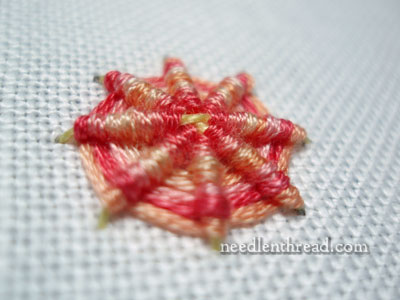
In the sample above, I worked the ribbed spider web with a perle cotton for the spokes (in yellow) and a variegated cotton floss for the wraps, using three strands of floss.
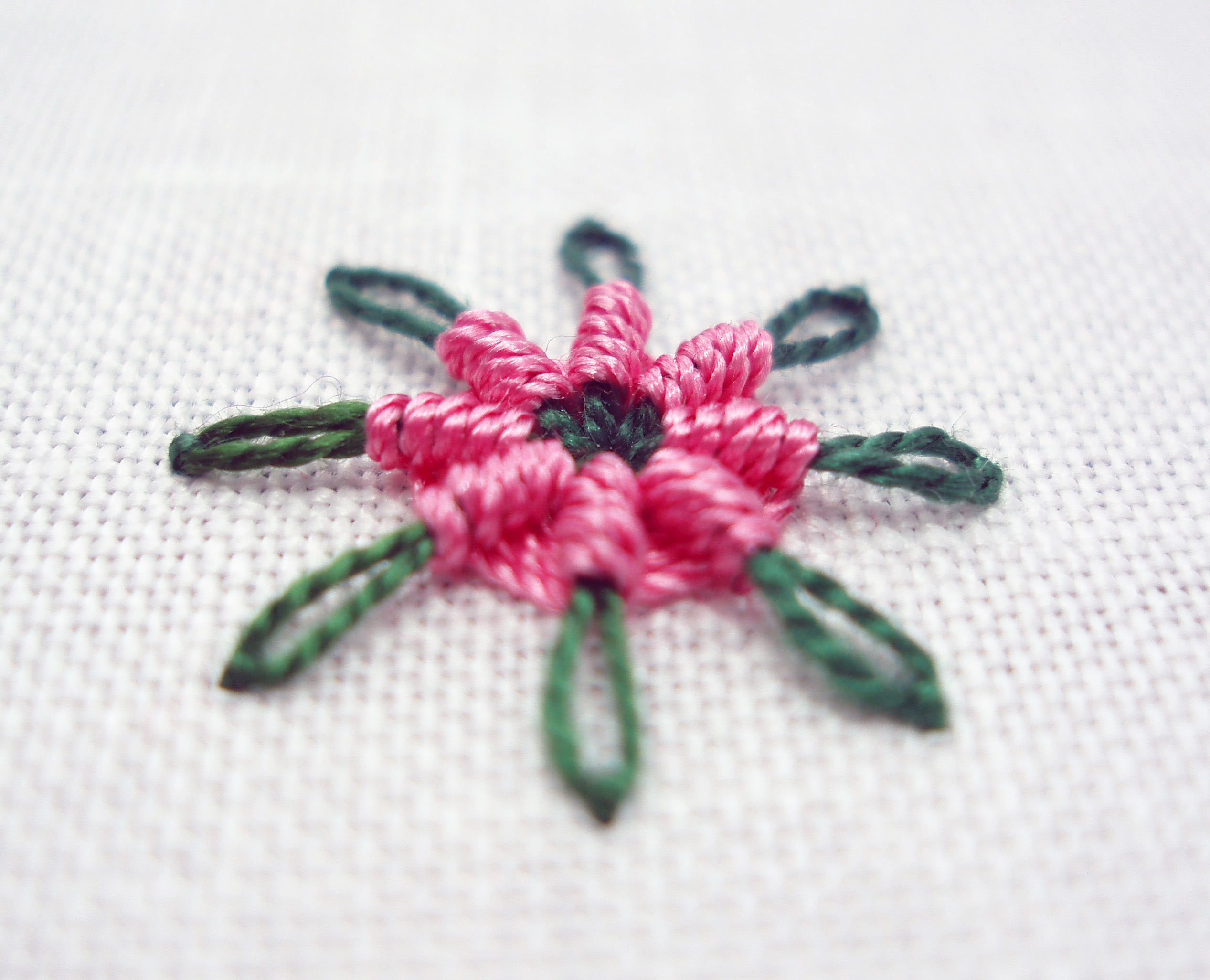
In this sample (worked in perle cotton), instead of using straight stitch for the spokes, I used detached chain stitch (daisy stitch) for the spokes, and left then half-way exposed. You can see this sample worked up step-by-step in this article in the Stitch Play series.
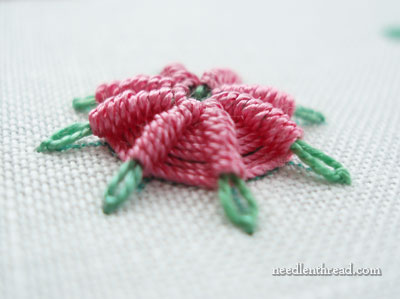
You can also pad underneath the spider web stitch to raise it up a bit, if you want a little more height to the stitch.
The ribbed spider web is a whole lot of fun to work, and is a great stitch to add to your embroidery repertoire! Here’s the video below. I hope you enjoy the stitch as much as I do!
Check out my collection of hand embroidery stitch how-to videos here on Needle ‘n Thread for further embroidery stitch instruction!
Looking for inspiration & information on hand embroidery?
There are all kinds of reasons to sign up for the Needle ‘n Thread daily newsletter! Check them out and sign up today!
If you like what you see on Needle ’n Thread, if you want to be a part of keeping the website thriving (and free of annoying network advertising), why not become a patron on Patreon? Check out my Patreon page here, where I’ll occasionally add special needlework bonuses for patrons.
If you shop on Amazon, you can support Needle ’n Thread without any extra expense to you by visiting my Amazon Recommendations page here, where you’ll find books and sundries for the needleworker available on Amazon.
Mary,
I would like to thank you for your generosity.
The video library of stitches that you build is a precious resource for people like me (a beginner) and I apreciate it a lot, but I cannot wait to see the bullion stitch tutorial (I have not mastered that yet!).
Have a great weekend!
Thank you,
Virgi.
franchement le video est tres util merci beaucoups
Hi, Virginia! Thank you, I’m very glad you find the video tutorials helpful! It makes them worthwile to keep going on them!
I do have the bullion tutorial “in the works” – I’ve actually filmed it twice. When I’ve reviewed it, I’ve found that you see more fingers than threadwork! So I’m trying to remedy that. It’s especially important, I think, with the bullion stitch to see the whole process, because it can be an intimidating stitch. It took me forever to master it – and I used to simply avoid it altogether – until my sister took me through it a few times.
So, never fear – it’s coming! Keep an eye out!
Its extremely good.
Thank u for ur generosity and the effort that u took!
Wow… your video is really really helpful for me to understand how to make this spider web a cute one. I can understand it in just under 5 minutes, thanks to your effort of making this video… I’m a beginner who find your instructions in the video really easy to follow… Thanks a lot Marry … now I can try it on my shirt ….
Hi, I was wondering if I could download the needlework intruction videos.
It’s very frustrating to watch online as even though I have a broadband connection, the videos keep pausing and I can’t follow it properly.
Thanks for your great site, if only the internet was foolproof but it’s not!
Many thanks for your wonderful lclear and concise instructions on how to execute the Spider Stitch. I am in the middle of a difficult piece of needlework and the instructions called for Spider stitch around the spokes!!! I was very depressed as I did not even know what this was!! I was thrilled to find your site and thanks again for your generosity in sharing your expertise with me.
I was wondering for the spiderweb what type of thread are you using. I used very thin thread and I didnt like the way it came out. I was just wondering what thickness you used.
Hi,
I’m using a #5 perle cotton (DMC). Perle cotton is great for these types of textured stitches.
If you’re using stranded cotton, you’ll probably want to use at least 3 or 4 strands together to get decent results.
Hope that helps!
MC
Thank you so very much for this wonderful site. I'm new at embroidery and the book I have is not always clear on different stitches. I just watched the "spider web" stitch and now I understand how to do it.
I will be back often!!
i luv dis site . it has been very helpful to me . it has solved my biggest problem .
thanx mary cobet
Is it necessary to do in 9 spokes can we do it in 8 spokes?
Thanks for the video its really helpful..
You can do this stitch with either an odd or even number of spokes – so, yes, you can use 8 spokes…
Mary, It’s high time I took a moment to let you know how much I appreciate your willingness to share your knowledge with anyone who wants to learn. Your videos make understanding stitches I simply couldn’t wrap my brain around a breeze. Thank you from the bottom of my heart.
Judy in MS
MERCI POUR LA VIDEO C SUPER BIEN EXPLIQUER
hi mary,i would like to thank you so much for these videos they are excellent and very useful.am a beginner in embroidery and you are like a teacher for me
thank you dear
love ya
namitha
Thank you^^
Thank you for sharing. After many years, I have discovered embroidery again and am realizing what fun it is to do. Using different size hoops, I have embroidered several simple pieces to give as gifts. Your short concise videos have been wonderful as I am a visual learner. And have even learn to incorporate more design and texture into my work with all the stitches you’ve presented. Here, summer is coming and now I can relax in my garden listen to the birds chirp and the waterfall splash into our Koi pond and embroider away to my heart’s content. Thank you.
vraiment je suis trés touchéé par votre generosité et votre sens du partage.vous étes unique of your kind et peu de personne sont comme vous qui veulent partager ce qu’il ont de particulier
merci beaucoup
god bless you
vraiment je suis trés touchéé par votre generosité et votre sens du partage.vous étes unique of your kind et peu de personne sont comme vous qui veulent partager ce qu’ils ont de particulier
merci beaucou
This is a very good stitch
Hello! I was one of the Tapestry of Scotland stitchers! I am now sewing the Thistle panel on my own, and have a question. The suggested stitch for the stem of the thistle is ‘Spiders Web in 3 Directions.’ I can’t figure this out! Could you explain how to do Spiders Web NOT in a wheel shape, but in three different directions, please?
Many thanks!
Excelentes videos !!! Muchas gracias por sus enseñanzas.
I love this stitch – I will have to find something to practice it on. It does not hurt that my formal name is Michele as you showed it on a stylized M and my nickname is “Shell”
I was having so much trouble with the bullion stitch as I am a beginner and it looks difficult. So I looked up an easy stitch to substitute the bullion and your ribbed spider stitch come up! It was great! I will someday conquer the bullion but I enjoy doing the ribbed spider and it looks great. Thank You!