
I’ve been stitching a second (or is it third?) approach to a small blackberry project that I’ll be releasing here on Needle ‘n Thread as a stitch-along this summer.
With this project, I wanted to use a natural colored linen, because I’m including some blossoms that are very light, and they will show up better against a natural background as opposed to a white background. I also like the look of this type of design (only slightly stylized, a bit “loose” and natural) on natural colored linen. It works.
The linen I’m using is not high count – it’s a 32/33 thread count weave (so not perfectly “even weave”) – but the weave is fairly full. The linen threads fill up the fabric surface pretty well, so you don’t have that airy, separated-weave look that you’ll often find in some linens made for counted work.
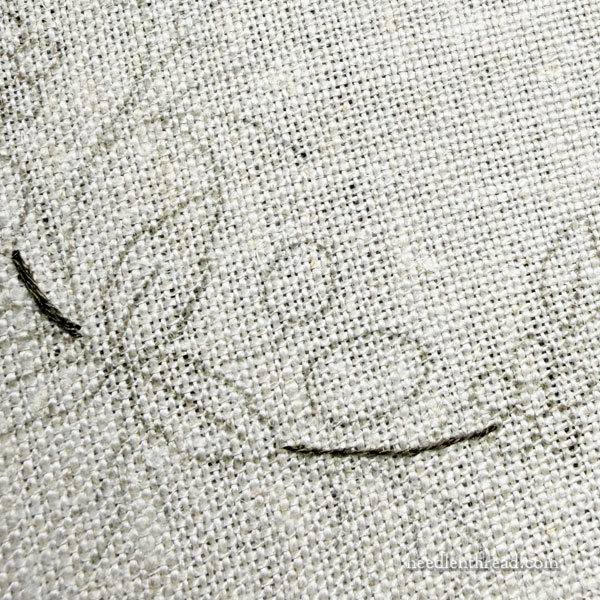
Still, the nature of this particular linen is a little “rougher” than higher count, finer weave, smoother-handed fabric.
And this poses a little bit of a problem with design transfer.
It is more difficult to transfer tiny details of a design onto this type of weave, and then, when you’re stitching under a good light, to actually clearly see your design lines.
So, I solve the tiny detail problem in a very specific way.
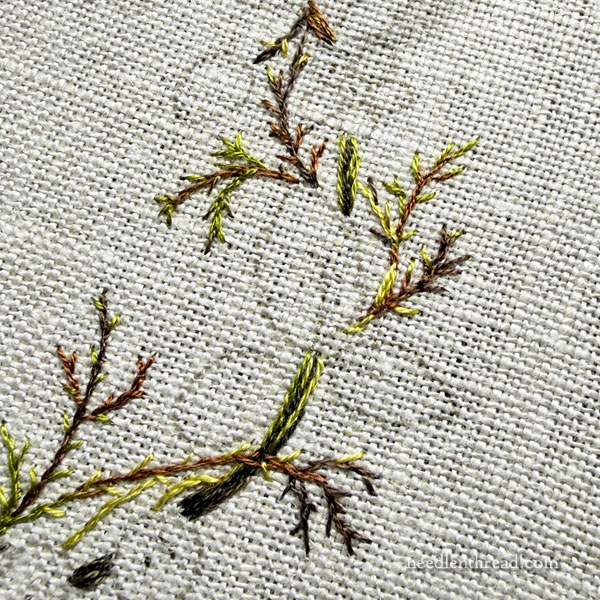
With this project, I’m starting with the “foundation” of the design, which is the twigs, vines, brambles – whatever you want to call them.
I wanted something quite dark as a foundation, so I’m working with a very dark grayish-brown. And to stitch the thickest part of the vine, I started with a very sketchy split stitch (using one strand of floss), next to which I added more lines of sketchy split stitch until the foundation vine achieved the thickness I wanted.
There’s no formula to this type of sketchy stitching. You just put in the stitches until you get a look that you are happy with.
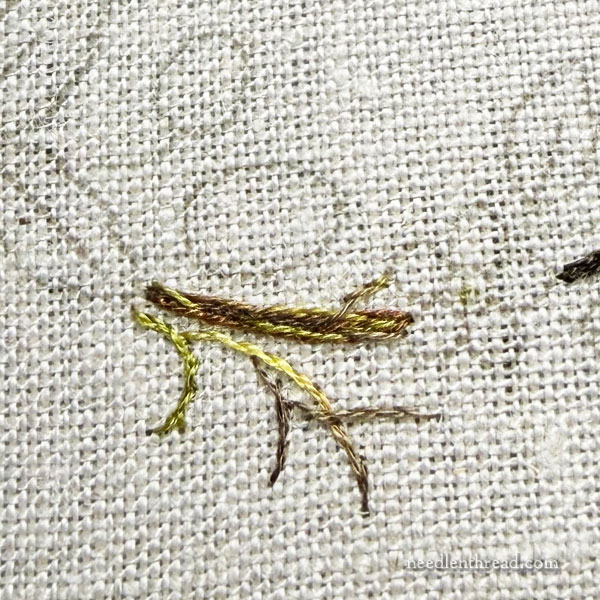
Onto the dark brown, I wanted to add some variation of brown and green, and the best way to do this for my purposes is with a variegated thread.
Again, no formula: no “this-color-goes-right-here” approach! Instead, the randomness (or seeming randomness) of the variegated thread dictates where the color changes happen. And that’s exactly what I want.
Some of the smaller twigs benefited from a more structured stem stitch, while others worked out in a fine and sketchy split stitch line. I found myself randomly switching between stem and split stitch, as the need struck, depending on what I wanted a line to look like. Did I want it tighter, more structured? I went with stem. Did I want it angular, split, sketchy? I went with split.
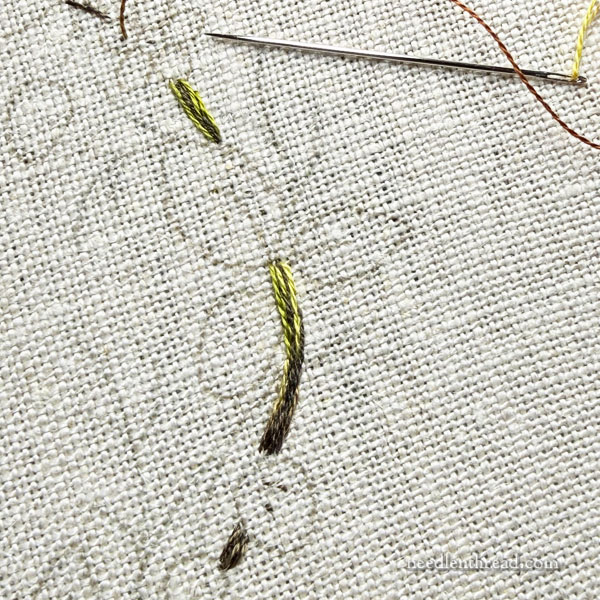
Even as I added some highlights of color to the “foundation” vine, it was really just a matter of a long stitch or two here using the variegated thread to put in a bit of color.
No, it doesn’t look meticulously “shaded” – it’s not supposed to.
When you zoom out from this close-up view, you end up with a mottled branchy sort of vine, which is what I’m going for.
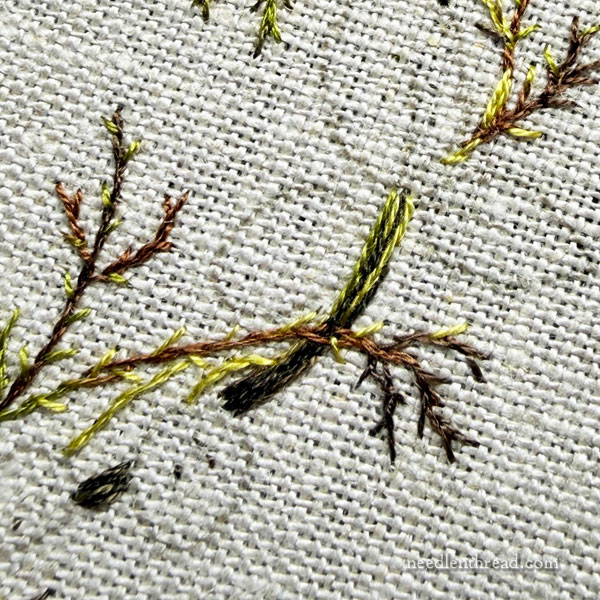
When it comes to the little prickly bits, they would get Utterly Lost on the linen by the time the “foundation” lines were stitched. You wouldn’t be able to see them, if you were trying to cover them on the design.
Little bits like this are completely free-handed. They’re just tiny straight stitches worked here and there, randomly, judiciously, haphazardly – however they work out! – to give you a prickly, brambly look to your twiggy things.
Even if I were stitching on a perfectly smooth, high-count linen – or even, say, something like a Kona cotton, which is very smooth and very receptive of design details – I would never include this kind of detail in my design transfer for this type of design. It’s not necessary, and it is, in a sense, too restrictive, because they would have to be covered, even if you didn’t want a prickle Right There.
But certainly, on this type of weave, which is much more hearty than the weave of super high-count, super-smooth fabrics, you wouldn’t even be able to see that kind of tiny detail. So you wing it!
And you know what?
It’s FUN! There’s a lot to be said for this kind of freedom and randomness with this type of design. Coupled with the variations supplied by the thread, it’s delightful to watch how it all turns out.
So, that’s early progress on this project. It’s come further since I’ve stitches this part of it, but the foundation was the first hurdle. I wasn’t 100% sure how I wanted to approach it, and after a couple test runs, I decided to get loose.
And that’s when I finally liked it.
In Other News
We resume shipping tomorrow. Thanks for your patience on that! Anna gets home from their vacation this evening, so she’ll be back on the shipping floor tomorrow. And at some point, I’ll be back in the studio for morning work sessions. (I miss Studio Life! It’s always so varied and exciting!)
We have just a few more copies of Volume 7 of the Handpicked Collection. You can read my review of the book here, if you haven’t seen it yet. We’ll re-stock this book if possible. They do tend to sell out of their print runs on these volumes, but I’ll try to keep it in stock as long as it’s available in print.
I have another fabulous book to review for you. It’s not something I’m carrying in the shop, because it’s available through the wider book markets and easy enough to get. It’s a fascinating book – I read it from cover to cover, and I think you’ll like it, too.
Next week, I’m going to show you our new thread organization approach. It works so well! Finally, I can find threads fast. I can easily see what threads we have or don’t have, so that I can keep my color choices up to date.
More to come, more to come!
Hope your week is going well!
As a devoted fly-by-the-seat-of-my-pants-er, I totally get this. I have only bought a few kits in my life, because I do love them, and do want to do them. But there they sit, year after year, while I keep pursuing my own designs which always include a great deal of flying by the seat of my pants as I go along. Sigh….But happy to see you do this as well when it presents itself as the way to go.
Linda
Cannot wait for this project!!