
I’ve recently acquired some new threads to play with.
I know. It’s a tough job, always having a reason to “play” with embroidery thread!
Soon, I’ll review the threads in depth, but since I haven’t actually stitched with them and tested their performance and resilience, today, I’m just going to show you the threads in general (no names, branding or anything) and share some first impressions – and some reasons why I think I might want to explore using them in some projects and kits.
I’m afraid I did the same thing to you a few weeks ago, showcasing this new collection of embroidery ground fabrics. This is the same approach with threads – a little eye candy, without much real substance.
Well, that’s candy for you! All sugar, no substance…
But who doesn’t like a little sugar now and then?
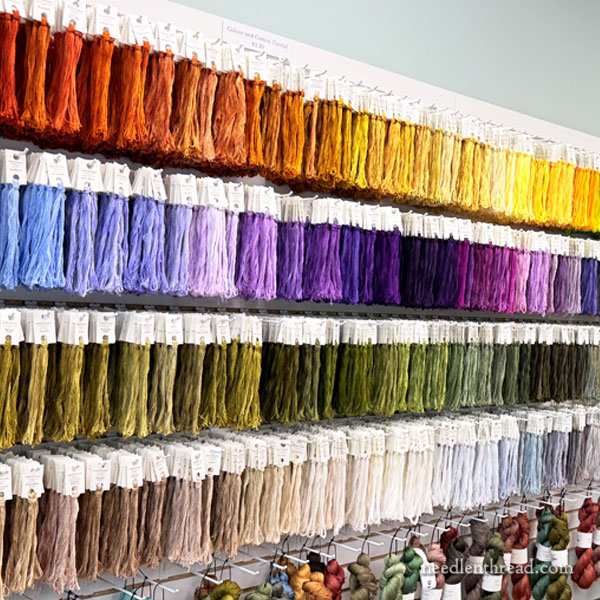
You see, I had occasion to visit an embroidery business that dyes their own threads, which they sell in a vast array of colors. These threads are overdyed – they have subtle (and sometimes not so subtle) variations in colors.
My first thought when I saw the thread wall before me upon entering the building was Good Golly! That’s a LOT of color!
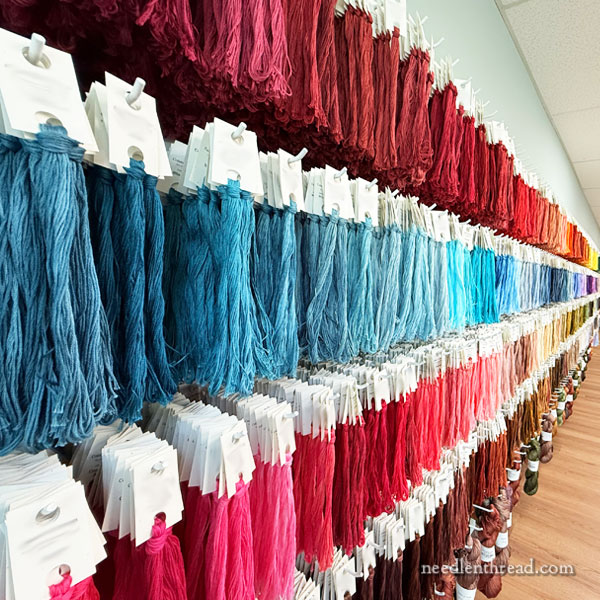
First, I just walked along the wall to take in the quantity visually.
I knew I would purchase some of the colors to take home and test, but in fact, I didn’t have a plan on how to approach that. I wasn’t expecting such a wide array of colors, with all kinds of shades and nuances.
Without a plan, there was nothing for it: I had to let whatever struck my fancy rule my choices. I regret now that I did not pause longer over certain color families and make more judicious – and extensive – choices. But more on that below.
I am always drawn to reds, and oh, the array! Here, it was a matter of picking colors that caught my eye first, followed by making choices within those colors based on the names.
I know it’s not a very scientific way to choose color, but that’s all I had to go by – the color of the thread and the name of the thread. I had to use something to narrow down my choices.
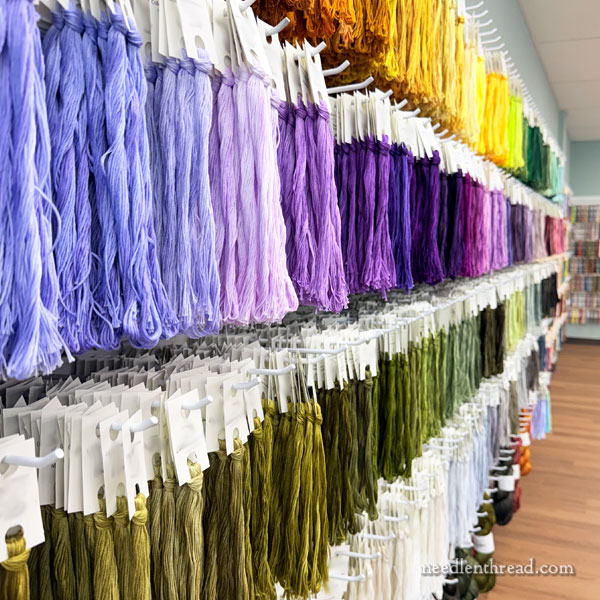
Here is where my regrets lie. There was a lovely range of purples, and oh, how I wish I had thought things out more carefully!
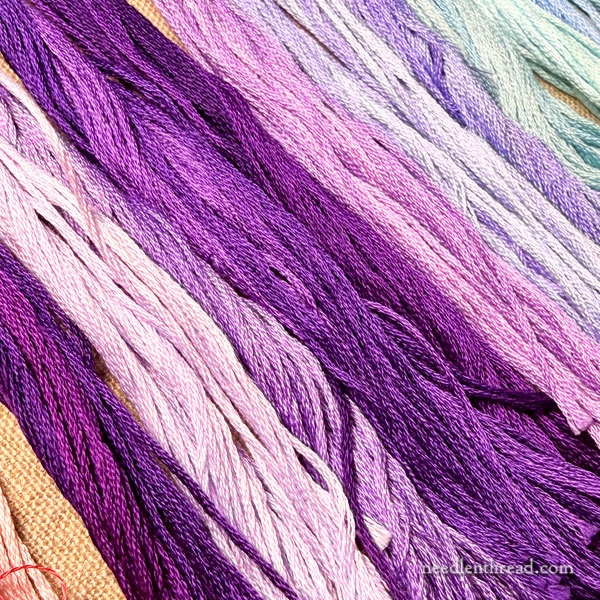
It always seems to me that there’s a dearth of good purples in most thread collections. The DMC line of floss, for example, suffers from a lack of varied purples in numerous shades and colors. Cosmo, the same. Even working between brands – combining DMC, Anchor, Cosmo – I’m always surprised that I still want more options in purple.
With purples lacking in the standard commercial floss world, I like to look at specialty threads to see what smaller dye houses offer.
And I knew this! But I got caught up in the moment, didn’t think, and didn’t concentrate on selecting more from the purple range. If there is a next time, I will know better.
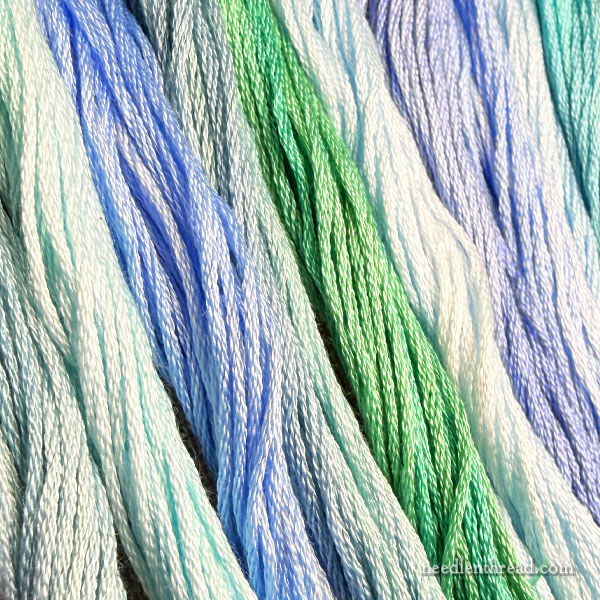
There is a wide and vast nuanced array of blues and blue greens. Think oceans tropical to polar and everything in between, in all their moods; deep and rich and light and airy.
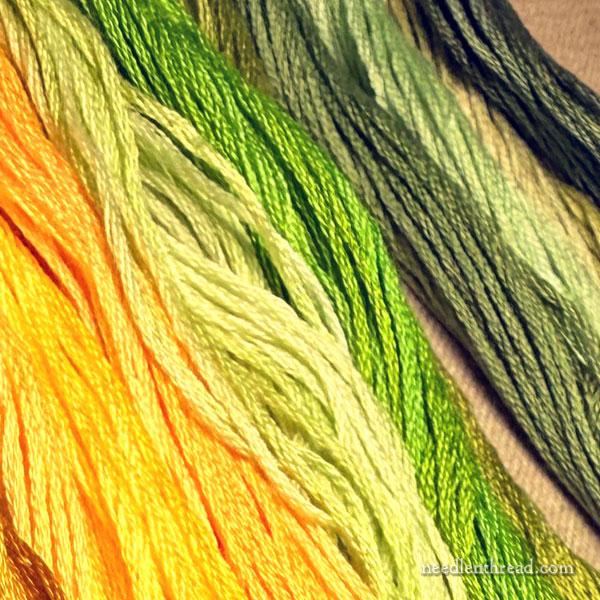
When I got to the yellows and greens, I was suddenly sadly defective in my ability to choose well! I acquired very few from these color families.
Oh my word, there was so much green to choose from. From deep dark woodsy greens to spring and summer grassy greens, and more – oh, much more! So many options!
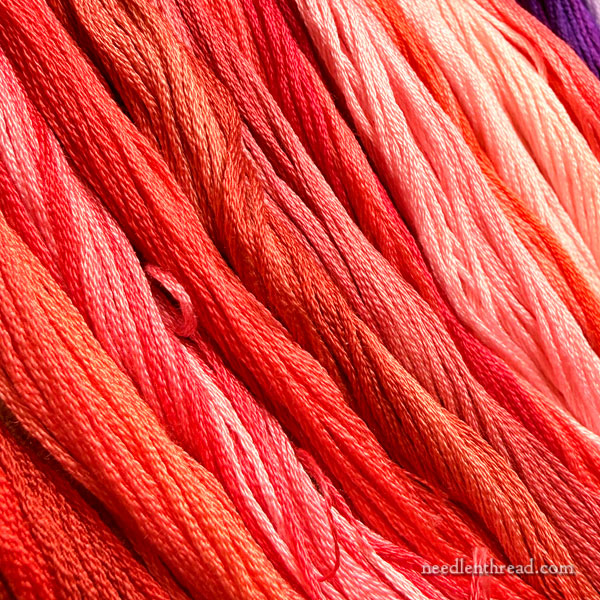
While I managed to work some brighter orangey reds into my red choices, I regret that I also didn’t concentrate on their orange range as I should have. Again, I was distracted by too many options.
I’m going to play with these threads soon, and I’ll share my experiences with you and tell you more about them as I learn more about them.
There are several reasons why this thread line appeals to me, and if it works out that I can use these threads for a project or two – or maybe as some curated thread color packs so that you can sample them, too – I will. We shall see!
Besides loving their extensive range of color, I’m happy that the company dyeing these threads is somewhat “local.” It’s a small US business not too far from me. So that attracts me, too.
More to come!
What a lovely array of colors! I think I can guess which brand & type they are, but I won’t say since you are waiting to review them. I started loving overdyed “threads” like that many years ago, when my sister in law gave me a little cross-stitch kit using them, while I was recovering from surgery. The key word I taught a girl last week, when I gave her a similar kit, is “meander.” If you stitch in a very orderly fashion, you will get stripes. Sometimes stripes are good, but more often, that is not the desired effect! Enjoy playing with your new stitching threads!
Oh, gosh, you are such a tease! I soooo want to know the name of the company!!! Personally I’m into the greens especially because I do textile art landscapes and need so many subtle changing greens for depth, etc. Hurry, hurry and play with them so you can give us “the goods”
You can always call them up and ask them to put together an order for you. When I worked at a specialty craft shop, I took just such a call – the customer had a budget, we talked about what kinds of things she liked and how much she wanted (one button in each style? Ten? Two dozen?) and then I spent several days pulling her order together from what we had in the shop.
I would be shocked if this shop didn’t have a DMC color card on hand. It would be very reasonable to call up and say “I’d like 40 skeins total from your purples, greens, and yellows. Here are the colors I already have, please give me a good range to sample from and avoid close matches with DMC (and Anchor and Cosmo, if they have those color cards as well).”
Yes, and they have a conversion chart for their thread with DMC. So that’s not a problem!
Oooh! Oooh! How could you possibly not take at least one of each? Jus as well that treasure trove is an ocean away!
LOL! Yes, threads are always tempting, aren’t they? And hard to resist! The relatively little bit I did buy there cost me over $200, so that’s probably the first reason I couldn’t take one of each. :-/
I feel a bit the same about “greens” as you do “purples”.
I’m Australian and our greens are very different from the greens you see elsewhere in the world. If I’m embroidering an Aussie vegetation or landscape piece, for example, I really struggle to find a “true” Aussie (particularly eucalypt) green. Some of our wildflowers, such as flannel flowers, paper daisies, or some of the native orchids, are also very distinctive “greens” that are hard to match.