

I’m not sure what it is about me and whitework lately, but here I am, back on another whitework subject! I received a really nice book this past week, and I wanted to tell you about it.
The book is called Schwalm Embroidery Techniques and Designs, by Christine Bishop.
Even if Schwalm embroidery doesn’t seem to be your thing, I discovered a couple good aspects of the book that would make it useful for those who enjoy other surface embroidery techniques.
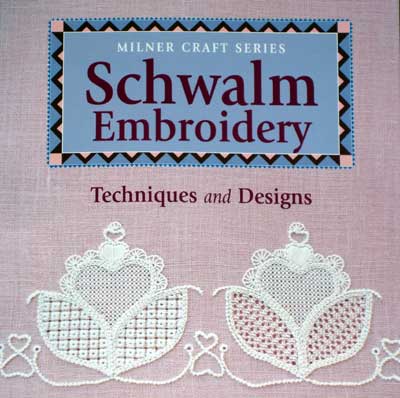
But first, a little information on Schwalm embroidery. It’s a whitework technique hailing from the Schwalm region of Germany (think Hansel and Gretel and other fairytales…).
The characteristics of Schwalm embroidery are basically bold outlines and delicate fillings. Schwalm whitework creates a lacy look, but it isn’t properly lace. Some stock shapes are typical to Schwalm embroidery – hearts, tulips, birds, leaves, etc. – but the technique is not limited to just these shapes.
The shapes are outlined with a bolder line, made up of coral stitch and chain stitch, and then they are filled. The filling is the thing that amazes me – the range of filling designs is limited only by the stitcher’s imagination, really. The fillings are executed on the fabric with threads drawn out, to lighten the look of them, or to enhance the pattern.
As far as materials go, Schwalm whitework is worked on high-count linen (32 count and higher, generally, with 50+ count being standard and even preferred for intricate designs).
The thread employed is coton a broder, something I’ve been mentioning a lot lately. This is a non-divisible 4-ply mercerized cotton that comes in sizes 12 (large) to 40 (small). Actually, here in the States, it’s easier to find 16 through 35, which are produced by DMC. You can find coton a broder in the US through specialty shops like Lacis.
One thing you’ll notice about Schwalm embroidery is that it looks rather “folk-ish,” and there’s a reason for that. Schwalm developed among the peasants of Germany, as a decorative embroidery for the “average” person, rather than for the wealthy. The “wealthy” counterpart of Schwalm whitework could perhaps be considered Dresden whitework, which looks more like lace and was worked by professional houses to supply the stuff to those who could afford it.
Dresden whitework reached its zenith of production and popularity in the mid-1700’s. Strangely enough, it was worked on muslin (very, very fine muslin, imported from India). Schwalm was generally worked on linen by the peasants, for their own personal decoration – household linens, clothing, and so forth. It’s quite a bit “rougher” than Dresden work.
Funny how things turn around – linen is a much dearer fabric today than muslin or cotton!
Of course, you have to consider the sheer fine-ness of the muslin then, and that it was woven by hand. An interesting story is told in a pamphlet published by Lacis on their whitework museum (PDF): “The story is told that when a Nawab reproved his daughter for allowing her skin to be seen through her clothes, she demonstrated that she was wearing no less than eleven thicknesses of such material.”
So – very fine stuff!
If you haven’t read that pamphlet (linked to above) and you’re interested in whitework, you might give it a look – you’ll find heaps of photos of different types of whitework and lace.
Now – I’ve strayed from the point – back to Schwalm and the book at hand.
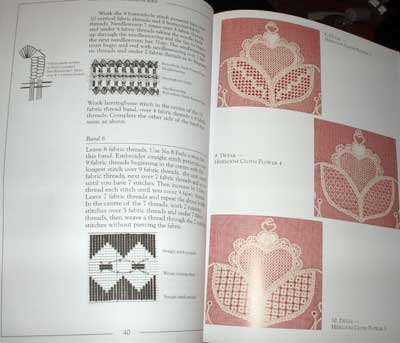
Schwalm Embroidery by Christine Bishop is a great introduction to the techniques of Schwalm whitework. It’s perfectly suited to a beginner, with techniques and designs of varying degrees of difficulty throughout the book.
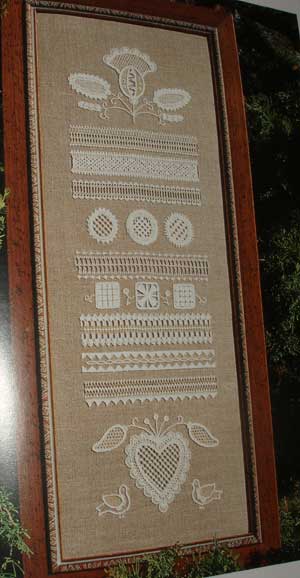
I particularly like the sampler that’s presented in the book. Samplers such as this one are great for those interested in trying out the various techniques within a particular type of embroidery before launching into a major project involving those techniques.
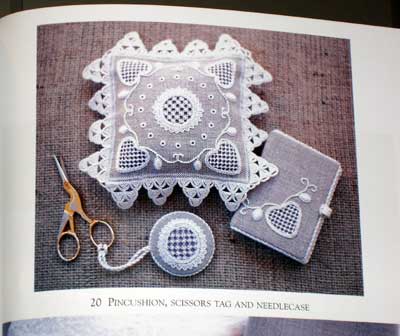
You’ll also find some really nice project ideas in the book. See the needlelace on the edge of the cushion? The author goes into detail on creating that edge, and the instructions are clear and accessible for the beginner.
Notice that the projects in the book are not all executed on white linen. I really like the look of the white on the natural linen, as in the sampler above.
Finally, as last point on Schwalm embroidery – I like the fact that it involves various techniques that carry over into other styles of embroidery: pulled thread, drawn thread, satin stitching, a variety of surface stitches – all are used in Schwalm embroidery.
So if you play around with Schwalm embroidery, you’ll pick up skills useful in other types of embroidery, too.
And this book by Christine Bishop will help you learn those skills!
Where to Find It
You can find Schwalm Embroidery by Christine Bishop through the following book affiliates:
In the US, Schwalm Embroidery is available here through Amazon.
Worldwide, you can find Schwalm Embroidery here through Book Depository, with free shipping.
Want More Schwalm Embroidery?
Schwalm Embroidery (in a nutshell)
Schwalm Embroidery on a Greeting Card – a chicken, no less! – Part I
The Schwalm Christmas Chicken – the finished greeting card
A Bit of Schwalm on a Whitework Sampler
I just picked up this book at the library and haven’t had a chance to examine it yet. Thanks for the review!
Funny that you should review this book and technique, Mary, as I have just sent in my registration for an Individual Correspondence Course, “A Basic Study of Schwalm Embroidery”, through EGA! I will be anticipating your Schwalm expolorations.
This reminds me a little bit of hardanger! It’s really lovely.
Nadia!
Merci pour le “link”!
Les instructions sont tres claires – les images sont tres bonnes!
Et mon francais est tres pauvre!
Do check out the link Nadia posted. Even if you don’t read French (the site is in French), you will find that the picture tutorial for Schwalm work is very clear – from outlining the shape to adding the scallops, to drawing threads and working the filling. Very NICE picture tutorial!
You can also drop the page in a translator…. definitely worth a look!
Mary, what a coincidence. I was fortunate to spend the weekend just gone with Christine in a workshop on Lefkara Byzantine at the Embroiderers’ Guild NSW Australia. Schwalm (which Christine pronounced Schvwalm) is one of the withdrawn thread/needlelace techniques similar which includes Lefkara and Reticella and so far I’ve only touched briefly on them. She makes it look so easy, but I always struggle with the picots, VBG.
One day, with a LOT more practise, I might get about a quarter as good as Christine. I’d recommend her book to anybody who’d like to sample this lovely technique.
Hooroo,
Christine
http://missmuffettwo.blogspot.com/
bonjour,
si vous lisez le français , il y a un tutoriel sur le blog de " Filoselle "
J'aime beaucoup cette broderie , elle est très jolie
Nadia
Hi Dear Mary
Many thanks to you by all information so complete that you give to us in your blog!!!!
It’s a type of embroidery that I enjoy and I’m learning to do now,in my little free time!
As Nadia also I have knowledge about Schwalm embroidey on Filoselle site.
A big hug
Maria del Valle
So funny this world!!!
The Schwalm Whitework reminds me a tipical embroidery from Viana do Castelo – a town in the North of Portugal – they are called Viana’s embroideries. They are made in red, blue, red+blue, and also in white. They are embroidered on typical clothes or on all kind of table-cloths. It is in Portuguese but you can see some photos (you have to scroll down) here
http://trajesdeportugal.blogspot.com/2007/11/o-bordado-de-viana-do-castelo.html
Thanks for the link, meri – I LOVE all the colors – very pretty stuff!
Hi,
I would love to buy many of your books, but I can’t find your email address. I am unable to use the link on your website. Can you send me the address?
Thank you so much. I love your work.
Laura
Hierdie boek lyk ook na ‘n moet as jy wil schwalmwerk doen. laat weet my ook hoe ek dit kan bekom asseblief
Hi Mary
Can we use Pearl cotton #8 or Anchor Stranded cotton for Schwalm Embroidery?
Please reply
Thanks
Hi, Shaz – they’re not normally used. I think the #8 would be a little heavy, and the Anchor stranded would not be heavy enough. If you don’t have the coton a broder available that’s usually used, I’d probably go for a #12 perle cotton, rather than #8, though I suppose you could use the #8 for some of the stitches (maybe the coral knots or the chain?)