




One of the greatest challenges I’m facing as a small (as in, teeny tiny) business is the challenge of imports.
You have probably noticed that most of the needlework goods that I use for my own work aren’t necessarily made in the US. Of course it would be nice if they were. But they aren’t, and the fact is, there’s no infrastructure in the country at this time to produce, for example, high quality linen or beautiful silk threads for embroidery. There used to be. But there isn’t now. And so, if we want those goods, we import them.
I’m sure we’ve heard much commotion lately about imports, and I want to assure you that this is not any kind of political rant or anything like that. You know me, and you know that’s not my M.O. (modus operandi). The purpose of this article is not to invite political commentary.
You see, the problem of imports and business and how such things affect the little person at the bottom of the business heap is not new.
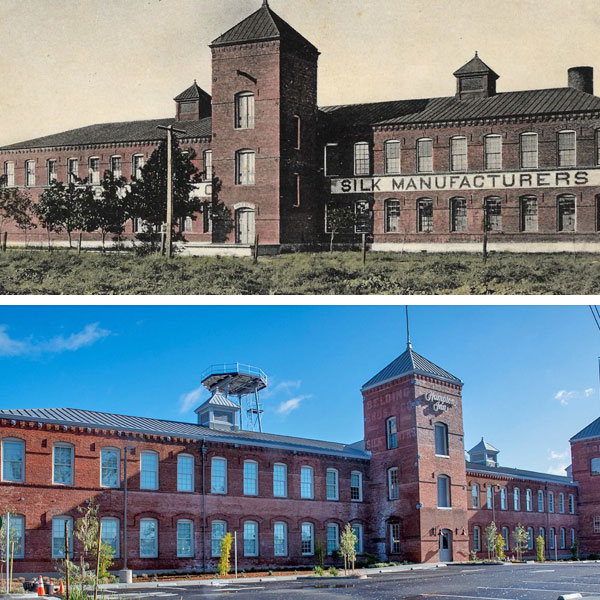
For this weekend’s delve, here’s an interesting bit of textile history in the US – and who knows? Maybe a place to stop if you happen to be driving through Petaluma in Sonoma County, California.
Once upon a time, and in fact, several times upon several times, there was a silk industry in the US. Many efforts to establish a sericulture industry in the US transpired throughout the 19th century, in response to the rising demand for silk. Some of those efforts were successful for a time, and some weren’t. Silk thrived. And then it didn’t.
Whenever I start to look into US industry in the 19th century, I find myself saddened and disappointed and even, admittedly, disgusted. Exploring the history of industrialization (in practically any country) reveals so many abuses, that the history can be rather horrifying. In fact, we would be naive to think that abuses in industry don’t exist even today.
But the sericulture industry that sprang up in Petaluma (and in other places, on the same model) is a little different. It was essentially the vision of a cottage industry that could supply women and girls with the ability to make mone, from home and establish a little independence. At its roots, it was a good thing.
This article from Petaluma Historian on the Carlson-Currier Silk Mill presents a good general overview of sericultural endeavors on an industrial scale here in the States, with special focus on the initial value of the cottage industry approach in the production of silk, especially in Petaluma.
Sericulture endeavors in the US didn’t last. Economic failures in the early 19th century, the competition of cheaper silk production in the Far East, the increasing popularity and affordability of cotton – talk about an industry rife with abuse! – and eventually, creeping into the 20th century – the First World War followed by the Depression, followed by the second World War and the rise of synthetics – brought a decided end to any sericulture here. The upshot: if we have silk in the US, it is because it is imported.
Anyway, it’s a good article – and an interesting history! I hope you enjoy it!
You can, incidentally, still see and touch a little bit of this history. If you happen to be road-tripping through Sonoma County, the old Carlson-Courrier silk mill in Petaluma is now a Hampton Inn. You can see pictures of the rooms and facilities that still reflect the building’s earliest days on the booking page for the Hampton Inn in Petaluma, here. No affiliation. Just a curious observer!
Have a lovely weekend!
This is so interesting! Thank you for sharing. I have white mulberry trees growing wild behind my house here in NC and I recently read that they were introduced into the US in an attempt to start a silk industry in the South, but they escaped into the wild and are now naturalized, even though the silk industry never took off. It’s fascinating to find a piece of history in my backyard!
Hi Mary,
Thanks for the interesting look at silk production over time in the USA. Similar happened in France and England. Industrialization definitely had its pros and cons. The cycle of industry is fascinating.
That is really interesting. I never knew part of the mill is still there. I thought most of the old buildings in that area were gone. Santa Rosa was leveled in the 1906 earthquake and it is further out from San Francisco.
My grandmother worked in a cotton mill in Massachusetts when she was 15.
Most of the west side of Petaluma sits on bedrock, and had very little damage during the 1906 earthquake. The old Carnegie Library (now the Petaluma Historical Museum) sustained only minor damage to it’s stained-glass dome. Quite surprising, considering the widespread damage elsewhere in the Bay Area.
Not silk, but Australia used to make fine quality embroidery goods. The Semco Art Needlework Company opened in 1907, making embroidery thread, stamped linen, and publishing. I have some of their booklets and thread from my grandmother’s stash dating from the 1920s. The thread is still lovely to stitch with. By the time I got seriously into embroidery in the 1970s they were importing floss already spun, only doing the dyeing here; then they were bought by Coates / Anchor and disappeared. The brand name has since been resurrected but doesn’t seem to have any connection to the original company.
Thanks Mary. Good read
Thank you so much for this informative article! As a longtime resident of Petaluma myself, this building is a familiar and frequent sight. I remember it as the Sunset Line and Twine Company, and then as an abandoned building for decades. It is such a beautiful part of our historic town, and I was thrilled when it was converted into a hotel, rather than torn down. But I never actually knew its history. So fascinating! And such a fun coincidence for me.
Ann Belove
Petaluma, California
Thanks for that link, Mary! I love the way they kept, and made a feature of, parts of the old mill. Tis sad that, as large as the U.S. is, we can’t competitively produce our own silk. I am guessing it is because we have been conditioned to the prices of foreign countries that use more-or-less slave labor, which we would not be able to get away with here (yet!).
I have been reading quite a few commentaries by small businesses who have been badly effected by the tariffs. I am a teensy-weensy small business myself and I recently had to pay a $179.00 tariff to bring in 32 yards of linen from Belgium. For me that is close to a weeks work to cover that cost! Yep, you can tell I am not in this thing for the profit! I am truly sorry for how it is impacting businesses, such as yourself, that are relying on their income to support themselves (and others).
All the best.
Karen