


Today, we’re continuing with the discussion of embroidery design transfers.
Here on Needle ‘n Thread over the years, we’ve touched on multiple ways to transfer embroidery designs, and recently we’ve talked at length about carbon (and similar) transfer processes.
Today, we’re going to broach the subject of “transfer mesh.”
I’ll introduce you to the general concept of using transfer mesh, talk about the brands that offer product for this type of transfer, and then, down the road, we’ll look at specifics, make comparisons, and I’ll share a few alternatives that can produce similar results.
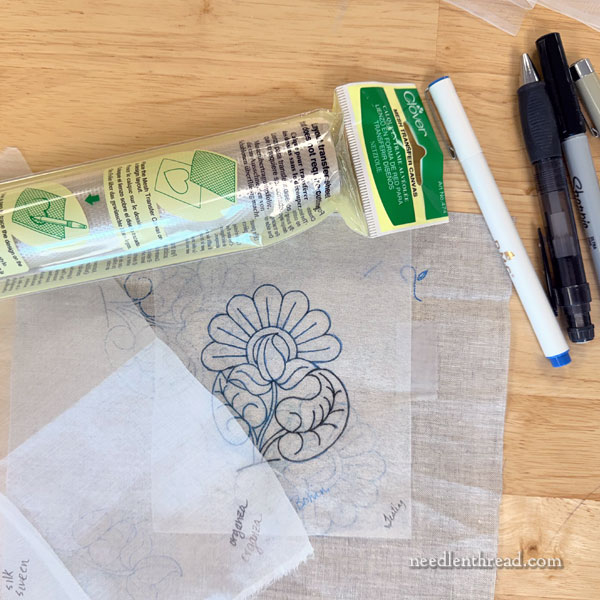
The concept of embroidery design transfer mesh is similar to carbon transfer methods, but it affords a much more “visible” approach. It requires more unique and specialized mediums for the transfer process, and these mediums are not as widely available as carbon and similar mediums are.
With transfer mesh, the process of transferring is a two-step process. First, you transfer the design onto the transfer mesh, and then you transfer the design onto the fabric.
Transfer mesh requires that you take the “mesh” (what “mesh” is varies, depending on the brand), lay it over your design, and then trace the design onto the “mesh” with a pen (what type depends, again, on brand).
Then, you place the mesh on the fabric and, using the recommended pen or pencil, trace over the design lines that are on the mesh, so that the transfer passes through the mesh and onto the fabric.
To my knowledge, there are only two brands that produce a product that is used as “transfer mesh.”
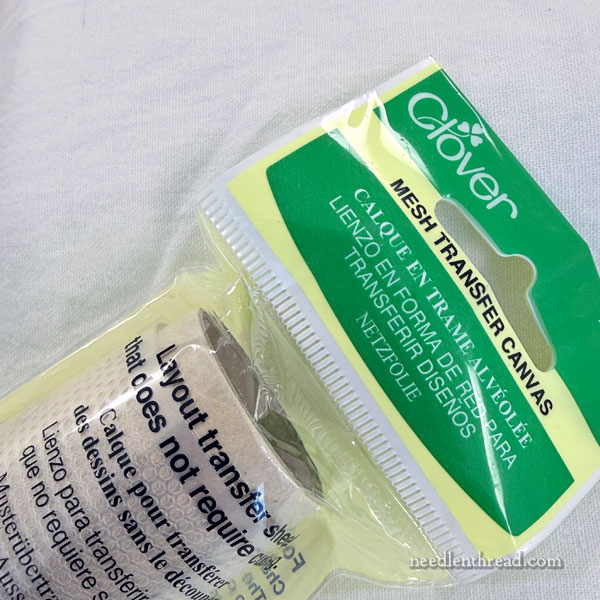
In the US, Clover is a widely recognized brand of needlework and sewing notions, and they produce a product called specifically “transfer mesh.”
Right now, we’re not going into detail about it. I will say this: don’t rush out and buy it, just because I’m mentioning it! It will be helpful for you to see it in action and then compare it with other methods before you decide whether or not it’s for you.
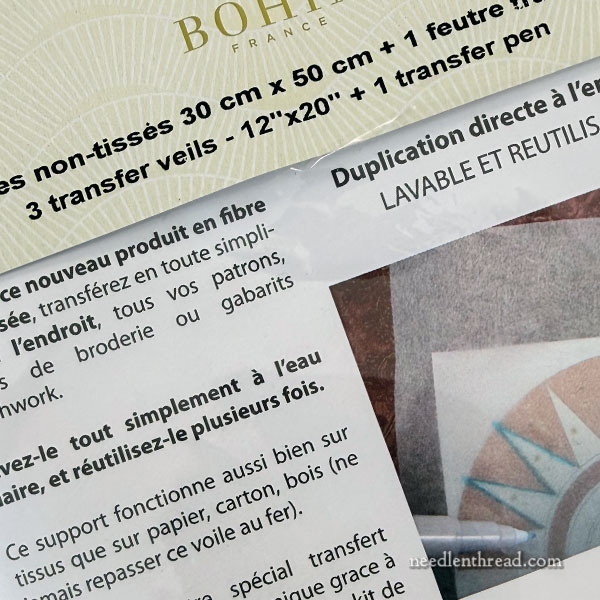
The other brand that produces a transfer mesh – actually translated as “transfer veil” – is Bohin.
Their product is completely different from the Clover product, and it’s not super widely available here in the US.
Even though the products themselves are distinctly different, they both operate via the same concept. Some points that we’ll address when we take a closer look at the products and processes are how they are different, which gets better results, and how they compare price-wise.
Besides these two brands, there are other mediums that can be used to achieve similar results with a similar process for transferring embroidery designs. We’ll look at those to see which ones produce decent enough results, and if they’re worth bothering with.
All of this is coming up soon!
I’ll also be sharing progress on my current home projects – those projects that I’m stitching at home instead of in the studio – and I’ll also show you what’s developing in the studio. Anna’s been doing a lot of cutting lately! Keep an eye out for new fabric packs! Hurray!
Leave A Comment