


Today, we arrive at Z!
And with Z comes the official end to the ABC Archives series here on Needle ‘n Thread!
Pulling Z way out of the deep archives, we’re going to talk about Z-Twisted threads.
This can be a rather confusing topic, and it might not matter a lot to you. But it can make a difference to your stitches under certain circumstances.
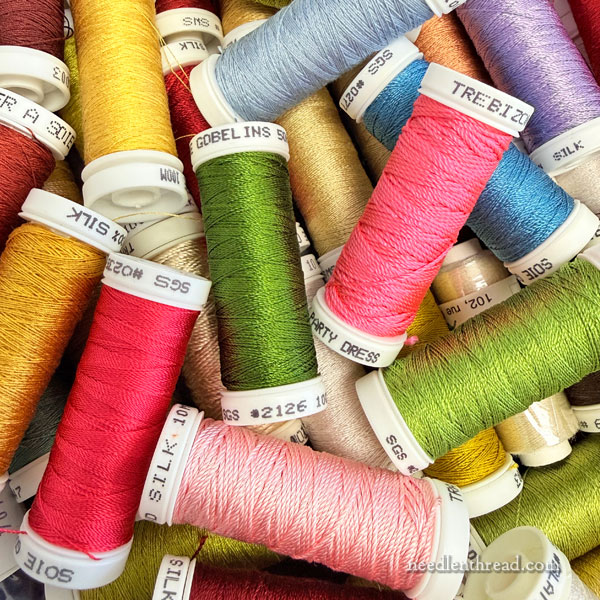
Depending on the type of thread, the twist of the thread can be one of two types of twist: s-twisted or z-twisted.
What does this mean?
Well, the twist on a z-twisted thread looks like this:
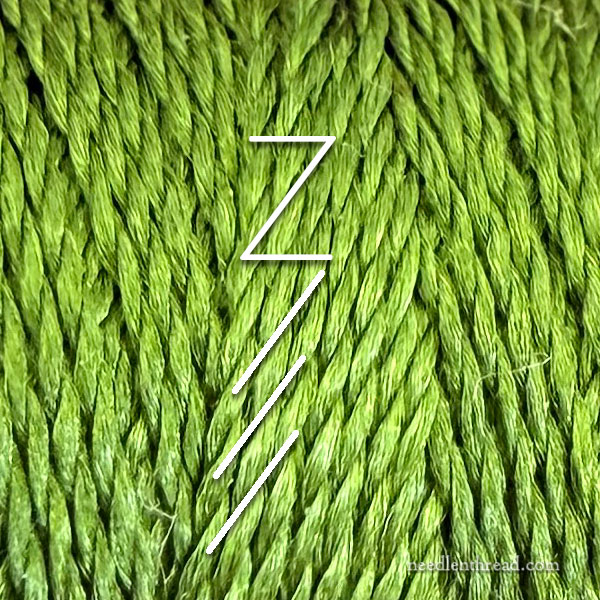
Rayon threads, synthetics, filament silks, and pretty much any thread that can be used in a machine are z-twisted threads.
The twist on an s-twisted thread looks like this:
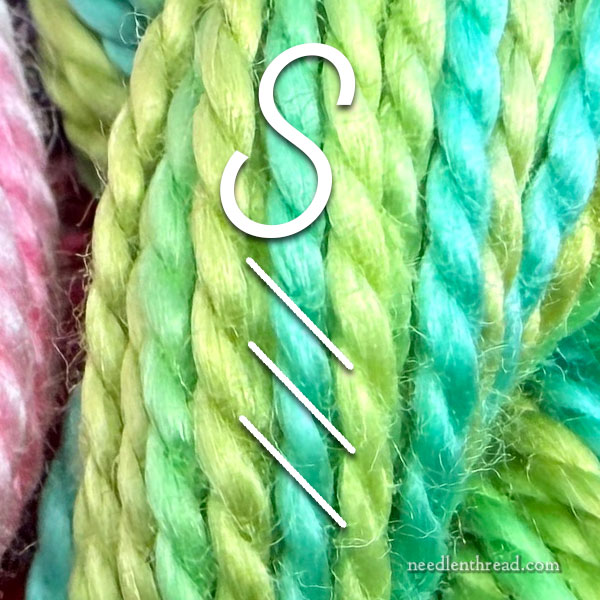
Cotton hand embroidery threads and wool hand embroidery threads are generally s-twisted threads, as are most stranded silks made with spun silk (as opposed to filament silk).
The twist of the thread can affect the way embroidery stitches turn out.
Now, if you only ever stitch with cotton, wool, and spun (stranded) silk, this is not something you have to worry about. The majority of stitch instructions out there are written for s-twisted threads.
But if you stitch with rayons (for example, for Brazilian embroidery) or with filament silks, or even with machine threads for tiny details, then the twist of the thread matters on certain stitches.
Any stitch that involves a sort of twisted “interlocking” between one stitch and the next – for example, stem stitch (the stitches twist together for a twisted together rope-like look) or buttonhole stitch (the edge of the buttonhole stitches results in the same type of twisted-together rope-like look) – changes with a z-twist thread.
I know! I know! This all sounds very complicated!
Does it even matter?! you might be tempted to ask.
It might not. Again, if you only ever stitch with cotton, wool, stranded spun silk – this probably will never matter to you!
In Detail!
If you’d like to learn more about z-twisted threads vs s-twisted threads, how to tell them apart, and how to handle them for certain stitches, check out these articles from the archives:
This article will introduce you to the terms s-twisted and z-twisted, and explain what they mean.
This article will demonstrate the difference between the s-twisted and z-twisted threads when they are stitched in certain ways.
I’m just enough of a thread and stitch nerd to find this type of information interesting, and I hope it is helpful for folks who are exploring a wide variety of thread types while stitching.
But I don’t want it to become a stumbling block for new stitchers! If you are working with cotton, don’t get hung up on these technicalities, because it won’t affect you, and it shouldn’t worry or trouble you!
Looking for More?
You can explore more of the ABC Archive series from Needle ‘n Thread here, at the ABC Archives Index.
More embroidery chatter coming up later this week!
Website News!
From Wednesday, June 17 – Wed June 24, we will not be shipping from the shop on Needle ‘n Thread. The shop will be open so that you can make purchases online, and any purchases made during that time will ship on Thursday, June 25th.

This is one of my favorite articles. I’m primarily a cross stitcher but enjoy adding a few embroidery stitches (known as specialty stitches to us) to my projects. I also enjoy playing with all types of threads so this article was so helpful. Thank you.
Z versus S twist is confusing, but I find it easier to understand that Z is twisted in one direction and S in the other. Not only does this affect stitch nesting, but also affects the inevitable untwisting or over twisting (and knotting) of thread as the needle is manipulated.
What perfect timing! I just finished a small embroidery pattern that came as a kit with silk and wool threads. I am new to stitching, and trying all types of materials to decide what I love most. I loved the silk thread it came with, but it was on little sampler spools, and I was unsure of the type of silk. I used a stem stitch, and it kept looping weirdly, pulling away from the line instead of hugging the corners. Just checked – it is z-twisted! I should have been using an outline stitch! Now I know how to proceed as I finish up the spool. Thanks for all your efforts in explaining this type of stuff to us. I may be new to stitching (started in November), but I have fallen in love with the process. As a retired scientist, I love being able to embrace these types of details in my learning process.