

Once upon a time, whitework embroidery was different from most of what we see today in the world of whitework.
This isn’t to say that we don’t see beautiful whitework embroidery produced today. Not at all! Because we do! Take, for example, many of the exquisite pieces of Jenny Adin-Christie (like this one). Beautiful!
But in some respects it is still different from the fine whitework of ages past.
Perhaps the best visual example of what I mean can be found in the book Lady Evenlyn’s Needlework Collection by Mary-Dick Digges, et al., where you can see cataloged the extraordinary and extensive collection of astounding whitework pieces amassed by Lady Evelyn Steward Murray (1868-1940). In fact, if you are in any way drawn to whitework embroidery and its history and development, it’s well worth adding a copy of this book to your library if you can get your hands on it.
In any case, the whitework of old is different. And it’s different for a number of reasons. Generally, we can just say “things change.” Fashions change. Tastes change. Society and trends and fads and wars and social upheaval and marketing and on and on – these influence the interest, value, time, effort, and more that we put into things that, in the past, may have garnered more interest, more effort, more value, more time, more care, and so forth.
And when Things Change, more things change – including the availability of materials. When the wider-spread ability or interest in using certain materials diminishes, manufacturers stop making those materials. A diminishing population of skilled or interested parties results in an extinct supply of the materials used by that smaller and smaller skilled segment of the population. It is, in a sense, the rule of supply and demand driven by the bottom line.
A few things have definitely changed in the “material world” of fine whitework embroidery, and the two most notable are fabric and threads. Today, it is nearly impossible to find the same exquisite quality of linen that was used a century ago. Handle or examine antique linens and you’ll know what I mean!
And it is nearly impossible to find some of the threads that were used in fine whitework. They are simply not made because they are not in demand. The skilled populace that used them, the interest in using them, and perhaps even the skill to manufacture them have diminished or disappeared. Because Things Change. C’est la vie!
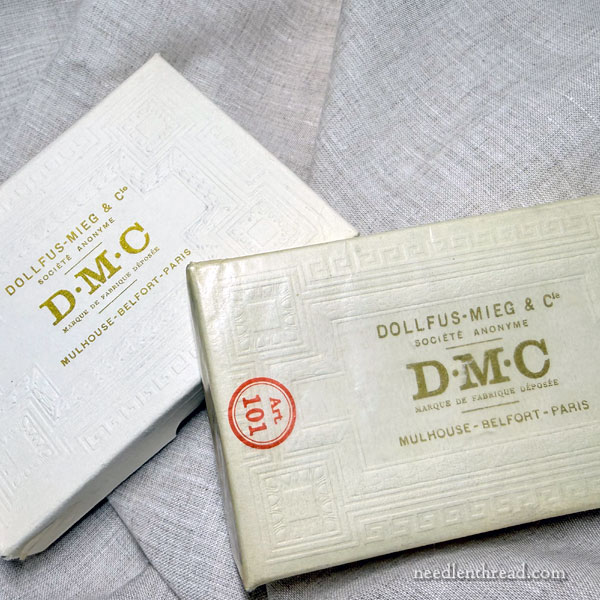
Through the very kind interest and solicitude of a highly skilled, renowned, and enthusiastic needleworker whom I have not met but count as a friend and mentor – she is ever a source of excellent advice and encouragement! – I have come by a fabulous collection of whitework (and other) threads, many of which are no longer made.
And they are in pristine, usable, beautiful condition.
The threads are mostly in the family of DMC cotton whitework threads (and some Anchor brand threads, too) of a type called “coton a broder,” sometimes also called “cutwork thread.”
You can read in detail about coton a broder here, where I compare it to regular stranded cotton. There are also other comparison articles linked to in this article, with more information on the thread.
Coton a broder is a softly twisted, non-stranded, mercerized cotton threads ideal for all kinds of whitework: monogramming, cutwork, drawn thread work, different openwork and lacework techniques, and so forth. You can read about it in detail here.
Coton a broder is, of course, still produced today. I talk about it – and use it – frequently here on Needle ‘n Thread. But it used to be that coton a broder was produced in much finer weights than it is today.
In fact, even 20 years ago when I started Needle ‘n Thread, you could still find coton a broder #40 and #35. Now, the finest weight of coton a broder available is #30. The heaviest weight of coton a broder available 20 years ago was coton a broder #12. Now, it is #16. (The higher the number, the finer the thread).
Today, you can find coton a broder #16, #20, #25, and #30 for whitework, and that’s it.
You can, of course, use other threads for whitework – including stranded cotton (or “floss”) – but it isn’t the same thread, and the stitched results are different.
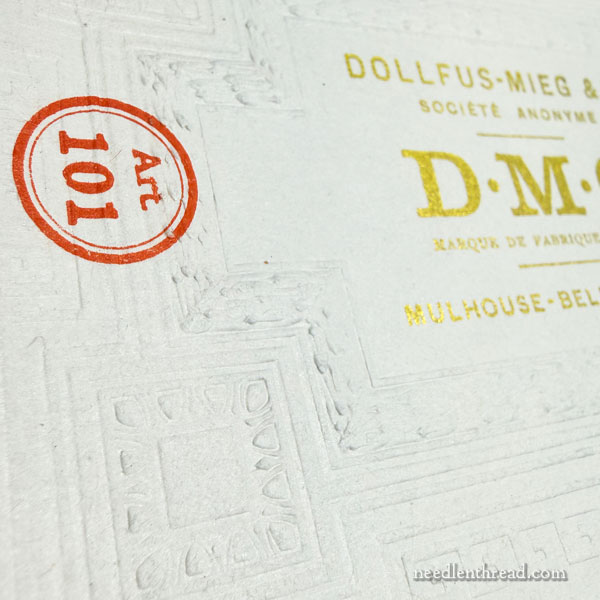
It is rare to find pristine collections of still-usable whitework threads. Here and there, you might come across a skein or two – maybe a box of skeins. Count your blessings if you do!
It is delightful to see how even the boxes are different. They are embossed, pretty boxes, wrapped in glassine paper.
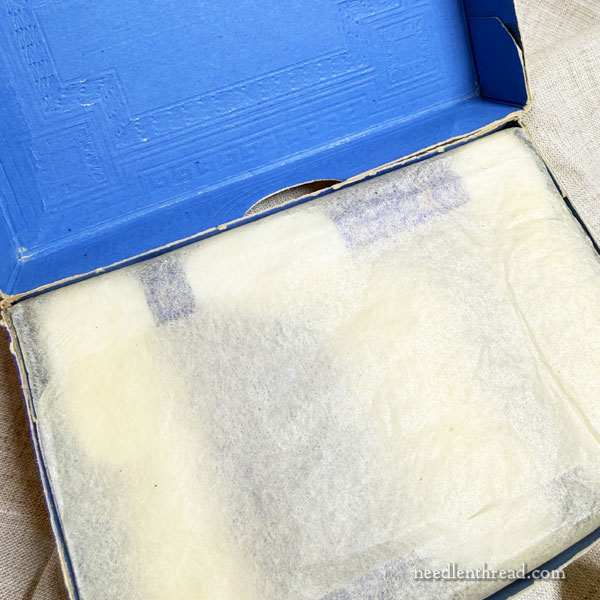
When you open them, you find blue-lined interiors and threads wrapped in tissue.
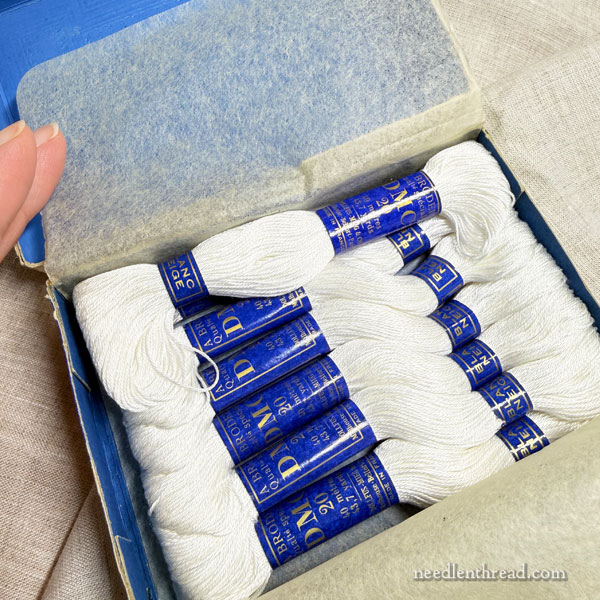
In my newly acquired treasure trove of whitework threads, there are a variety of sizes. There are some of the sizes we still see available today, like 20, which you can see above.
The “put up” of the skein is different. These are not what we call “pull skeins,” which is the typical put-up for stranded cotton (and all sizes of coton a broder) today. These are more like hanks that are put up in circles (like floche or even perle cotton, but without the final twist on a hank of perle cotton).
I prefer this vastly to a pull skein. I’ve never loved pull skeins.
You can read about my approach to pull skeins here. And you can read more thoughts about pull skeins here, especially with coton a broder.
And you can read about my approach to this older kind of put-up for coton a broder here. Because even as recently as 20 years ago, coton a broder was not put up as a pull skein.
Besides the sizes we’re familiar with today, there are other obsolete sizes in this collection, including…
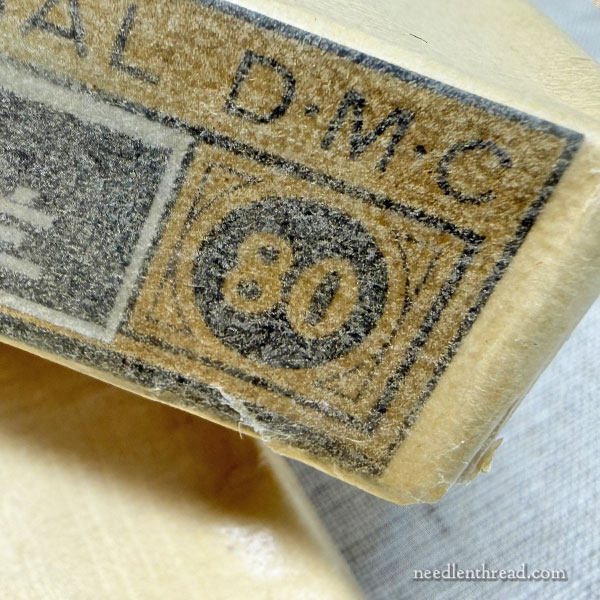
…the treasure of treasures: coton a broder #70 and #80.
You just don’t find these today. And if you do, the chance that 1. there’s an abundant supply of them that is 2. in pristine, usable condition… is Pretty Slim!
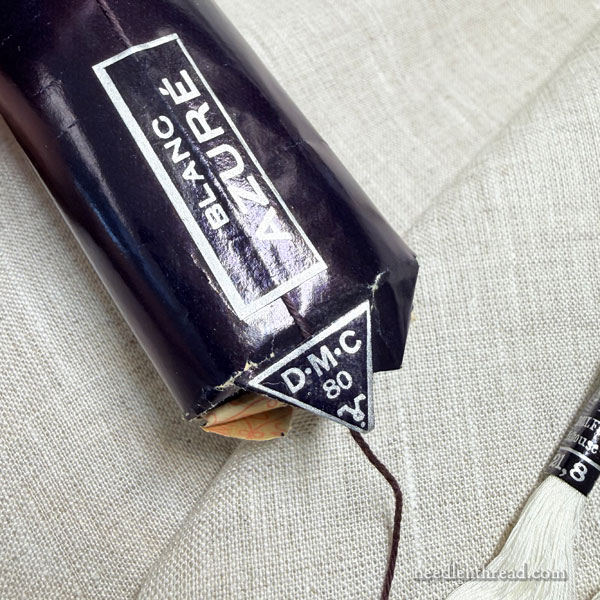
They didn’t always come in the flat, glassine-wrapped boxes.
Sometimes, they came in tubes.
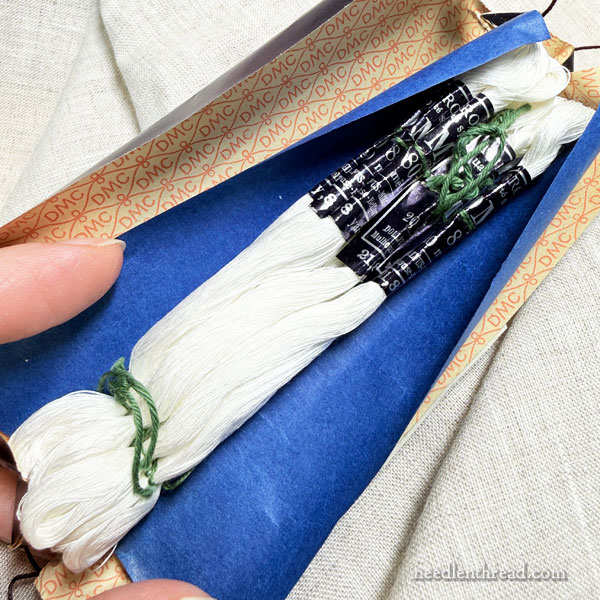
When you open the tube, you find a bundle of slender skeins wrapped in blue tissue.
The skeins are so slender because the thread is so fine.
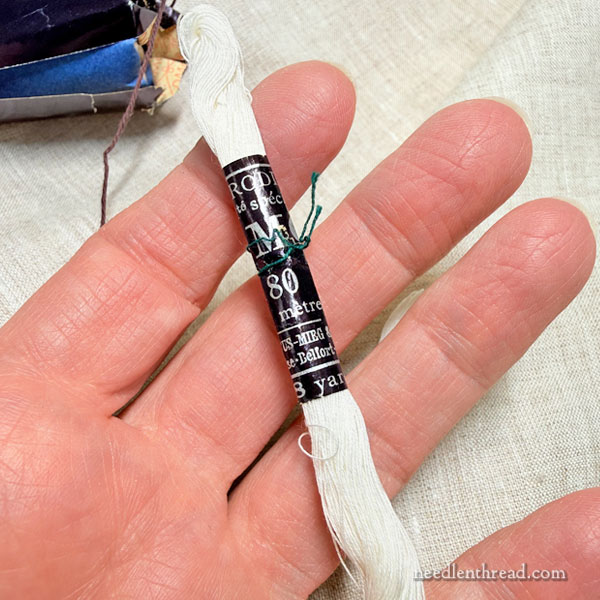
And there it is!
What a treasure!
Thank you, thank you, thank you, Bobbi!
What Will I Do With Them?
I have not yet decided what to do with this incredible cache of practically extinct threads.
I suspect there is more here than I would ever use in a lifetime – or at least, in as much of my lifetime is left.
I am considering putting together a very limited (for obvious reasons) collection of fine whitework threads in obsolete weights, for those who are interested in trying them at least once in their lifetime. It would be a way to share the joy of experiencing threads from the past – of stitching, in a way, with a bit of history!
At the same time, I can think of several uses for them here in the studio, for bespoke or custom work. But the reality is that the supply is limited. And to work “commercially” with supplies that don’t exist anymore doesn’t necessarily make sense.
I’m toying with ideas, letting them percolate.
What do you think I should do with them?
Thanks for a really interesting post Mary. Several years ago in my stitching career, I was not fond of white work, but I have come to appreciate its beauty and precision. If you do decide to make some of these antique threads available for purchase I would very much be interested in buying some. I will also be curious to see what you do with them.
Gosh, they sure are amazing! I can’t think of any more beautiful use for them than to make exquisitely embroidered palls for the Mass.
You might consider offering some of the coton a broder to your favorite museum that hosts a collection for repair work.
Re white work threads
First do you know about Ferguson’s linen? They are set up in Ireland and they produce fine linen. Perhaps they could do a run of very fine linen for you? That is if you decide to share the wealth in a kit form. You will probably still have linen left which you could offer up for sale. I think it would be snapped up in a wink! Even though it might be expensive. I have purchased from Ferguson’s over the years and never been disappointed. It is worth purchasing just to receive their quaintly packed parcels good St-Onge waxed paper tied up in linen thread. Inside wrapped in tissue and tied with a ribbon bearing the Ferguson name. *sigh*. Just like parcels were wrapped with care instead of being slung into a plastic sack! I remember searching high and low for fine threads for my aunt. Her mother, my grandmother was a wonder and I have doilies, runners, linens and such that she made, crocheted embroidered, knit, tatted, anything using thread! It is such a luxury and beside the memories there is a sensory luxury when handling such things.
At first I was going to say “keep them, just to have them and perhaps use a few, who more deserving than you? ”. Then I was reminded of William Morris, Confucius or may it was the gospel according to Margaret ( me). The threads were made to be used otherwise it’s like hoarding gold. It’s just heavy and it never displays its splendour of you keep it away from the light or prying eyes. Where is the pleasure or the joy in that? So I would suggest you keep what you can use and just a little more of the most precious. You never know you might be able to squeak out one or two more items with your treasured thread???Offer some to Anna, oh yes I know you don’t need to be told to do that….. then either make up kits or what about this? I accidentally ran across the article about your Christmas embroidered banner. Perhaps offer the remainder of the threads to the ladies who so kindly came to your aid in an hour of need with a banner that continues to bring you joy year after year.
I sympathize with your quandary, one of the better kinds of such. I think you will feel better giving them a good home.
Fondly
Margaret
Luckily I did not drool on the keyboeard!!!! You are a fortunate lady – wealth of the Indies! Treasure trove! Joy and rapture unconfined! I have a few old skeins myself and take them out to pet periodically – not enough tyo do anything with and the hands and eyes will no longer allow it anyway. Thanks for sharing. Charlotte in California P.S. The Avelea piece came out so nicely – looking forward to your hem solution.
I think you should bundle them up and send them to me!
Bom Dia,
Ganhei de uma amiga 04 meadas do fio Floche Cartier que foi feito exclusivamente para D´Lacroix. Considerei um tesouro, pois alem de ser bem parecido com o fios da DMC Floche, o fios deslizan no tecido mais suavemente e o brilho é espetacular.
Vou usa-los em um projeto do Livro ja Jenny que voce indicou.
Obrigada pelas dicas e fique com Deus.
Maria Eusáquia
The threads should be used by someone with the skill/knowledge/capacity to make appropriate use of their special qualities – whether that be you and Anna, another embroiderer, or someone involved in textile conservation at a museum. As long as they are used.
Oh, these are so lovely, Mary! What a treasure! I still have some No 12 coton a broder, which I haven’t used simply because I can’t get any more. With your treasures, for me there would be competing pulls: preserve it because it isn’t available anymore, and use it because it’s so very lovely.
That is indeed the problem! But if I preserve it, it will just sit in a box unused and … well, it was made to be used. It seems like it would just be a waste. If I use it – or if other people use it – then something beautiful may come about, and I know what’s going to happen with it. If I just store it, who knows what the future will bring? I’m all for use, though I’d retain at least a skein of each for future reference.