


These are my thread drawers. I wrote about them a long time ago – thirteen years ago, as a matter of fact.
Until recently, the drawers were organized in a pretty basic system: A series of drawers would be dedicated to one brand and type of thread. So, for example, DMC stranded cotton occupied some 8 or so drawers. Each drawer (or two) was dedicated to a color family: two drawers full of green DMC stranded cotton; two drawers of reds; one drawer of purples, and so forth.
If I needed red DMC stranded cotton, I went to the “red” DMC stranded cotton thread drawer and dug around for the specific color number I was looking for – or, if I wasn’t looking by number but rather by shade or tone, I rummaged till I found the shade or tone I was looking for, or I referenced the real thread color chart, found the shade I wanted, and then rummaged for the number.
You can image that such rummagings are not conducive to efficiency.
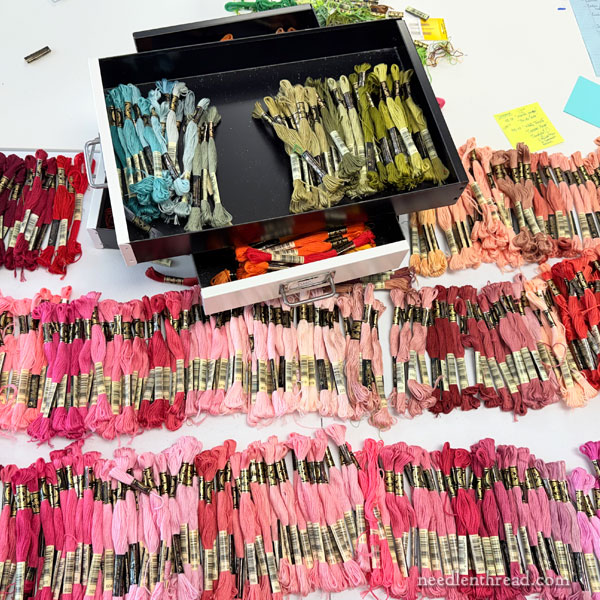
We use DMC cotton more than any other thread, and we have a lot of it on hand to design with. And while we do work with a lot of other thread types and brands, they don’t all occupy as much space or cover as great a color range.
It’s never been quick or easy to find DMC colors within color families, either by color number or by preferred shade or tone. Digging through drawers, checking each label for a number, or pulling threads of various shades and tones to lay out and compare with other threads, and not finding just the right shade, but knowing it exists … so you dig, you rummage some more. All this leads to disorganized and messy drawers and it eats up a lot of time!
The Rummage System eventually grew old, needless to say!
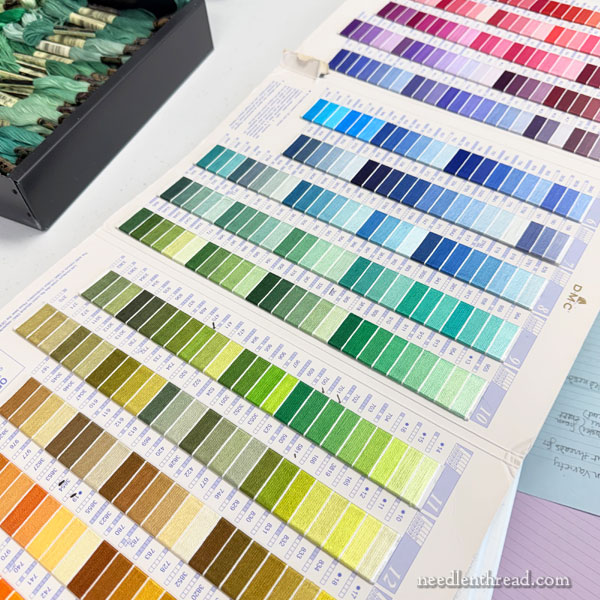
More and more frequently, we’d find ourselves using the real thread color card to narrow down colors and shades we wanted to use, before “screwing our courage to the sticking point” and facing the Rummage Job in the thread drawers.
(Are you familiar with real thread color cards? I wrote about them here, and we carry the DMC real thread color card in the shop, here.)
At least when we referenced the color card, we had an idea of the shade and a number to seek. And that was helpful.
But it still wasn’t efficient. We’d find a good blue, for example, on the color card. And then, with an idea of the color in mind, and knowing the color number, we’d have to still fumble through the unorganized morass of every shade of blue in the blue thread drawers
Ugh.
What a time sink!
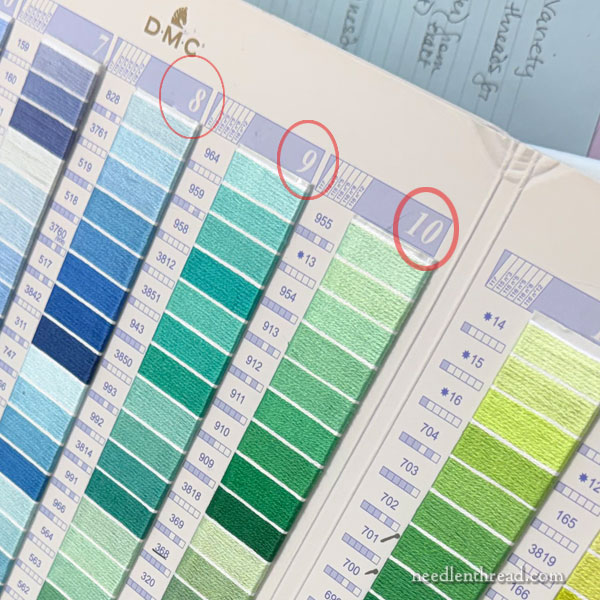
So we decided to use the color card as the basis of our organization.
Each column on the color card has a number at the top of it.
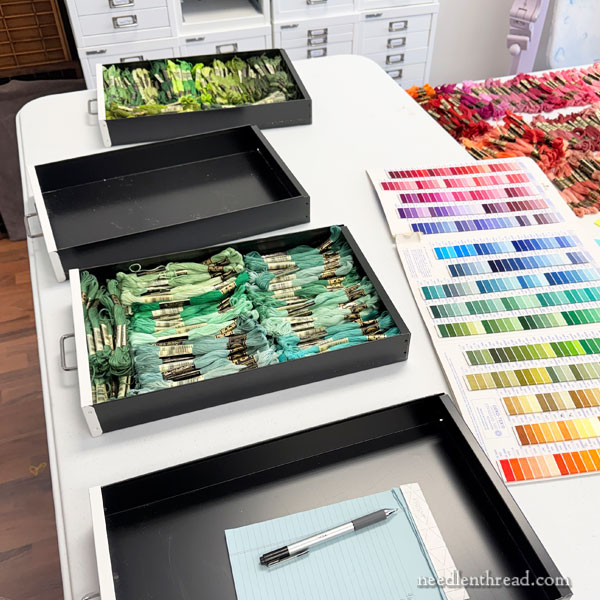
We sorted all the colors on that column into organized groupings in the drawers, following the order of thread numbers found on the particular column on the color card.
Sometimes, we fit two columns in one drawer, depending on the quantity of threads we have in those colors.
Then, we marked the label on the drawer with the column number.
Now, when we find a color on the color card, we look at the column number at the top of the card, go to that drawer, and quickly find the color from the threads that are laid out in the drawer in the same sequence as the numbers on the color card.
We have the color we want, lickety-split!
It’s also very easy to see what colors we’re out of, to make sure we replace them.
We also finally made a thread inventory list that we can update when we add or remove threads, or when we realize we’re out of a color.
We’re now in the process of updating thread inventory spreadsheets that we can keep up-to-date on our phones, that we can also access on the computer when we’re placing orders.
It’s oh-so-much more efficient!
We’ll be applying some of the same organizational tactics to our silk threads and goldwork threads, too – but the need is not quite as urgent, so we’ll be doing that as time allows. We don’t have as many, and we don’t access them as often.
And that, my friends, is our ongoing thread organization venture!
I really can’t emphasize enough how convenient it is to have real thread color cards. It would be ideal if every thread manufacturer produced them, but I’m sure it’s time consuming and expensive to do so.
Happy July 1st! See you Friday!

Fabulous!
I was very fortunate to be able to purchase the DMC drawers (which are a delight), which came with every thread on the thread card. This has made thread organisation so easy and a joy to find the thread I need. Almost every project includes the DMC number, but with the card it’s really easy to see what’s needed if the DMC number isnt included.
A while back I bought on Etsy from their shop Artinspirate DMC Vinyl Labels size 16 x 32mm. All the Labels are marked with the color Name and Number I use the in Tandem with the Real Thread Color Card. When I received them I had them Laminated together. Page 1 and 2, 3 and 4, 5 and 6, 7 and 8, 9 and 10, and 11. It is Great! Artinspirate is in Kyiv, Ukraine. I use them both all the time. Very helpful.
I keep my DMC in number order. I stitch from charts, rarely swapping from the called-for colors. The 100-200s are in one drawer, 300-400s in another, 500s through 900s get their own drawers, etc. Each color is in a reclosable baggie that need larger labels to be easier to read and keep them from slumping under other bags. The rest is (very!) vaguely organized by type. The whole setup needs work though.
Your floss drawers are So Pretty! Nice work and organizing by the DMC chart…sweet! I don’t think I’ve seen that system before.
Mary, thank you for sharing this—it’s just brilliant! I’ve got a retreat coming up and this will be one of my projects for it. I keep my floss in clear bags, grouped by color, but organizing them by the DMC floss chart makes so much more sense!! Brava! 🙂
OK, so that covers the DMC stranded cotton – good job! – but what about the rest?? Now you have to show us how you organize *all* of the threads! We can wait…
Hi, Deborah – well, the rest probably don’t need to be as organized, because I don’t really have complete sets that I use as frequent and access as frequently. The complete sets I do have don’t have nearly as many thread colors! With some of them, I can fit the whole set into a drawer (the au ver a soie silks that come on spools) or into two drawers (Heathway wool, floche, etc.)
Congratulations, I have been organizing my threads according to the DMC Chart for years. I use the old sectioned off plastic boxes and organize them by rows. Each row is sectioned off again so the threads are also organized in each row. I have 20 boxes. such time saver.