

I love old needlework books.
I love needlework history.
I love old needlework threads.
I love old needlework designs and instructions and tips and other delectable tidbits.
And I love it when all of these come together in one tidy package in one way or another!
Often, these topics did come together in the needlework pamphlets, catalogs, and promotional materials published in the late 19th – early 20th centuries by thread manufacturers.
Whether Corticelli (I wrote about them here – they merged with Belding in the early 1900’s), M. Heminway & Sons (I wrote about them here and here – they were the first silk manufacturer to put up silk threads on spools! – and they also merged with Belding), or Belding Brothers (founded in 1860, and eventually becoming Belding-Heminway-Corticelli in the 1900’s), all of these companies – which eventually became one consolidation supplying over 90% of the silk in the US – put out some great instructional and marketing booklets in their respective heydays.
(It always amazes me to think that we once had a thriving silk manufacturing industry in the US!)
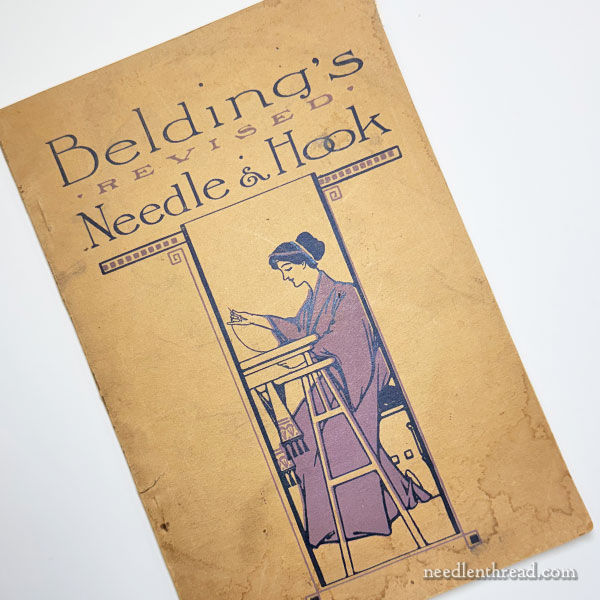
Recently, a kind reader sent me a copy of Belding’s Revised Needle & Hook from the early 1900’s. There are many editions of this book – this one is the seventh edition. They are all prized antique books. I’m so happy to add this treasure to my collection!
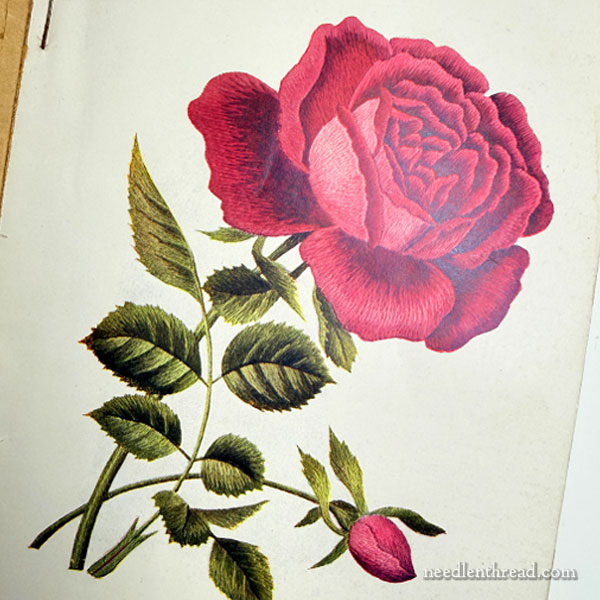
These books – like the M. Heminway & Sons book I wrote about here – contain color plates of silk embroidery worked with their threads.
The books, after all, were marketing tools. Books like these are chockfull of instructional tidbits, examples of stitchery, and examples of designs and products produced by the manufacturer and available to the retail market at the time.
The books normally focus primarily on embroidery, but you’ll also find crochet, knitting, lace work, and even macrame in some of them.
Any needle art or craft that can utilize the variety of thread types and weights that the manufacturer produced was fair game for content.
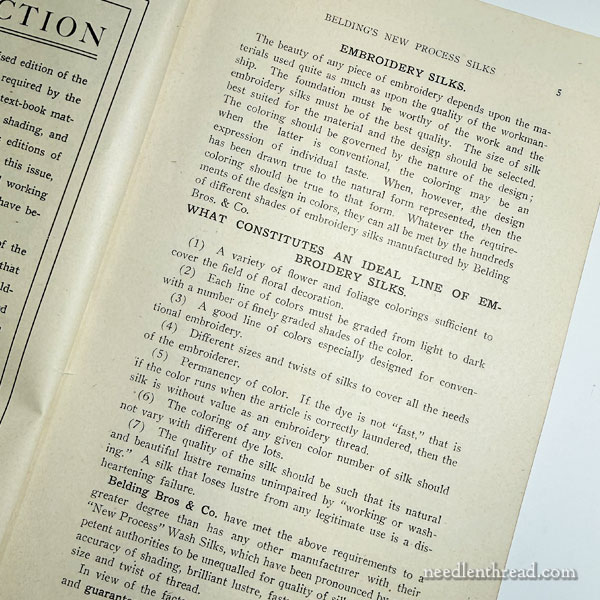
When I meander through these old books, I enjoy pausing to read the numerous tips and techniques offered to the potential client.
Some of these tips (and much of the language!) may be a bit outdated, but many of them still hold true!
And while some of the content is most assuredly a sales pitch (“What Constitutes an Ideal Line of Embroidery Silk” focuses, of course, on Belding silk), that content is still applicable to many points we look for in a good thread today – like a variety of colors, finely graded shades of color, colors designed for conventional embroidery, different sizes and twists to cover multiple needs, permanency of color, lack of variation between dye lots, and a quality and luster that remains despite working or washing.
Sounds like a great line of threads to me!
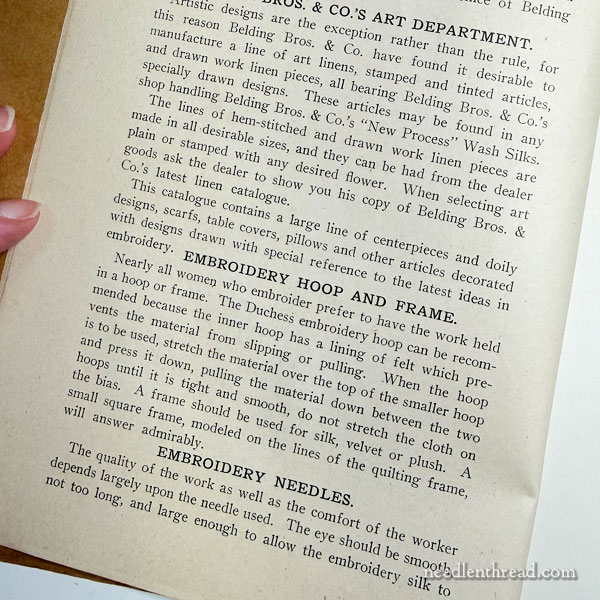
While Duchess hoops are not made anymore (I’ve never talked about them here on the website, but I have a couple, so I’ll show you one up close one of these days), some of the information about hoops and frames still applies. I find the wording for the description of how to use the hoop a bit odd. It makes it sound like the fabric is cling wrap or something!
Nearly all women who embroider prefer to have the work held in a hoop or a frame. The Duchess embroidery hoop can be recommended because the inner hoop has a lining of felt which prevents the material from slipping or pulling. When the hoop is to be used, stretch the material over the top of the smaller hoop and press it down, pulling the material down between the two hoops until it is tight and smooth, do not stretch the cloth on the bias. A frame should be used for silk, velvet or plush. A small square frame, modeled on the lines of the quilting frame, will answer admirably.
Today, instead of an embedded felt strip on the inner ring – which was a popular feature of the Duchess hoop – you can wrap the inner ring of good quality wooden hoops with cotton twill tape, which provides the same holding power and helps protect the fabric and the stitching. You can read about the process of wrapping or binding a hoop here.
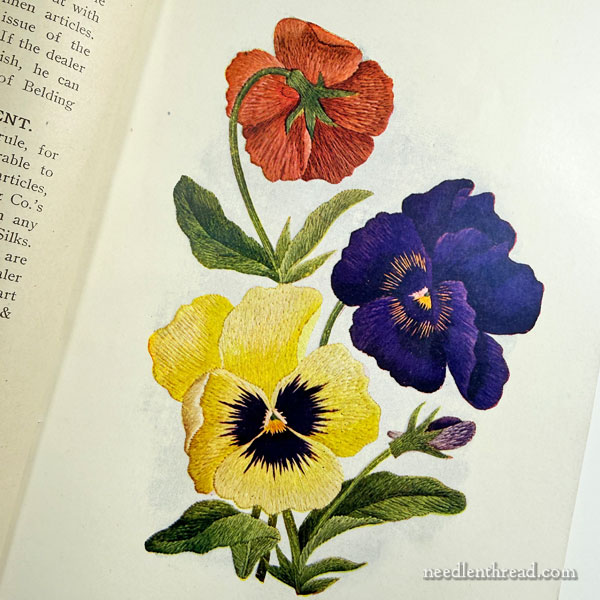
Oh, look! Another color plate!
The silk embroidery showcased in the colored plates is typical of Society Silk from around this era. This is all “needle painting” – the floral designs are realistic, and the embroidery is shaded in a realistic manner using long and short stitch or variations.
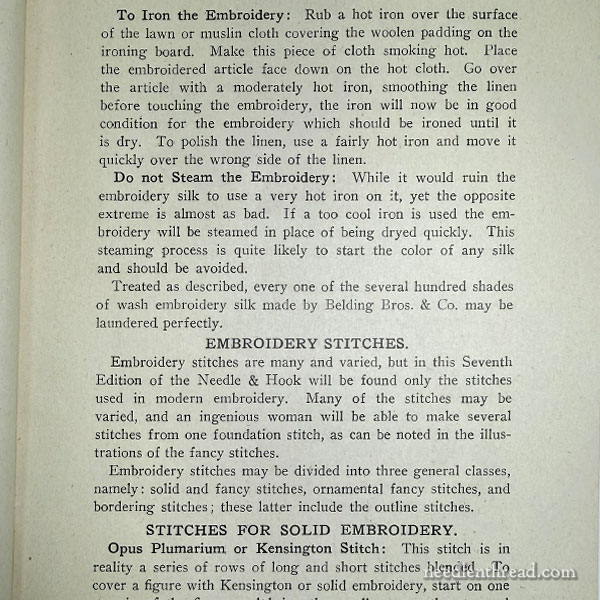
The tips in the photo above on ironing the embroidery are interesting. They might produce a bit of anxiety on first reading them (“make this piece of cloth smoking hot”!!!!), but the tips actually do make sense – especially the point about steaming, which can produce color run, even with “colorfast” threads.
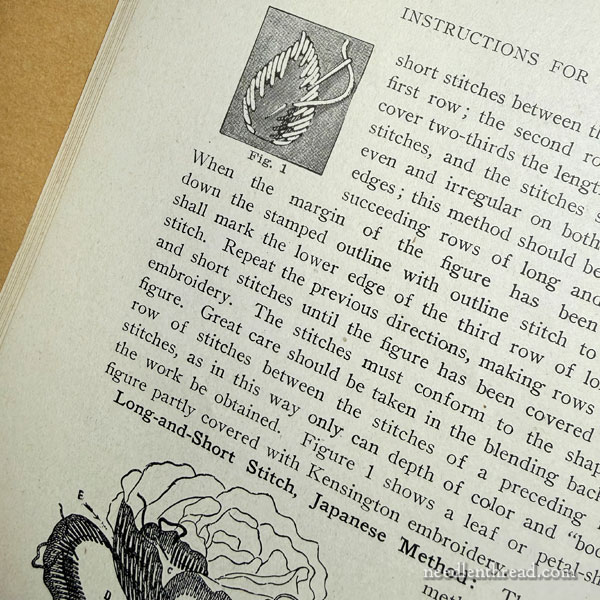
The long and short stitch instructions are intriguing, too! Remember this discussion about methods of long and short stitch that we began here? Well, here are some instructions that play into our discussion.
In this booklet, it illustrates what they called the “Kensington method,” which involves taking the needle down and between the stitches of the previous rows.
Beneath this explanation, there is an explanation of the “Japanese method.” They are more or less the same instructions in this booklet, with the exception that the Japanese method is more rigid and evenly filled.
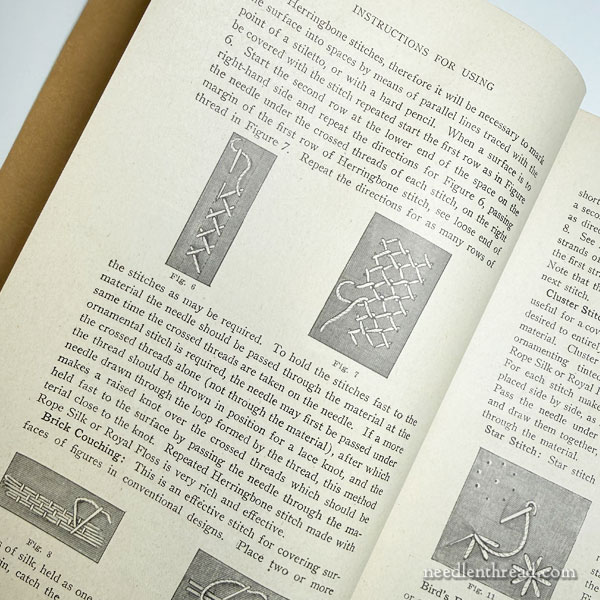
There are, of course, many diagrams for many different types of stitches, too!
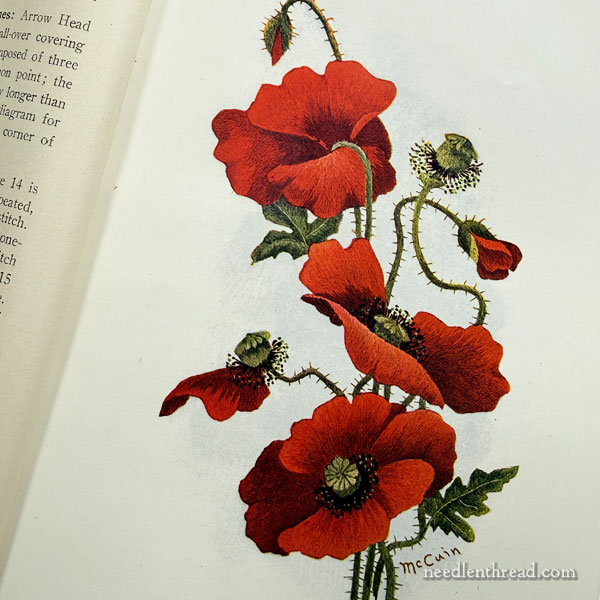
Ok, fine! Let’s admit it – we really just want to flip through and see all the colored plates!
I love, love, love these red poppies!
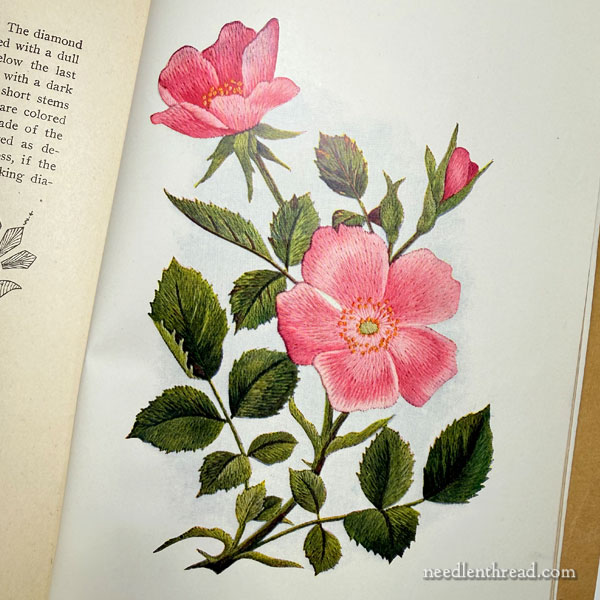
I love these wild roses!
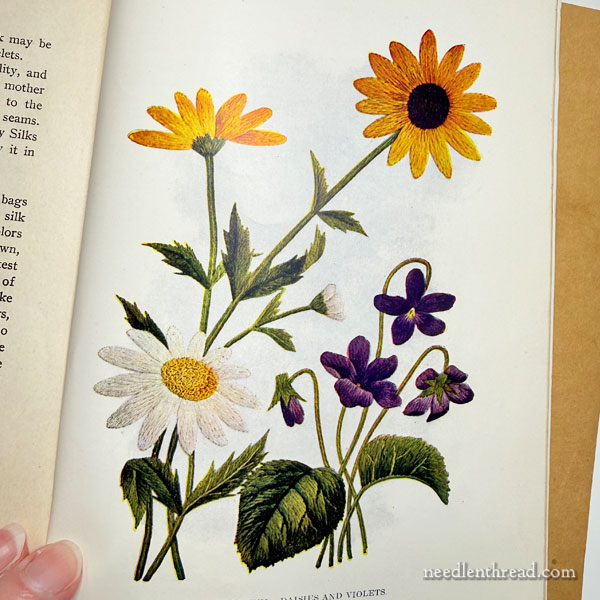
This is “ok” – I’m not really so keen on this arrangement. The elements don’t look very comfortable together.
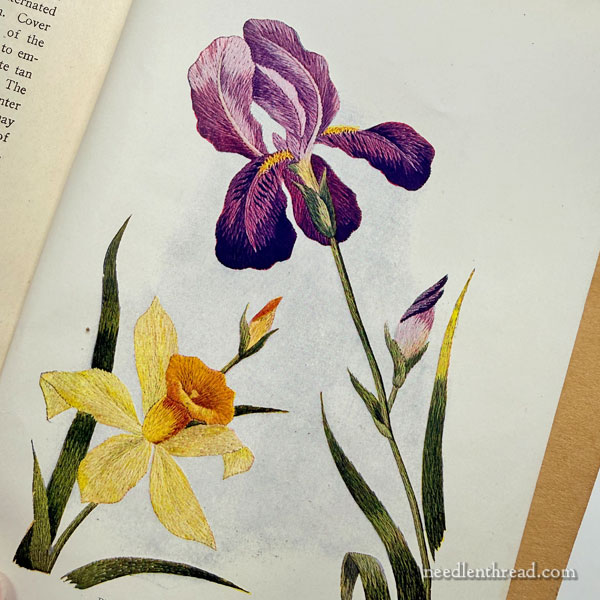
But who doesn’t like daffodils and irises?
Again, maybe not in this particular arrangement…
There are other lovely colored plates in the book, but we are, alas, out of time and out of words. I’ve hit 1,000, and you’re probably sound asleep by now!
I hope you enjoyed this brief look at a little thread from the past. Lovely, lovely book! And I’m sure it will pop up again on Needle ‘n Thread in the future!
Happy Monday! Hope your week is off to a grand start!

Not just in the U.S., but in Kansas itself! You probably already know about Silkville in Franklin County…. it was one of the Utopian settlements that had a heyday in the 19th century. They tried to survive on silk production, but it was not to be. A few of the old buildings still remain!
Yes!!!!! I’ve wanted to go down there forever, but I just haven’t been able to. I’ll be going down to Oklahoma City for a spot of surgery in the not too distant future. I might be able to work in a little side trip on my way down. Fingers Crossed!!
That is such a beautiful book and such a generous gift! Thank you for sharing the color plates. need to up my silk game.
What a lovely find! (Although all the Belding merging renaming did irresistibly call to mind the Fielding-Wilding-Belding building in the old “Two Ronnies” “Ponting Punting” sketch. XD https://www.youtube.com/watch?v=r56wlRsHric )
Oh MY GOSH. Thank you so much for that, Kim. I just had a really good laugh at that! It made my day. How hilarious. I’m going to have to look up the “Two Ronnies” – I’ve never heard of them!
Oh gosh. I’m still laughing.
Hi Mary,
I love reading your article today. I have several Duchess hoops that are in wonderful
condition. I consider them some of my best hoops! They are beautiful and they hold
the fabric so well. I don’t embroider with them but I do use them to display my finished work.
Ann