


Rarely do I write an all-out negative review of a needlework product.
In fact, I don’t think I’ve written one.
Normally, even if I don’t personally love a thing or I would never use a thing, I can understand what other people might like about it. I can acknowledge good aspects about things that might not be my cup of tea. And I can recommend them on those merits.
If I can’t find those positive aspects, I generally won’t write the review or mention the product.
But I have recently encountered an embroidery hoop that has nothing to recommend it – including the hefty price tag for its worthlessness.
I think it’s worth mentioning so that you don’t do what I did: buy it to try it.
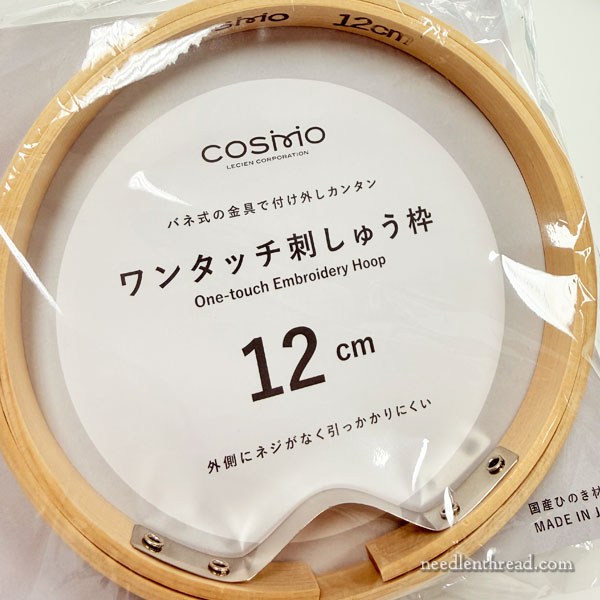
Cosmo is probably best known – at least here in the States – for their very nice, high quality cotton embroidery floss. I like Cosmo floss! I wrote about it eons ago, here. I don’t use it often, because it’s not as universally available as DMC, it’s much more expensive than DMC, and it requires “converting” the color numbers from DMC to Cosmo if you want to use it in place of DMC on projects that have a DMC thread list.
But it’s a nice thread.
Cosmo is a brand of needlework supplies from Japan, and among the supplies they offer is this very questionable embroidery hoop.
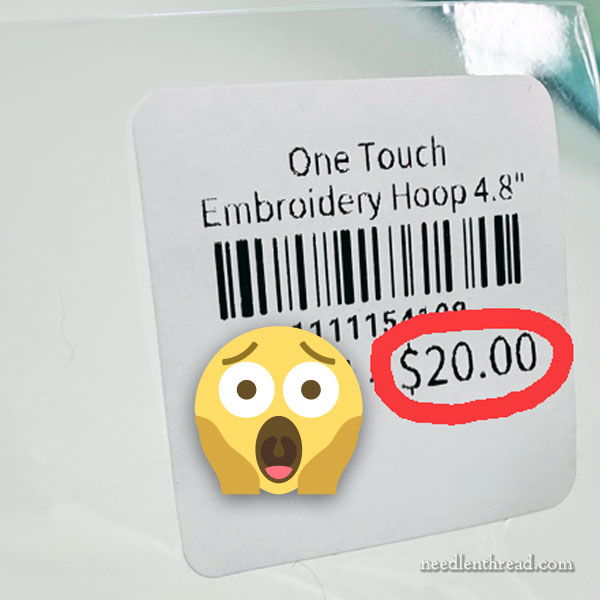
I recently purchased this under-5″ hoop for the hefty price of $20.00 because I was curious. I mean, for $20, there had to be Something Mighty Special about this hoop!! And if there was, then (so I thought) you should know about it, too.
(See, I’m always thinking of you!)
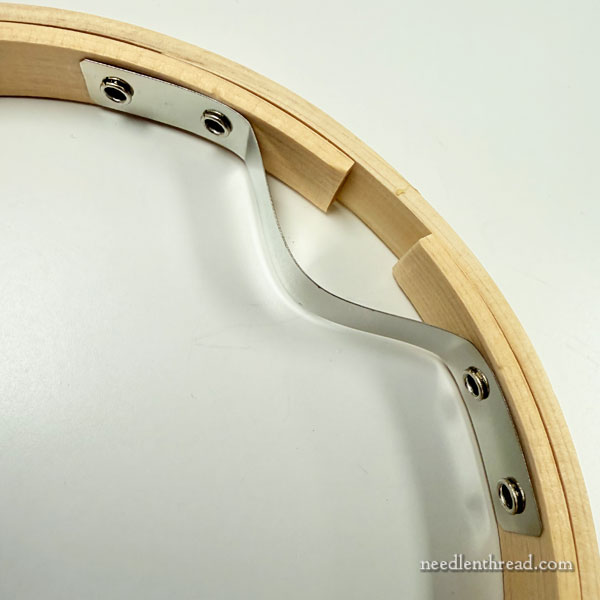
What ultimately piqued my curiosity was this, above.
Not too long ago, I wrote about this antique Duchess embroidery hoop. The same company also made the Princess embroidery hoop, which was a kind of “sprung” hoop – that is, it worked on the principal of a spring action from a metal strip that helped keep the hoop tight. You can Google “vintage Princess embroidery hoops” to see what they look like, and I’m sure someone out there has gone into detail about how they work.
They’re not made anymore.
The Cosmo hoop here caught my eye because it has a spring-like feature very similar to the one on the Princess hoop, except that, on the Cosmo hoop, the “spring” (the flat metal piece) is on the inside of the inside ring. On the Princess hoop, it’s on the outside of the outside ring.
Curious!
How well does this thing work? I asked myself.
Just looking at the hoop, I was not thinking favorably of it. But sometimes, looks are deceiving. I was willing to gamble $20 to see what this thing was all about.
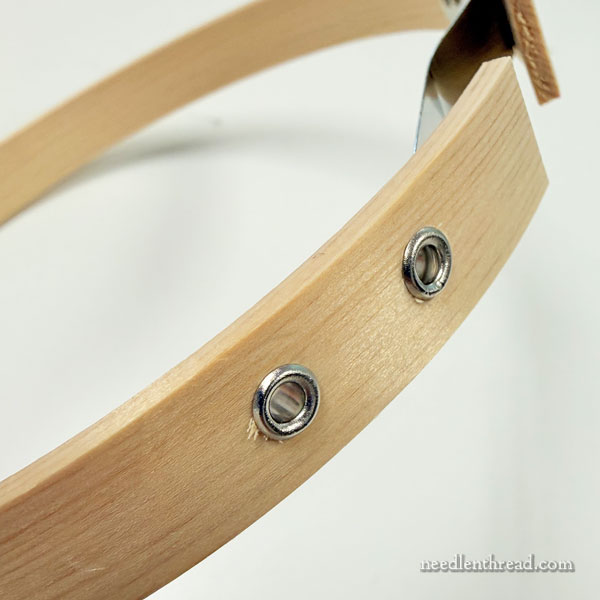
I separated the two rings and took a look.
The fact that these grommets are on the side of the ring in contact with the fabric didn’t strike me as promising. How well would that work, squeezing embroidery between these grommets? Would thread catch on those little rings? Would the rings cause problems with embroidery or fabric? These things I did not know.
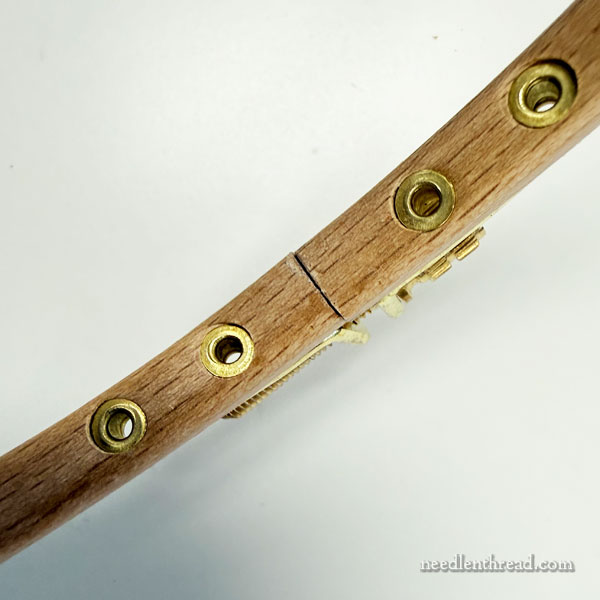
Just as a comparison, this is one of the very high quality hardwood hoops that I carry in the shop. I’ve used this thing for years and years and years. In the States, they’re often branded as Hardwicke Manor hoops, from Access Commodities, but you might also know them as Klass & Guessmann hoops. I’ve been using the same ones for 20+ years.
As you can see, they have hardware, but it’s sunk in the (real) birch hard wood that the hoops are made of. I don’t have to wonder if that hardware will affect my fabric or stitching, because it doesn’t come in contact with either.
But back to the hoop in question:
Aside from the hardware, my greatest point of consternation was the very, very, and I mean very cheapness of The Thing. It is cheaply made out of cheap parts. The wood is cheap. The hoop weighs practically nothing – there’s nothing to it. It’s the type of wood that feels vulnerable to any pressure, easily breakable. It reminds me of the cheap craft hoops at big box stores, only worse.
And, at $20, this wasn’t exactly cheap.
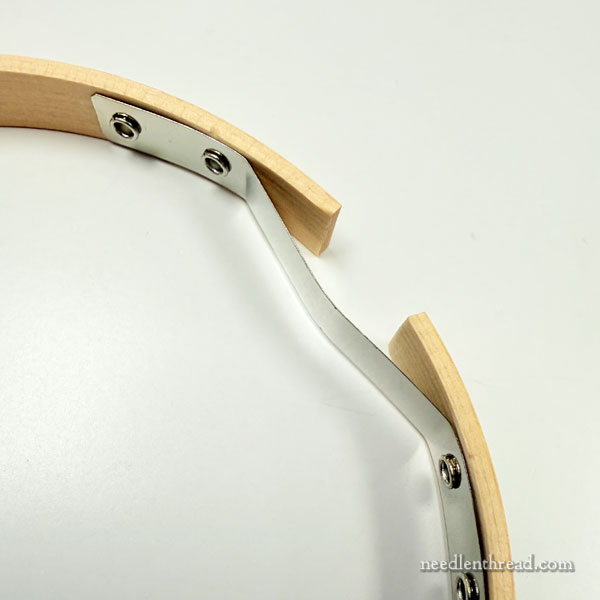
Let’s look at how it works. Maybe that’s where the secret to its greatness lies.
When you remove the inner ring, the thin strip of metal stretches out flatter.
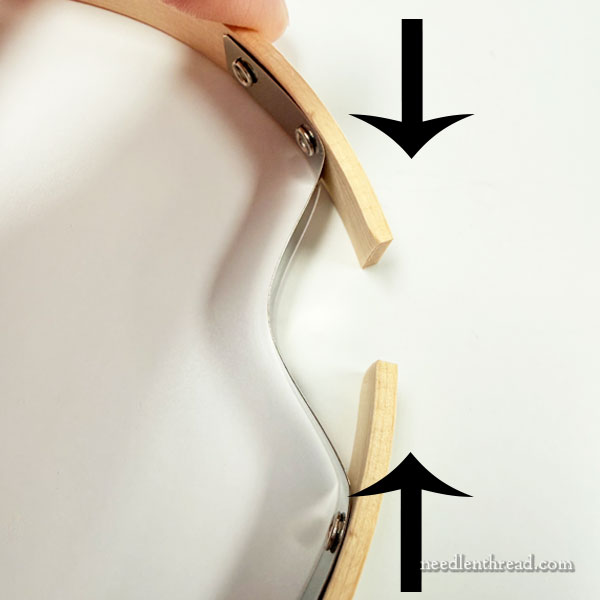
You squeeze the inner ring to get it into the outer ring, and this is supposed to be what holds the tension on your fabric.
That’s the working principle.
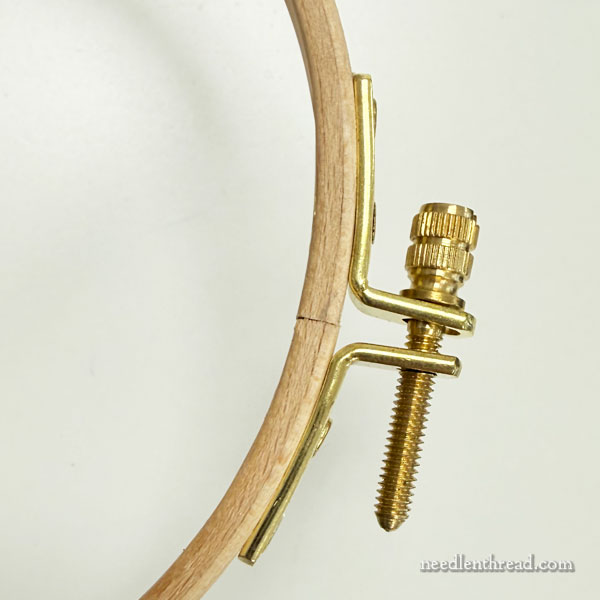
This is the solid brass hardware on a Hardwicke Manor hoop, by the way.
But you know, I’m not trying to sell you Hardwicke Manor hoops. That’s not the point. Other hoops have good hardware, too – Nurge, Edmunds…
That thin flexible metal strip isn’t what I’d call good sturdy hardware.
But let’s keep exploring!
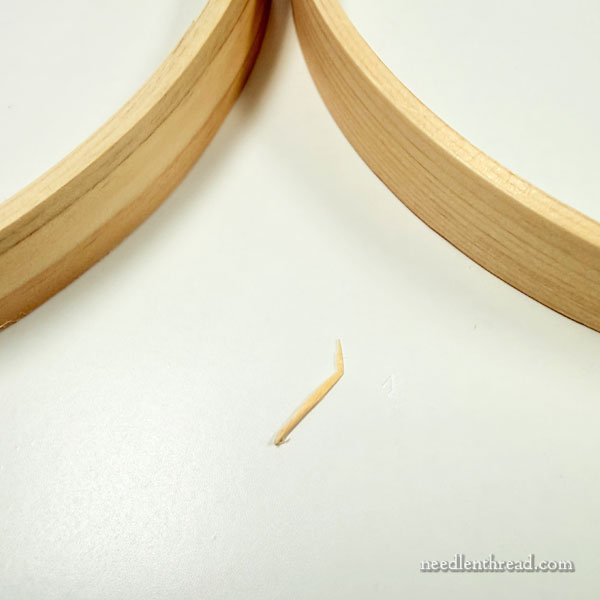
Oh!
Well!
I never!
Where did that come from?
Here I was, just looking at the thing, and there on the table in front of me materialized a sliver of wood. I wasn’t sure where it came from…
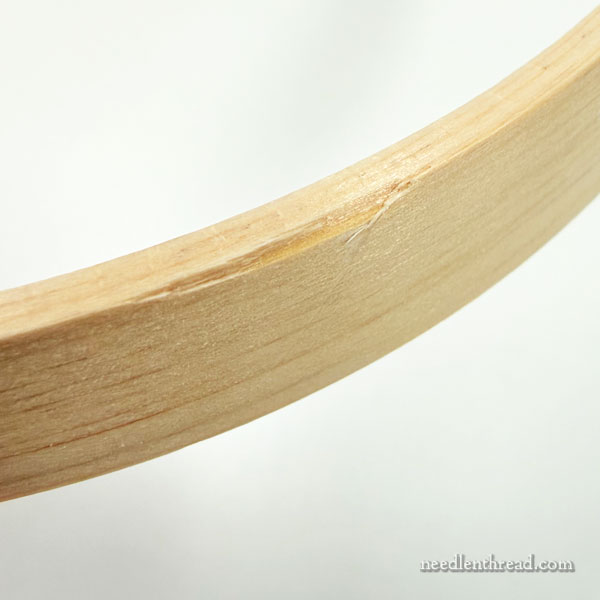
…but a quick perusal around the edge of the hoop revealed the source.
Hm.
$20.
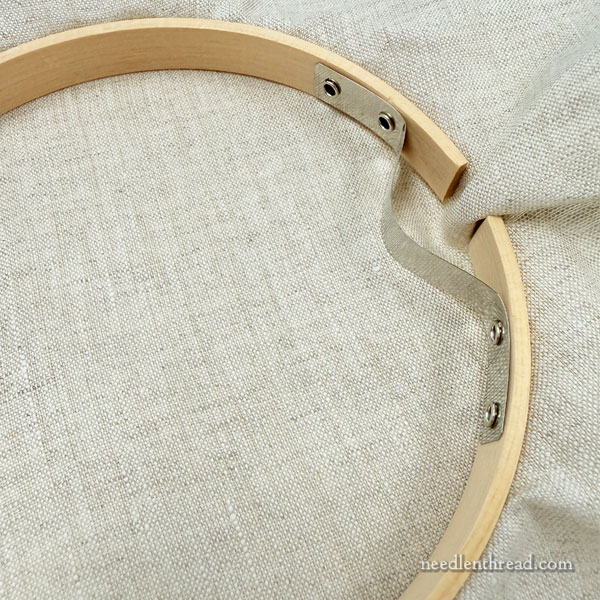
To hoop up your fabric, you have to go backwards with this one. You place your outer ring down first, then your fabric front-side down, and then you squeeze the inner ring to get it to fit into the outer ring that’s on the table, pushing the inner ring into the outer ring, so that the fabric is between the two.
Well, ok… if it works…
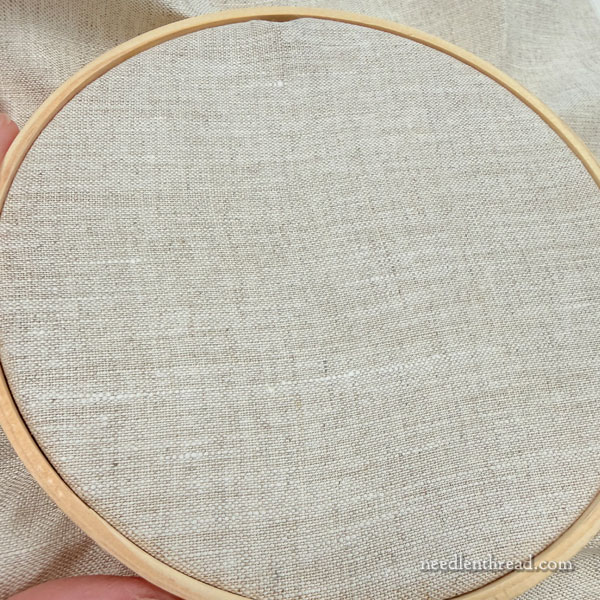
There’s the front of the fabric inside the hoop.
Is it taut? Does it work?
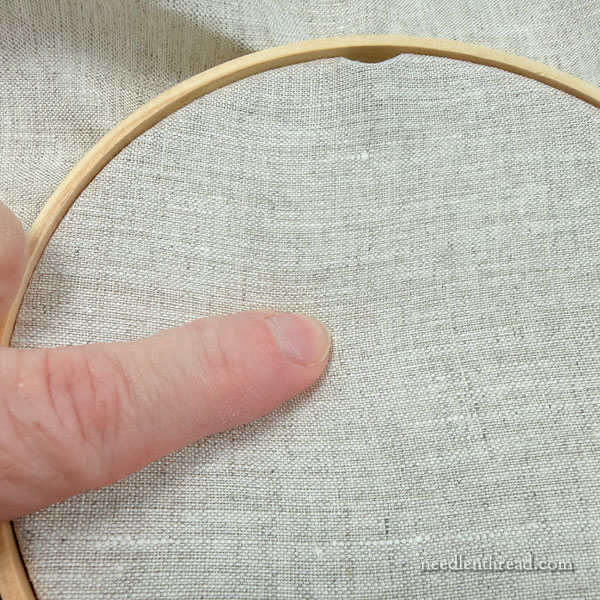
No.
If I push on the surface of the fabric ever so slightly, the fabric pushes straight down to the table and the outer ring moves up. It shifts upwards off the fabric.
I’m using a regular linen between light and medium weight – not a full medium weight, but not lightweight like handkerchief linen, either. A good hoop holds this fabric taut without a problem.
I use this fabric all the time in hoops! I can always get it drum-taut, and it stays that way through multiple stitching sessions.
I haven’t even tried stitching on this fabric in the Cosmo hoop. There is no point. It will not hold taut at all. It is immediately loose with the flimsiest excuse for tension, just holding it in my hands.
It is not usable, in the way that a hoop is meant to be used.
Oh, ok. Fine! Let’s give it another chance. Let’s tighten it up and try again…
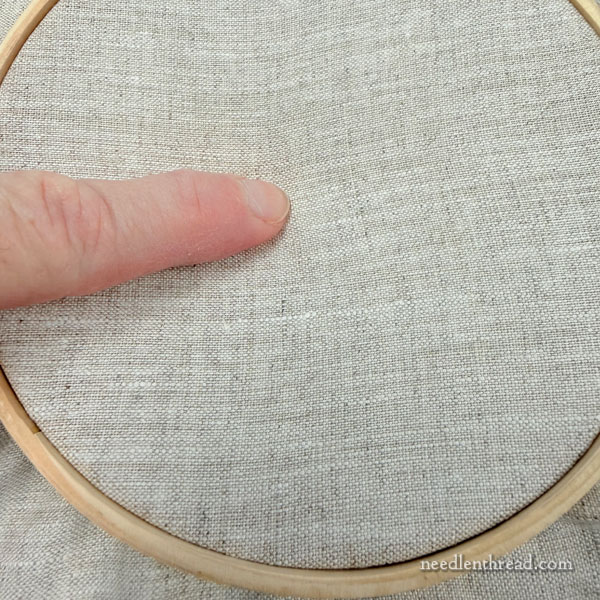
Nope. And there goes the outer ring, upwards again.
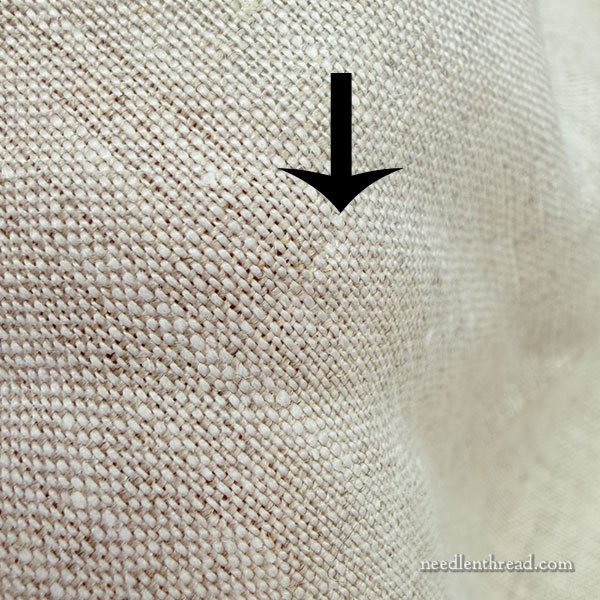
Incidentally, it’s kind of hard to see, but there’s the dent from the grommet after a whole minute in the hoop. That doesn’t bode well, either.
Pros and Cons
Pros: none
Cons: all
It is a non-functional waste of money.
Where to Find It
Do you really want to know?
You’ll have to Google it. I cannot bear to shoulder the responsibility for your disappointment or for the wasteful expenditure of your hard-earned cash.
Well, it was a good $20 spent, if only to prevent you from doing the same! There’s nothing more disappointing than purchasing low quality goods at “high quality” prices. You can buy good hoops for almost half the price of this bad hoop.
Hope your week’s going well!
And, by the way, if you’re looking for quality hoops, these are worth the investment:

Thanks for the warning! I’ve seen this hoop at my local store and have considered trying it out, but never ended up buying it. Good to know I saved $20!
Thank you for the review! I also do not see how the metal strip can act as a strong enough spring without something on the outside of the hump pushing it down. Having hardware that is not countersunk up against your fabric is one thing (not ideal) but what about if you move the hoop and it lands on your stitching? I also wonder about the kind of steel used. Rusting happens even with stainless if it is not the right kind of stainless. Maybe that’s why it’s so expensive. But if the wood is not great quality, then what about the stainless steel! I hope people who have this hoop chime in!
Pretty sure it’s not stainless, but I’m not sure how to test that. It does not indicate that it is stainless steel.
I purchased a Cosmo hoop several years ago and was completely dissatisfied with it. It did not hold the tension and was very frustrating. I agree that it was a total waste of money. Thank you for warning others and saving them money.
I looked at this hoop several times because like my old metal spring hoop and thought this might make a good addition. However, I never bought one because, just like the metal inner spring and plastic outer hoop, there is that gap where no or little tension so about a third of the fabric can’t be stitched well there. I do have good wood hoops (the Hardwicke type) but sometimes struggle with getting good tension as my hands get older (but my ideas don’t!). I have not yet put on the twill tape (need to order some) so that may help.
The wood on the Cosmo hoop is Japanese cypress for anyone who is curious. … Per the info, it shouldn’t splinter.
Thanks, Sandy! It does splinter, unfortunately, so maybe they are no longer using the same type of wood? And it splinters not just a little bit. Since writing the review, I’ve had another section of the outer edge splinter. It happens when I try to push the inside ring out from the outside ring.
It’s like the in-real-life version of those AI embroidery patterns that have no possibility of ever looking like the picture. Thank you for the warning. I hope you can send it back.
On a similar note, I purchased Cosmo Lecien Hidamari Sashiko No. 4345 needles and was very disappointed in how rough the eyes of the needles are. I have avoided anything from the brand ever since.
Though, to be fair, I am trying DMC cordonnet thread despite their needles being lousy also.
On the up side, that bad needle experience led me to finding you when I subsequently went down a needle quality research rabbit hole! Thank you for your work to vet various products!
We are lucky to have you to help us sort through which companies have quality across their range and which ones are just good for thread. Thank you.