

If I had to pin down my favorite topic to explore and write about on Needle ‘n Thread, it would be the Embroidery Stitch.
I like exploring embroidery stitches, playing with specific stitches, trouble shooting them, putting them to work in a variety of ways, experimenting, sampling – you name it, if it has to do with any kind of stitch play, I like it!
So that’s one thing you’ll find in abundance in the archives on Needle ‘n Thread – a wide variety of articles, tutorials, tips, and so forth for embroidery stitches.
As we continue the ABC Archive Dive series, today, for R, we’re going to look at one of my favorite textural stitches, the ribbed stitch. Whether you’re working it linearly (is that word?) or in the round, ribbed stitch (also called ribbed spider web, ribbed wheel, ribbed backstitch, raised backstitch, and so on!) is a fun, tidy looking, textured, and versatile stitch.
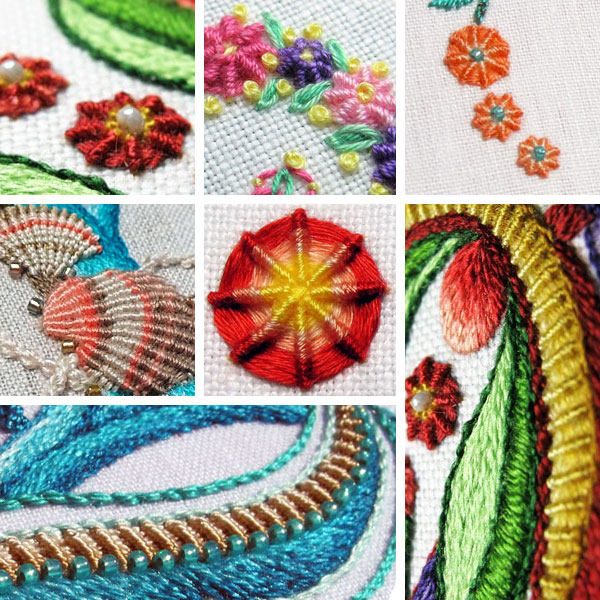
You’ll find a video tutorial for ribbed wheels here. I think this is how we normally or more frequently see this type of ribbed stitch, worked in the round as a textured floral element or accent stitch.
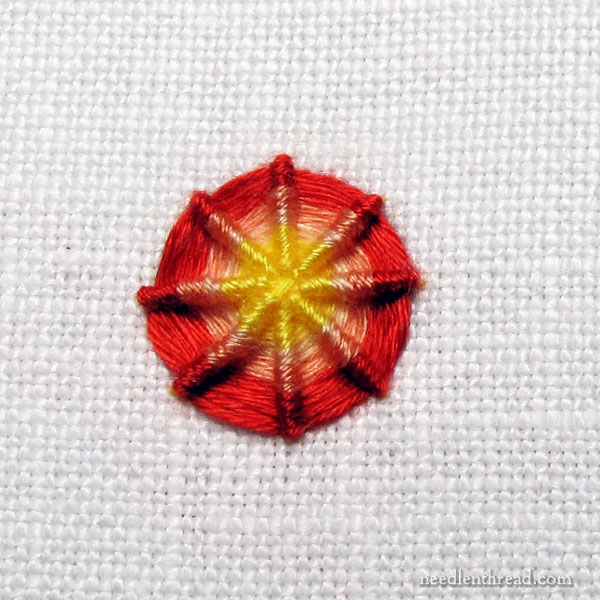
In this tutorial, I explore working ribbed wheels with changing colors.
Projects with Ribbed Wheels
You can find many examples of ribbed wheels in various projects across Needle ‘n Thread.
For example, I used it in Jacobean Sea:
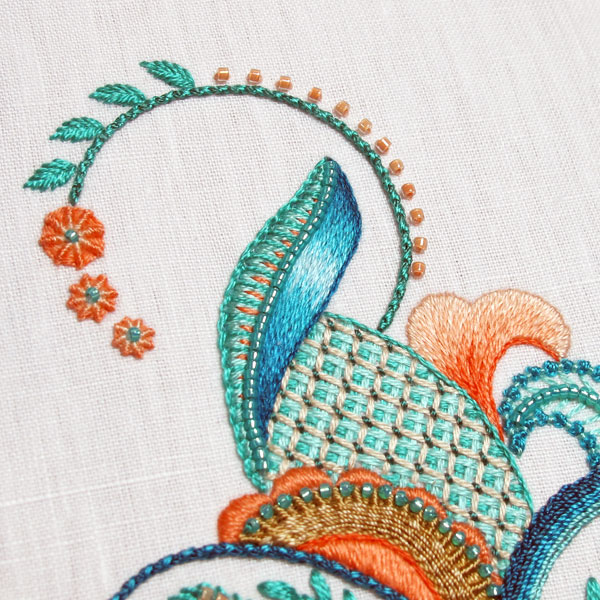
I also used it in Fantasia in Silk:
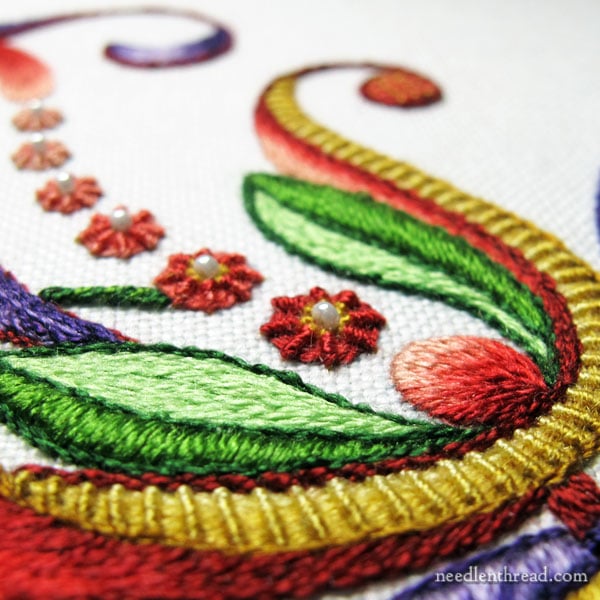
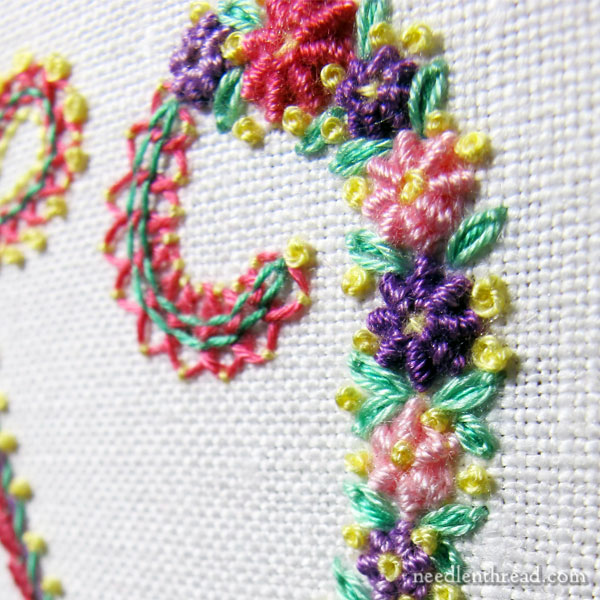
Worked small and tight, these little round ribbed elements are as delightful as colorful little pieces of candy!
Here, I used them to add variety in one of the samples I stitched for Stitch Sampler Alphabet.
Playing with Variations
Playing about with the stitch, I used it to create a “chain stitch (ribbed) spider daisy” and a “raised ribbed spider daisy,” and you can find tutorials for both of those variations through these links:
Chain Stitch Ribbed Spider Daisy
Chain Stitch Raised Spider Daisy
They’re pretty much the same stitch, but one is worked over a foundational “mound” to raise it up a bit.
Worked as a Band
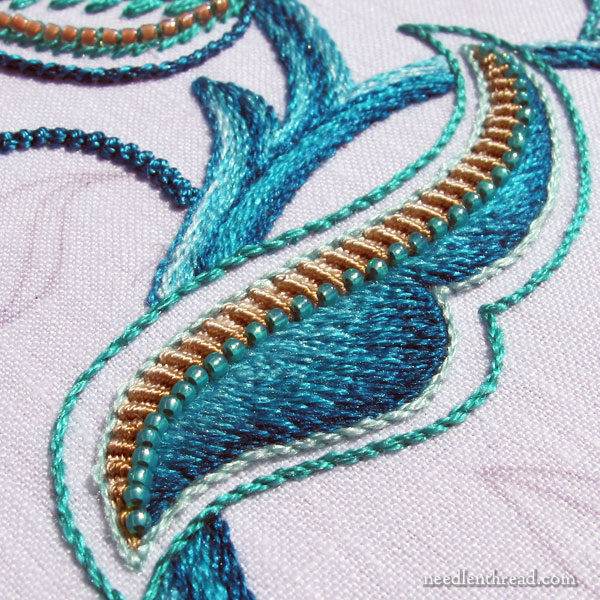
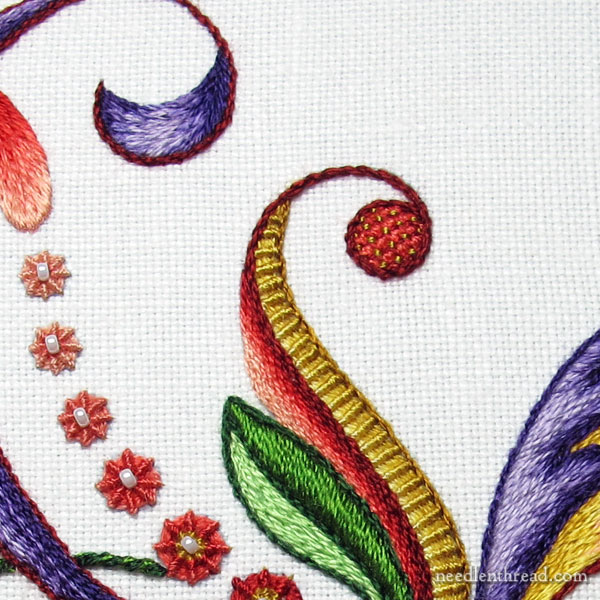
The ribbed stitch can be worked in a linear fashion, too. It doesn’t have to be worked in the round. It can be worked along a band.
You can see examples of the stitch worked in a band on Jacobean Sea:
And also on Fantasia in Silk:
Exploration & Comparison
In this article, I explored how a change in direction when working the stitch changes the finished look of the stitch.
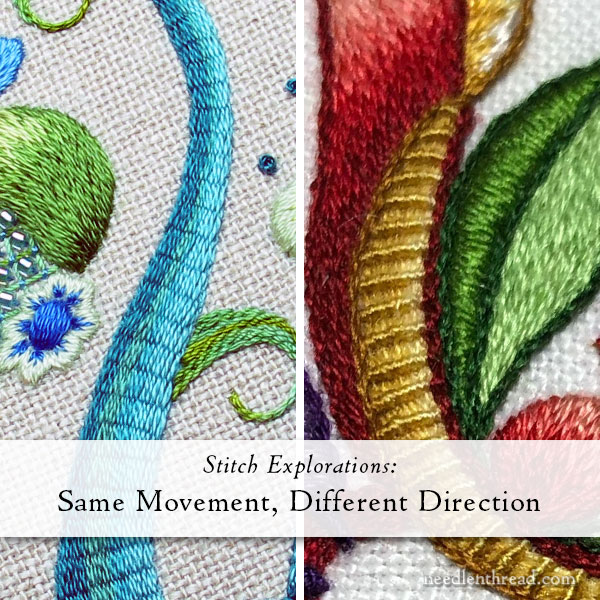
It’s the same movement, but worked from in a different direction – and the result is entirely different. One is essentially a backstitch (the ribbed stitch) over a foundation, while the other is raised stem stitch.
Use it for Other Textured Elements
And finally, you can use ribbed stitches to create textured elements of other shapes, too. For example, the ribbed stitch is a perfect choice for seashells, as you can see in this monogram:
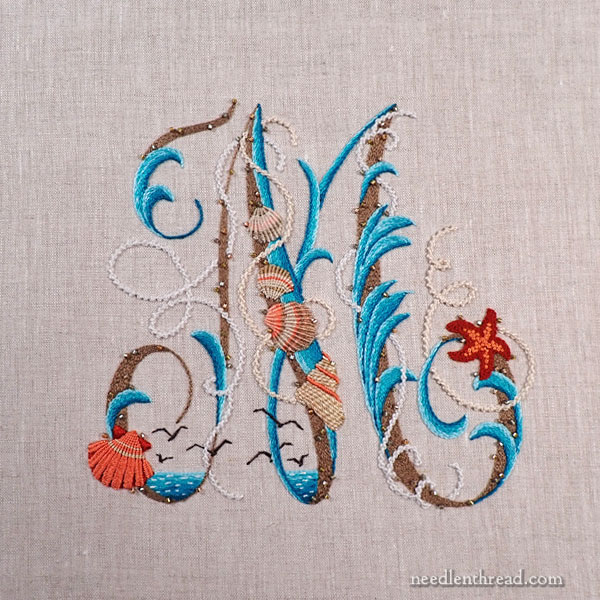
I worked this M monogram from Elisabetta Sforza’s book, A Sea to Stitch. (This title is out of stock right now, but we will have more in stock later this spring.)
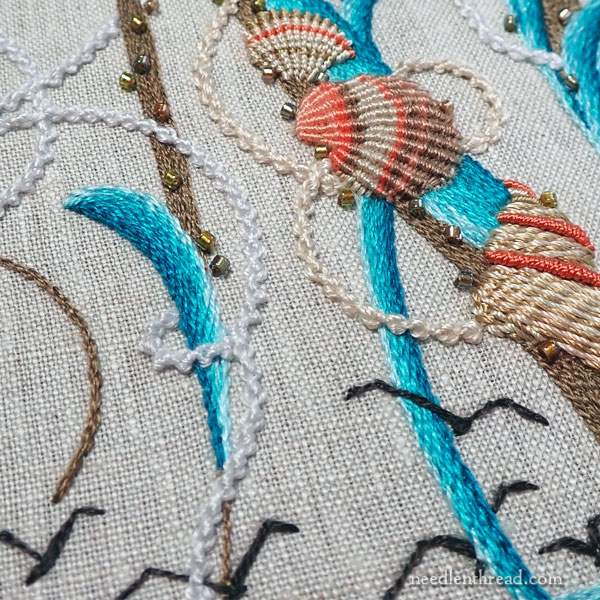
I love the texture in this piece, and my favorite part? Those ribbed seashells!
You can find all the articles relating to stitching the monogram, here.
I hope you enjoy this look back on various projects and tutorials involved ribbed stitches!
If you’d like to explore other articles in this ABC Archives series, you’ll find all the previous articles in the series listed here, alphabetically, in the ABC Archives Index.
Leave A Comment