


Couching is a very simple hand embroidery technique. It involves two threads: a laid thread (this is the thread that is being couched onto the fabric) and a working thread (this is the thread that holds the laid thread onto the fabric).
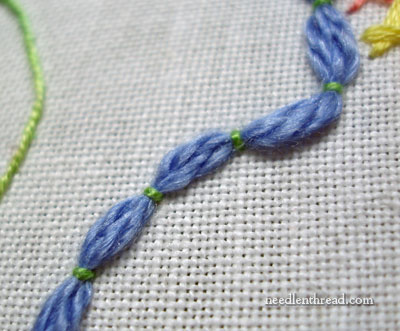
The simple couching stitch involves a small straight stitch taken over the laid thread. In the photo above, a couple strands of blue wool thread are couched onto the fabric using one strand of green perle cotton.
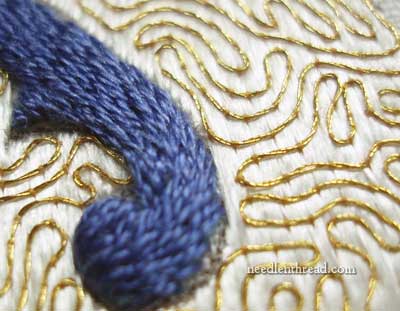
The couching stitch is very simple, and it can be used in all kinds of embroidery, from simple surface embroidery to complex goldwork techniques. In the photo above, the background is covered with a tiny gold thread couched onto the fabric in a technique called “vermicelli.” You can find plenty of tips and information on how to work vermicelli in gold in this article.
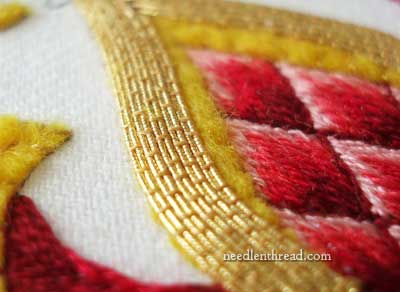
Couching is often used in goldwork. Above, you can see double lines of gold thread couched down over felt padding to fill an area. If you’d like to read a little more about this type of goldwork, you’re welcome to read through all the step-by-step articles for the goldwork pomegranate project .
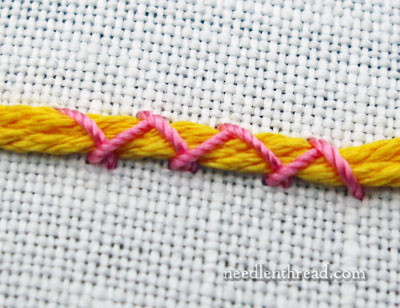
You can also couch threads using a variety of stitches. To read more about this, please visit my Stitch Play article on couching threads using other stitches.
Here’s the video for the basic couching stitch:
Do you want more inspiration & information on hand embroidery?
There are all kinds of reasons to sign up for the Needle ‘n Thread daily newsletter! Check them out and sign up today!
If you’d like to learn some other hand embroidery stitches, feel free to check out my collection of how-to embroidery videos here on Needle ‘n Thread!
If you like what you see on Needle ’n Thread, if you want to be a part of keeping the website thriving (and free of annoying network advertising), why not become a patron on Patreon? Check out my Patreon page here, where I’ll occasionally add special needlework bonuses for patrons.
If you shop on Amazon, you can support Needle ’n Thread without any extra expense to you by visiting my Amazon Recommendations page here, where you’ll find books and sundries for the needleworker available on Amazon.
THANKS! I am really glad you did this video. It is better to SEE how to do stitches than read how-to in a book. This type of stitching is new to me and will of great help to others I’m sure.
That was fabulous…I can see how this would answer all those questions about a stich, you just don’t get by looking at a picture..thanks for doing this.
Eve
Eve and Sheila – glad the stitch videos are helpful!
Thank you for these videos. Do you have any helps for people who are left handed. Most everything is for right handed.
For left handers, you would have to do everything in the stitch “backwards” – although, with this stitch, you can work it the same exact way, but you’d be holding your working thread with your left hand. For stitches like the stem stitch, instead of working left to right, work right to left, and keep your working thread above your needle instead of below it. Hope that helps!
Thank you very much for the videos. They are very helpful.Since I ‘m a slow learner, how to do in books was not that helpful. This videos helped me with the stitches i wanted to do. Thank you again.
thank you for the videos.
the only problem i have is that this, and the last, video do not have audio.
=[[
wow this is a great work and I am really interested in it. In the same way I tried it myself and I found this video my first teacher and now I am doing it on my own clothings. thank you . Also i want tell that this video and the instructions on this site make me go into the work.so no wonder i will visit this site each time I access to internet. Keep up the wonderful work and please keep on adding new things. thanks a lot. bye.
This is clear and I have recently couched a goldmetallic thread on a sampler, but how on earth can I tie down the ends of the thick couched thread? (They are currently sticking out riskily at all angles!)
Take a large eyed needle (that the couched thread will fit into) and plunge the threads to the back of the fabric. Then stitch them securely to the undersides of the couching stitches.
Hope that helps!
these video tutorials are really great help for me.thank you very much.
God bless you!!
Thank you SOOOO much for the wonderful,wonderful videos! I feel like I can do any stitch!! I was wondering if you put cross stitching on video.Thanks again!!
🙂
Are you going back into the same hole?
Thanks.
It depends on how thick the laid thread is… for thicker threads, you don’t have to, just go down on the other side of the laid thread. For fine threads, if you go through the same hole, make sure you don’t pull the laid thread to the back of the fabric – then you’d be doing a whole different technique, called undersided couching….
Thank You so much for all them Video Tutorials
it really helped me to finish off my artwork
I still need to get the hang of Chinese Stitch
ican’t find it anywhere =[
Marilyn
thnx again ! : )
hey,thnx.
this helped a lot for our assignment.
but how about "filling" to do that,?or, does "filling" exist?
This was just what I needed. I haven’t embroidered in years and just couldn’t get this stitch by reading the directions. Thank you!!!
Hi Mary, I have just discovered your tutorials and i love them…your voice is just the right tempo for this and your demostrations are so easy to follow along with your explanations..i had needles, thread and no material but i soon remedied that and went and bought a piece and i have been sitting here following your demostrations..thankyou for an enjoyable rainy afternoon…the older ladies at the craft group i go to will be pleased to see what i have achieved with out interrupting their work, not that they mind..they will teach you anything if you ask them…they love to share their knowledge as well …but again i love your site ..have saved you in my favorites, so i can easily find …cheers
Hi,
mary thanx a lot for putting videos of stiching. i’ve a doubt pls help z german knot stich z same as french knot or z it diffrent. waiting for ur reply.
Fantastic lessons!! I ‘m so glad to find and learn with your videos. Thank you so much from France!!!
Mary,
Like you I just picked up again embroidering that I learned from my grandmother. I just wanted to let you know how much I enjoyed your web-site ! I am so excited will be going to the store soon !
hi mary….
i am new in needle work.I even don’t know basic.. so kindly teach me how nd what to do first…?
I got halfway through my current project before I noticed that half of the detail stitching involved “couching.” My brain came to a screeching halt and I almost abandoned the entire mess. I’ve never come across that before! *lol* Thanks for clearing the confusion, and thanks for the videos! ^_^ Now I’m a bit more confident that this latest (semi-hair-brained) project won’t be a fiasco. Silk purse, sow’s ear, y’know. 😉
i’m very thankful to u that u give us amazing ideas so we can do some thing unique in embrodiry
I realized that in my country blocked the site youtube . more movies you of the site. For the Iranian people , I ‘m sorry I can not access