
After writing some time back about floche, a 5-ply non-divisible cotton embroidery thread, I received a lot of inquiries about it: What is it? What’s it used for? How’s it different from other embroidery thread? and so forth.
So, using a few photos, I thought I’d draw some comparisons between some commonly known cotton embroidery threads and floche.
For the sake of comparison, I selected two relatively common cotton embroidery threads – DMC stranded cotton and DMC Perle Cotton #5. The floche in the photos is also DMC.
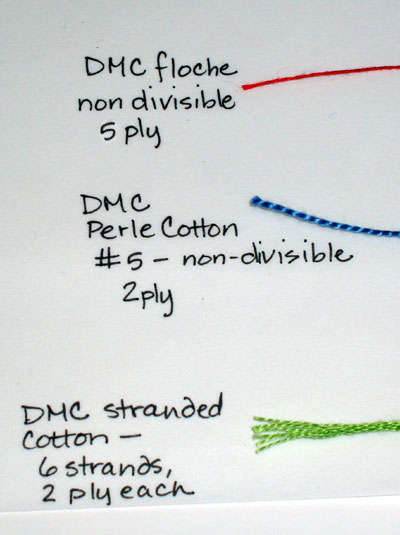
First of all, the terminology: a “ply” is part of a “strand” – the plies twist together to make the strand. So when you look at your regular DMC stranded cotton that you buy locally (the green floss above), you will have 6 “strands” that you separate to use.
Each one of those strands is relatively small, and it is made up of two “plies” that are twisted together to form the thread that you embroider with. “Non-divisible” means that you normally don’t separate the thread into strands to use it, so perle cotton, for example, comes straight off the skien as it is, you cut the length you want, and start stitching with it.
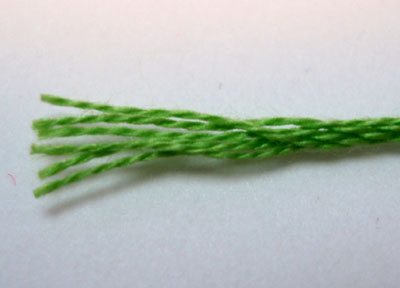
Looking at the familiar DMC stranded cotton first, you’ll notice the 6 strands there, and, if you look closely, you can see the distinct twist of the two plies that make up the strand.
That’s important – the two plies are very visible, and, small as they are when you’re looking at one strand of cotton, they make a difference in what your thread looks like on your embroidery projects. There’s texture there – more so than in the floche, discussed below.
Notice, too, that the twist on the plies is not as tight as it is on the perle cotton in the photo below
The texture from the plies twisting together make a difference in the way your project looks – not just because of the “texture” (as we think of it – rough or smooth, etc.) but also because of the way the light plays off the thread.
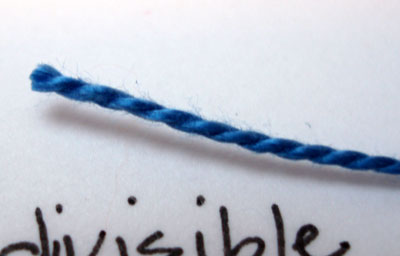
Here’s #5 perle cotton. You can distinctly see the two plies twisting tightly together. They look more like a cord than the twisted plies in the stranded cotton above.
Like the stranded cotton, there’s a texture in the overall thread – the bumps formed by the twist of the plies. You don’t normally think of it, but it is one of the features that distinguishes this thread from, for example, floche. The light reflects off those bumps, and you see them pretty clearly.
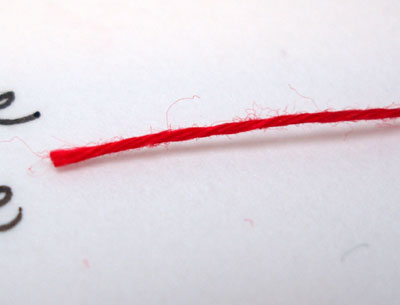
Here’s the floche close up. The plies are a little harder to see, aren’t they? The twist is a little looser than the perle cotton, certainly, and the long twist and the number of plies (5) make the thread a lot smoother looking. You don’t see as clearly the individual “bumps” from the plies.
Now, on a close-up photo like this, it looks like floche is a really fuzzy, hairy kind of thread. It’s actually a very smooth thread.
Size-wise, floche is larger than a single strand of DMC, but not nearly as large as the #5 perle cotton.
Floche is a mercerized cotton (just like the stranded cotton and the perle, which means it’s been chemically treated to give it a shine), but it doesn’t look as shiny as the perle cotton, and in a finished project, it tends to give a kind of subtle “gleam” – more so than the stranded cotton.
Now, what can you use floche for? Well, what can’t you use it for? If you can embroider something with two or three strands of stranded cotton, you can probably embroider it with floche! One strand of floche is equivalent to about 2 strands of DMC stranded cotton.
Floche, I think, gives better coverage and a smoother finish. It isn’t always desireable to use, though. For example, I wouldn’t use it in something like my needlepainted bird or iris – the detail would not be the same at all.
That’s not to say it can’t be used for long and short stitch – it can! – as you can see in this article on long and short stitch with floche.
But I would use it on monograms, and I’d use it on embroidered baby clothing or for smocking.
I would use it in whitework (though I prefer the coton a broder – which is kind of like 4-ply floche – for whitework), and I’d definitely use it in projects that call for satin stitching (floche works up wonderfully in satin stitch) in cotton.
And I’d use it for long-and-short stitch work in bolder designs, for the fun of it. I think it would be wonderful in crazy quilting – it works up very nicely in all kinds of stitches. So the possibilities, really, are only limited to your stitching imagination!
Where can you find floche? It’s available through specialty needlework shops online. Check Lacis – they carry it!
What a great explanation, thank you! I’m going over to check the site you mentioned.
Thank you very much for this information, Mary. I do find all the different possibilities in thread a bit confusing and hard to keep track of. It’s nice to have a visual guide to look at.
Although I do love the convenience of online shopping I sure do wish there were someplace to go to see all sorts of different types of embroidery thread up close and personal. There must be some specialty stores out there, devoted to needlecrafts, that would offer more than the usual DMC 6 strand thread that the chain craft stores carry. I’d probably have to go into Boston for such a thing. – Jeannine
Hi, Jeannine – I think each cost has good needlework shops, and you should definitely be able to find something in the Boston area. The thing is, you probably won’t find “every” kind of thread at one shop. I know in the KC area, there are about 4 shop – all devoted to needlepoint, not surface embroidery – and although they carry some of the same threads at each shop, they also carry something different from shop to shop, so if I want to make the rounds and see a bunch of different kinds of threads, it would take me a whole day – leaving very early in the morning, as the closest shop is 2.5 hours away, and the others stretch out up to a 1.5 hours further down the road. I’ve never actually been able to do that in one day! I rarely make it into the city to go needlework shopping anymore, so I really appreciate the online shops with good selections and good service.
Glad you found the information useful, Susan. Hedgehog is a FUN shop to browse through – be careful! 😉
Hi Mary,
This is a great explanation of different threads and their use. I’m confused by the Article number on DMC products – is there a ‘key’ anywhere online showing what kind of thread Articles 89, 107, etc. are?
I haven’t found a store in the Atlanta area that carries everything either-most stores are chains or totally devoted to either cross stitch, needlepoint or knitting. Thank goodness for the excellent online vendors you recommend!
Terry
Jeannine, I don’t know how far away from Boston you are, but if you go up north at all, Keepsake Needlearts in Center Harbor, NH may be a store worth looking into for threads and such. I’m in Leominster, MA and I know how hard it is to find a good store for any kind of needlework around here, so if you discover something, please share it!
MGM
[email protected]
Thank you for the reply, Mary C. Yep, we’re in the same boat…A boat out in the boonies! I wouldn’t trade it for the world though.
Hello, Mary Grace McNamara! Mary Grace was my mother’s name. 🙂 Thank you sooo much for the information about Keepsake Needlearts! I’m about 1.5 hours away from Boston, and about 2 hours away from Center Harbor, but Center Harbor would surely make for a nicer drive!
I think I’ll for sure plan a nice day trip to check out Keepsake Needlearts. Even though I’m sure I will continue to buy most of what I’m looking for online, it would be nice for a novice like myself to be able to check out a large selection of threads in person and then I’ll have a better idea of what it is I’d like to get more of later.
Thanks again, Mary and Mary.
-Jeannine
Hi Mary, I always enjoy your thread comparisons and although I know (or think I know) some of what you say, it is nice to have it confirmed by another and you always have something extra to say that I did not already know.
CA
Thanks for the post, Mary; I was one of those who was fireing inquiries at you! It’s great to have the differences laid out so clearly. I never knew that ply and strand weren’t the same thing: I used the terms interchangeably!
Just one question. I bought some floche (5 ply) to try out and the tag says “coton floche a broder.’ What then is coton a broder (4 ply) sold as?
-Christiana
Dear Mary,
About threads ow long do they last? I have a large box of different threads from a friend and some seem to be falling apart. Is there a life time for thread. If any one will know its you. some strands seem weak. thank you Mary, Eva
Hi, Eva –
Well, I suppose it depends upon the type of thread and the method of storage. The other night, a friend took out a packet of wools that she had from her grandmother, and that had been in storage for a while, and they were not in good shape – looks like moths got to them and perhaps water or moisture. If threads are stored for a long time in the wrong kind of packaging – something with a high acid content, for example – they aren't going to last very long. But then there are examples of folks who find cotton threads from the middle of last century & earlier that are still usable. So I suppose it all depends. I'm not really an antique textile expert, or a restoration specialist, so I couldn't give you a definite answer, but I think the variables (storage, type of thread, type of dye used, etc.) all bear on the question.
Hope that helps!
MC
Ah – Christiana – floche a broder is 5-ply. Coton a broder is 4-ply. Floche coton a broder = floche. Coton a broder = embroidery cotton. If it’s five-ply, it’s usually floche, to my knowledge. If it’s 4-ply, it’s coton a broder, which is usually sold for whitework techniques.
Thanks for the reply, Mary. Where do you get your coton a broder? I didn’t see any on Hedgehog Handworks’ site and my local store doesn’t carry it.
-Christiana
Hi, Christiana!
I get my coton a broder from Lacis, where you can find it under cotton threads in their online catalog. They have all the sizes. Be aware that most of the coton a broder they sell is DMC, but the #40 (which is the smallest) is by Anchor, and it is a different white – it’s a brighter white than the DMC. It doesn’t look “bad” if mixed with the other DMC sizes in a piece, but it is noticeable. I prefer not to mix them, because I think it makes the DMC look almost dingy – though others haven’t noticed it, so I think it’s just me, being picky!
Floche, I get through Hedgehog.
Wonderful information, Mary! (As always.) I’m posting a link to this article right now. Thank you so much!
Denise
http://needlework.craftgossip.com
I have very basic questions about the embroidery thread. I am a beginner and feel stymied at even the most basic level!
1) How long of a thread is best?
2) If using two or three strands of DMC, am I supposed to twist it before I start embroidering or are they meant to be left untwisted?
Thanks
Hi, Maria –
Thanks for your questions!
I never use longer than an 18″ strand, and with some threads, I restrict myself to about 16″. Once the thread starts getting fuzzy or looking frayed as you’re stitching with it, it’s time to change it.
When using a few strands of DMC, you should “strip” them individually from the main thick strand (of 6 threads). Take one strand out, then take the other (and the other, if using three, etc). Then, you put them back together without twisting them. The point is that you want them to be smooth and to “fill” the stitch, rather than to twist up and get too thin or irregular, which takes away from the look of the stitch.
I hope that helps a little bit! If you have any other questions, don’t hesitate to ask!
Best,
Mary
Hi Mary
I have just discovered your website and confess to being a tad hooked. The discussion about floches etc is fascinating and brings to mind my own abysmal ignorance of the thickness of threads. I know that there a number of ways of describing it, but that just makes it more confusing than ever.
Do you know of a simple (?!) chart or something that explains thickness of threads?
Also can you help me with determining whether a thread has a ‘Z’ or ‘S’ twist please?
Thanks
Hi, Christina –
Thanks for your comment! The question of thread thickness and numbering is an extremely confusing one. I don’t think there’s a “universal size chart” for thread. Normally what I do in describing the thickness of a thread is compare it to threads that most people would be familiar with. But this doesn’t always help, does it?! I’ll look into the subject and see what I can come up with, ok?
For “S” and “Z” twist threads, the easiest method of determining which twist a thread is, is to look closely at a strand of the thread. The direction of the twist will match the direction of the center of an S on s-twisted threads, or the center of a Z on z-twisted threads. Most cottons are s-twisted. Most rayons are z-twisted. Silks are predominantly s-twisted, but there are some z-twisted silks, like Trebizond. I hope that helps a little bit!
I’ll look into the first question and see if I can come up with some information on it, as soon as I can!
~MC
I just found this web site and fell in love with it as soon as I saw it. I would love to have a nice new Christmas present from you. The first time I picked up a hoop many long years ago it has been so easy but for a baby I stopped. Now I see all the stitches I never have done. Please remember me on that very special night.
i am confused about the different numbers of Perle cotton. Which one is for embrodery and which ones can be used for needlepoint. I often see them on sale and do not know which ones to buy.
Can you give me a little help in telling which sizes are for what projects?
Thank you so very much,
Karen
Hi, Karen –
Perle can be used for needlepoint or surface embroidery. Sizes 3 and 5, I think, are commonly used for needlepoint. But they work fine for surface embroidery, too! ~MC
I recently bought two skeins of a beautiful variegated Caron thread. It’s a divisible 3-ply hand-dyed pima cotton; the ones I bought are from their Wildflowers line. The web site and the label tell how many strands to use according to the size of the fabric you’re using, but neither say what size the skein is – #5, #8, etc. The Caron lines obviously come in different thicknesses – you can see that from looking at them. Is it important to know the size – wouldn’t the size of the strand be different with different weights of thread? (To be honest, when I bought it, I thought I was buying nondivisible perle cotton).
Correction: The description found on their website of the Caron Wildflower line does say that one ply is about the same as a #5 perle cotton, or 6 strands of stranded cotton floss. But, you have to get to the website to find this info. I think it should be on the label.
My mom got me some DMC Pearl Cotton, both 3 and 5, at a going out of business sale (so sad that the needlework shop closed), but I’ve only ever used floss for cross stitch and a little embroidery. Is there an equivalency conversion of number of floss strands to pearl cotton strand, or should I look for patterns that call for the pearl cotton specifically? Thanks for the great information on your website!
Thanks so much, this was just the info I was looking for.
Japanese Temari balls require the #5 perle so now I know just what to look for.
Hi Mary,
I was just wondering about perle cotton #5 and I googled the question and this wonderful article came up. I had coupons today – and thought I would finally give #5 a try for 50% off. I also learned that if I were to use 3 strands of my cotton floss – I need to take them out one by one. I usually just grip three strands and put them out together. I can see how they would be fuller individually. Thank you again – you always have my answers.
Hello Mary! Do you know where the DMC floche is available other than the websites you mentioned above? I just started embroidery so I have tons of questions! Okay, so which kind of embroidery floss works best for regular surface embroidery (and is easy to work with!)? I don’t know which ones to buy!!Thanks so much!
~Sky Kim~
Hi Mary:
Great to see a site like yours. Lots of craft stores closing here in Vancouver. I have a Shepherds Bush, Christmas (Jeffery’s Stocking)which calls for DMC Pearl. I have made a lot of these in the past using regular DMC floss. I think you may have answered this question below #21. Would 3 strands of DMC floss be the equivalent to 1 strand of DMC Pearl.
Also this new pattern calls for
Weeks Dye Works #1270 Rum Raisin
Crescent Colors P5 Black Coffee –
Both of these have no DMC equivalent
Hope you can help me
Hi there, I love your site and would like to know if you have any particular websites that you recommend for thread purchases? I am on the hunt for #5 perle cotton and I am just not finding a good source. Thanks.
The patterns calls for some DMC cotton and #5 Pearl cotton. I can’t find pearl cotton #5 in my area…what would be the best substitute. How much difference would it make if I used all DMC..6 strand embroidery threads. The colors are all the same as I own a sample book.
In other words, how many ply (threads of DMC would equal #5 Pearl cotton. I presume it’s the thickness as well as the way the pearl is woven?
Hello Mary,
Thank you so much for this information. I sure have been wanting to understand threads more because of all the brands, types, and weights of threads in the stores.
I was hoping you could help me out. What perle cotton thread is closest in weight and size to Sulky cotton 12 wt thread? It is for use in a vintage Singer Single-Thread Embroidery attachment.
Thank you!
Thank you for sharing your passion! Grateful for such a refreshing resource. Will be here often.
Mary,
Excelente explicação, muito grata!
Engracia
I came back to your site to see the difference between floche and other cotton threads and I found the answer for every question. Thank you for this post.
So glad the information was helpful!!
Dear Mary, which projects here can be achieved with stranded cotton ? Thank you again.
Well, I’m not sure which projects you’re talking about. You can work most projects with stranded cotton if you want. It’s just a matter of substituting threads and making any adjustments for thread weight, technique, and so forth, depending on what you’re stitching.
Mary, hi again. My question was which of your projects can be achieved with stranded cotton ?
Any of them! You can adapt any design or project to embroidery with stranded cotton, so any of the designs here on Needle ‘n Thread will work!
Thank you so much for this information! It was incredibly helpful!
I’ve come across 12 skeins of Cartierre-Bresson Floche Brilliante, 25 (in a circle), 151 Metre 165 Yards. I found out that it is a Size 16. The atricle about the difference between floche, perle cotton, and 6-stranded cotton floss indicated that floche is equal to about 2 6-stranded cotton. What size is DMC Floche? Thank you. Alice
Hi, Alice – yes, you can substitute two strands of regular floss for floche, but in actuality, weight-wise, I’d say one strand of floche is about 1.5 single strands of floss, so it’s finer than two strands of floss, but not as fine as one strand. It’s #16.
I’m curious to know why you don’t recommend floche for embroidering a bird or iris. I’m a fairly new embroiderer, and these bundles of thread look amazing!
There’s no reason you can’t use floche to embroider a bird or an iris.
If you’re needlepainting, and you want to achieve the very natural, delicately painted look of needlepainting, floche might be slightly heavy for that, and you don’t have the extensive amount of shades that you’d find in regular DMC or Anchor stranded cotton, or that you’d find in most silk ranges.
But if you’re not going for that type of look, there’s no reason why you can’t use floche to embroidery pretty much anything in the way of surface embroidery.