

What feels like eons ago – but was really only month before last – we had this little chat about using carbon transfer methods to transfer embroidery designs onto fabric.
Today, we’ll pick up that topic again and talk about a different type of carbon transfer medium.
In the first article, we looked at dressmaker’s carbon. Today, we’ll try something else!
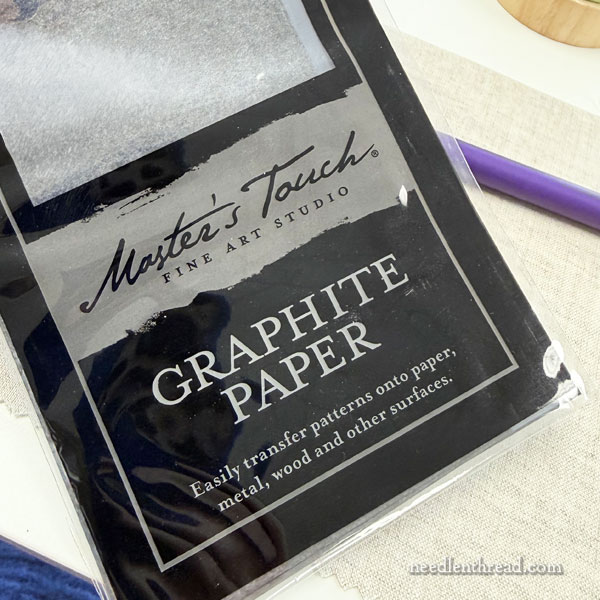
Never underestimate the value of exploring arts & crafts stores to find products that will do what you want them to do, even if they aren’t specifically sold as needlework-related products.
In most art stores, you will find artist’s graphite paper.
There are differences between artist’s graphite paper and dressmaker’s carbon, and those differences can be significant when it comes to using this type of carbon transfer for hand embroidery. So we need to talk about it and weigh pros and cons.
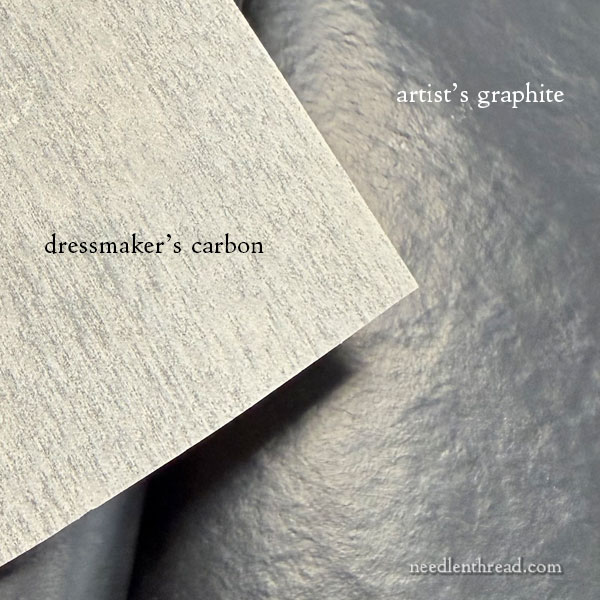
On the left, you’ll see dressmaker’s carbon and on the right, artist’s graphite paper. Obviously, one is much much darker than the other.
The overall advantage of any carbon transfer is that, if it works, it’s a good way to transfer onto fabric that is not suitable for tracing, and it is less time consuming than other forms of transfer on heavy or completely opaque fabrics.
Dressmaker’s carbon is paper coated with a chalky pigment, and it is specifically intended for fabric. It’s intended to be temporary. It is often (but not always) applied with a tracing wheel, and the lines it produces are usually somewhat thick and not necessarily crisp. It can smear and rub off, and often does if you are embroidering something that gets handled a lot.
Artist’s graphite paper is… well, graphite. It is not necessarily intended to wash out (but that doesn’t mean it won’t wash out – often, it washes out ok, especially over time). It will normally produce crisp lines and details well. It can be used over and over again, even on areas that have already been used. While it can smear if it’s rubbed (especially if purposely rubbed), it doesn’t tend to smear or wear off as readily as dressmaker’s carbon.
The most distinct advantage of artist’s carbon is that you can accomplish very fine lines and details, and usually, these fine lines are easy to cover with embroidery.
A distinct disadvantage is that artist’s graphite can migrate to the embroidery thread noticeably, if you’re using light threads. Still, sometimes this effect is desired (ie Appenzell embroidery, where the graphite transfer is characteristic to the finished embroidery), and, like I mentioned, it can wash out.
If you consider that designs for some whitework techniques are transferred via graphite (for example, Schwalm), you will understand that it is possible to remove graphite transfers. Look, for example, at Luzine Happel’s Basic Principles of Schwalm Whitework reviewed here. You can see the graphite transfer of her designs in those images.
Let’s look at the artist’s carbon for embroidery design transfers.
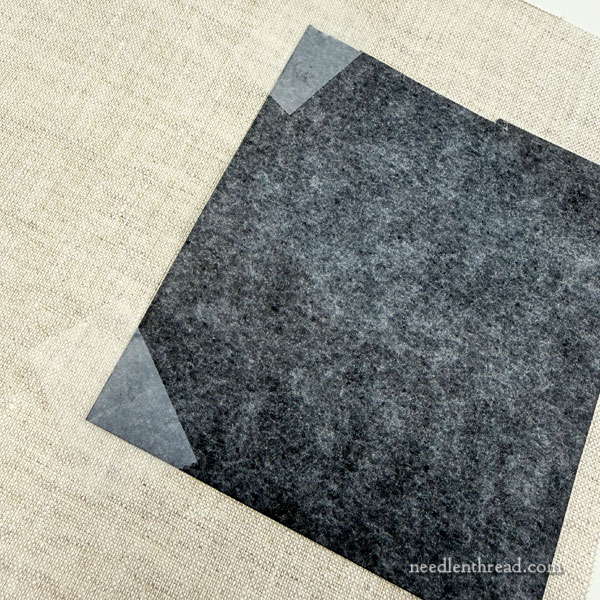
The first test here is on a higher count natural colored linen that has a close weave and a smooth hand.
I’ve taped the carbon gently to the fabric surface, carbon face down onto the fabric.
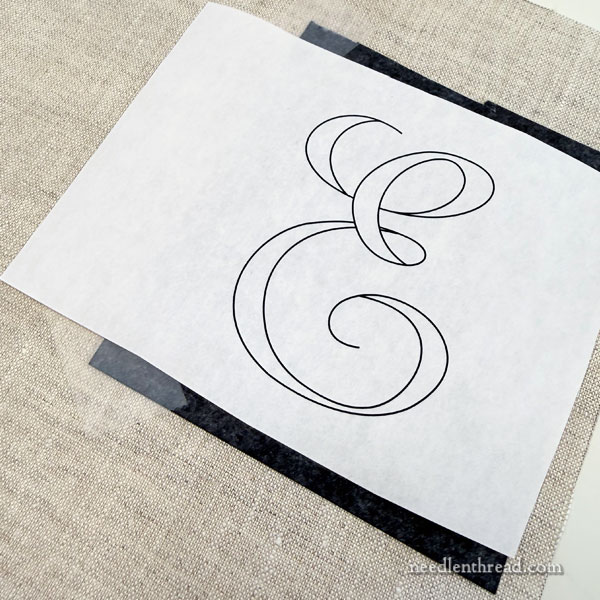
I’ve placed my design on top of the carbon, face-up. It’s just printed on regular printer paper.
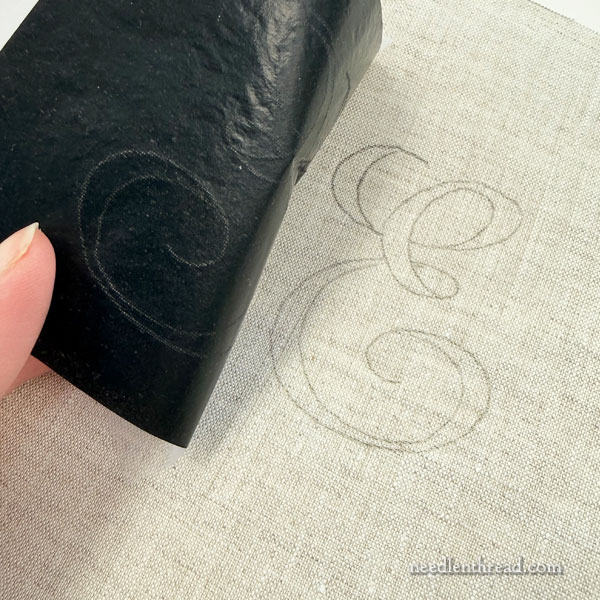
I just used a ballpoint pen to trace over the design, and I didn’t go at it too aggressively, except on one small section, before I remembered I was using graphite paper instead of dressmaker’s carbon.
The transfer is crisp and clear. To achieve this level of clarity with dressmaker’s carbon with the same easy tracing pressure would not really be possible.
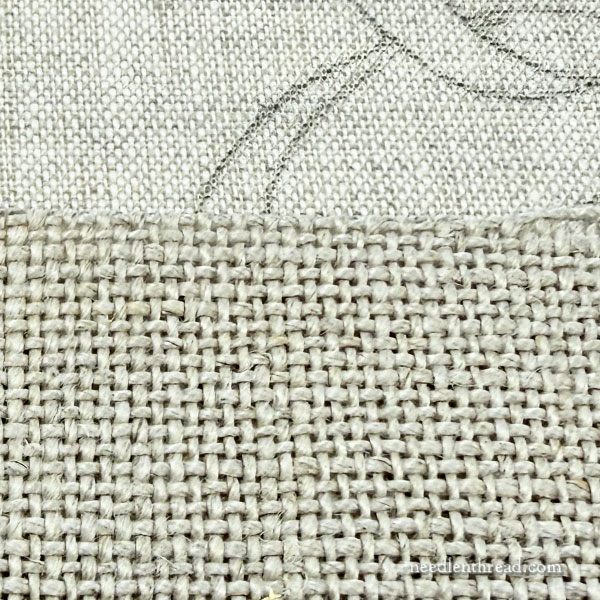
Let’s try it on a much heavier linen, with a low thread count and a chunky weave. This would be the type of fabric that’s impossible to trace on, even with a good light source behind the linen.
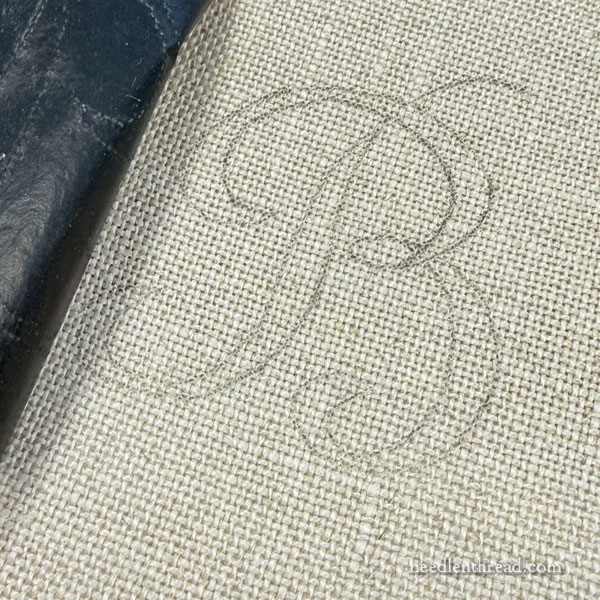
Not a bad transfer! I was a little more aggressive on the pen here and there out of habit, so you can see where the line is a bit darker where I was a bit more aggressive.
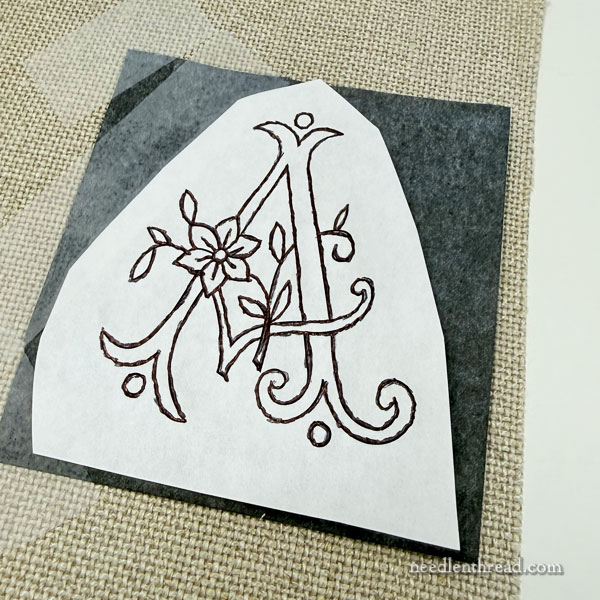
Let’s try something a little more detailed. I was a bit sketchy with my approach with the pen on this – you can see that I didn’t transfer with one continuous line, but rather “sketched” or “colored” the line with the ball point.
I don’t think that this much aggressive “coloring” of the line is necessary, but the level of pressure when transferring will vary from person to person, fabric to fabric, design to design. Test!
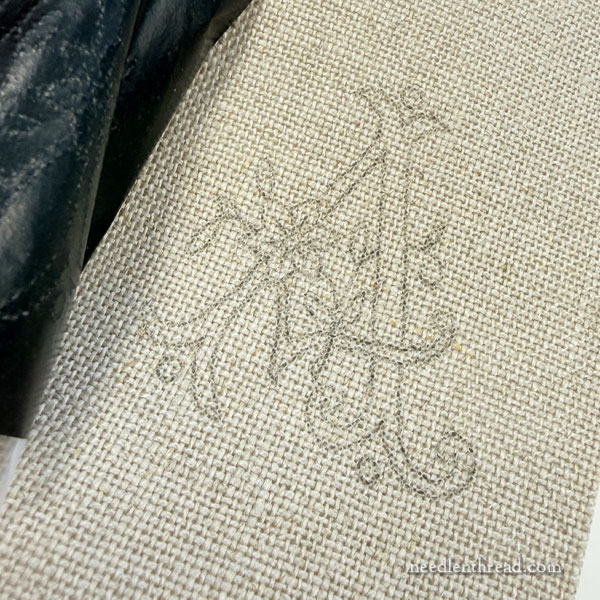
Even on chunky fabric, that’s a pretty clear carbon transfer.
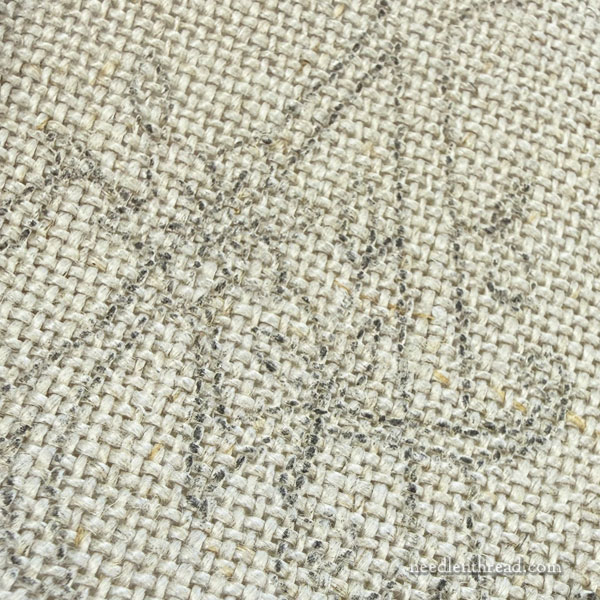
If we zoom in close on the image, you can see the darkness of the graphite on the fabric threads.
If you’re going with this type of transfer for a project, take the time to test the fabric and the thread with this transfer technique before committing whole-heartedly to it.
I’d work a small sample of the design, transferring it via this method to a small piece of the ground fabric I intend to use. I’d use the same threads I plan to stitch with and stitch a portion of the sample. I’d check the threads for any graphite migration. If there is any notable graphite migration, I’d hand wash the sample to test the removal of the graphite.
Interestingly, with Schwalm whitework, after embroidering, the linen is boiled for a while, and the graphite disappears completely. Whether or not this method will work for your project depends on the threads you’re using! Test, test, test.
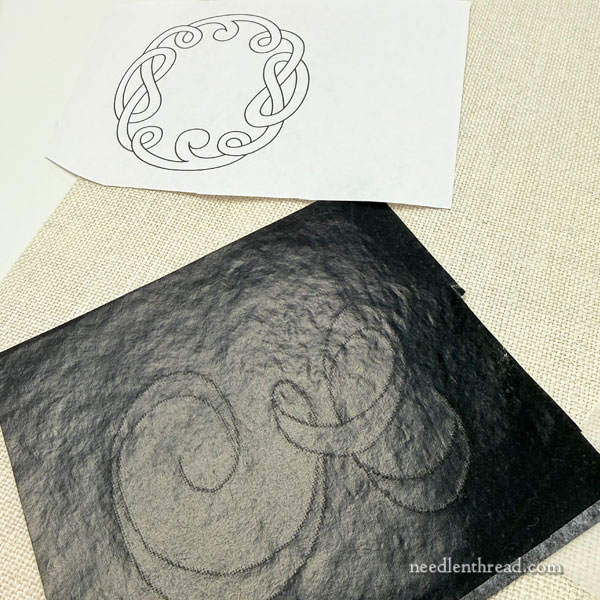
Here’s a used piece of artist’s carbon. I’m going to use it again, right over the previously used area, to transfer a more intricate design.
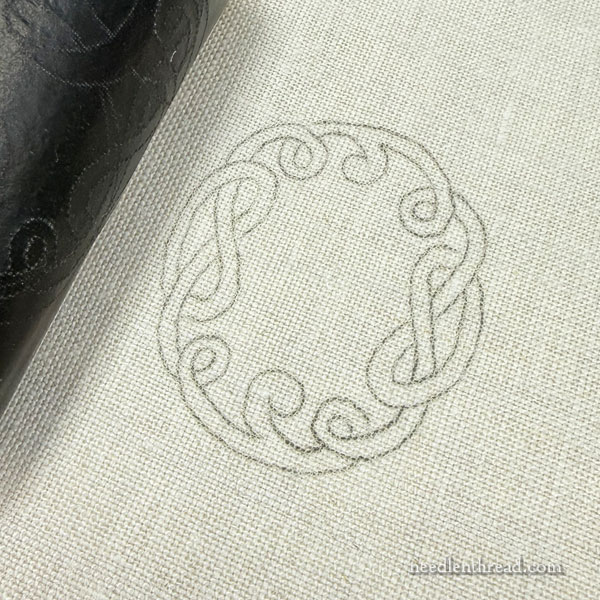
I transferred the design onto a medium weight natural colored linen. It’s probably about a 30-32 count linen, so not as low count as the above chunky-looking natural linen, which is 24-count, and not a high count linen like the first linen (which is a 50-or-60-something count plain weave).
The transfer is nice and clear, with no skips in the design where it ran into the used portion of the carbon.
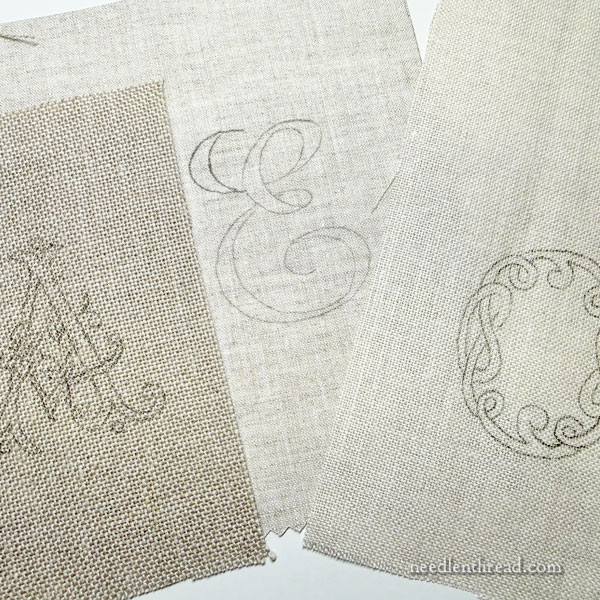
Here are all three samples on three weights of linen, using the artist’s carbon. It works well for details, even on the heaviest weight linen, which is usually a bear to transfer detailed designs on.
Test! Test! Test!
As you can see, there are advantages and disadvantages to using artist’s carbon for transferring embroidery designs.
It does work, and it is a viable option under many embroidery circumstances.
If you are interested in using this kind of carbon, my advice is to test the technique for your particular project by transferring a small sample of your project on the fabric you intend to use and stitching that sample with the thread you intend to use to see if it works for you. If you notice graphite migration, hand wash the sample in a way that is recommended for the threads you are using.
At that point, you should be able to make an informed decision of whether or not you want to use this method of transfer.
Coming Up!
We’re not quite finished with this subject – I’ve got a few more samples and tests to show you soon.
I’m also going to review a new product on the market (also having to do with transferring designs) and share some thoughts about it.
Earlier this week, I mentioned my Border Blunder. I’ll share a blunder and my fix for it. Yes. It was a real blunder. And yes. It looks pretty bad. But … what can one do? Well, we’ll see!
And I’ll introduce you to our upcoming stitch-along, Blackberry Brambles & Blossoms. This is a little project that’s been in the works for a while, on and off the burner. We’ll have a limited number of kits available, and I’ll go over all the stitch-along details once we have the launch date set in stone.
Your website and embroidery tutorials have been very helpful. I read your article comparing artists graphite and dressmakers carbon for transfering. Can you tell me about Sticky Fabri-Solvy Printable Sheets? Will this product work for transferring patterns to linen?
Thank you.
Hi, Kathleen – sticky solve isn’t a transfer medium that puts the design directly on the fabric. It’s an adhesive-backed stabilizer that you feed through your printer. The design prints on the stabilizer, like it would on paper. Then you peel the back off the stabilizer and you stick it onto the fabric. You stitch through the stabilizer and the fabric, and then you wash away the stabilizer (it dissolves in water). The process works fine for some embroidery applications. It would not work for bead embroidery, goldwork, anything that has extra anything on it, other than colorfast thread on washable fabric. It would not work if using overdyed threads or stitching on overdyed or hand dyed fabrics – or on anything that you don’t want to submerge in water. There is also the matter of the “sticky” part. While many folks aren’t bothered or don’t notice the “sticky” part, others do. I have used sticky solvy and similar products for some embroidery, and I don’t mind it for casual, washable goods, but I do sense the gumminess on the needle after a bit of stitching on it.