July 10, 2013
Organizing Future Embroidery Projects
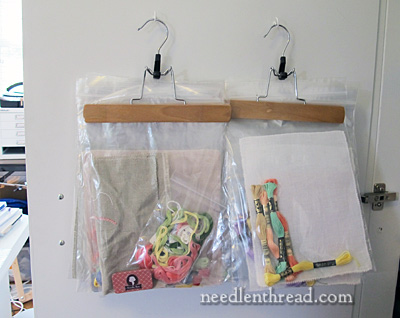
Yesterday, when I mentioned the tip on using spray starch when transferring embroidery designs, one thing I didn’t expect was an influx of email asking about the last picture in the article:


I learned to embroider when I was a kid, when everyone was really into cross stitch (remember the '80s?). Eventually, I migrated to surface embroidery, teaching myself with whatever I could get my hands on...read more
Contact Mary
I learned to embroider when I was a kid, when everyone was really into cross stitch (remember the '80s?). Eventually, I migrated to surface embroidery, teaching myself with whatever I could get my hands on...read more
Contact Mary
July 10, 2013
Yesterday, when I mentioned the tip on using spray starch when transferring embroidery designs, one thing I didn’t expect was an influx of email asking about the last picture in the article:
July 9, 2013
Last week when I reviewed the LightPad for transferring embroidery designs, I mentioned that I’ve transferred 52 monograms in the past month-ish. This generated a lot of questions, but the most common one was about the transfer process itself.
What do you use to trace monograms (or any patterns) onto linen, if the monogram is going to be laundered. Should the transfer be permanent? What if you can’t cover it up?…. Lots of questions about tracing designs.
I’m pretty sure I’ve mentioned this tip before on Needle ‘n Thread, but if not, I should have! It deserves its own article, its very own space in cyberspace.

July 8, 2013
Last week, we delved into the fun of creating fluffy stitches by examining Victorian Tufting, a technique involving layers of herringbone stitch which are cut and then fluffed up to create a dimensional pile on the embroidery surface.
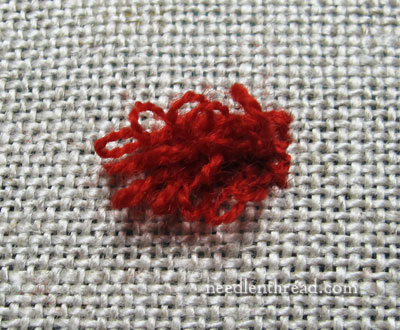
Today, just for the fun of it, let’s look at another fluffy stitch. This one is called velvet stitch, and although it’s more often seen in canvas work, it can also be used in surface embroidery.
July 6, 2013
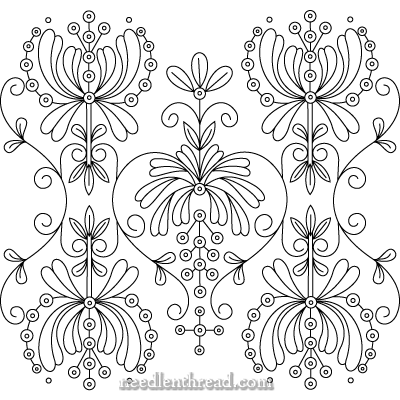
I’m calling this free hand embroidery pattern Art Nouveau, although it doesn’t quite have all the qualities of an Art Nouveau design. I think the reason Art Nouveau came to mind was because this is a pattern from an old catalog from the early 1900’s.
This was originally a cushion pattern, and the full embroidery design could certainly be used in the same way. But what I like about this particular design is that it can be taken apart fairly easily and reconstructed into different design schemes. It can be rendered in embroidery in many different ways.
July 5, 2013
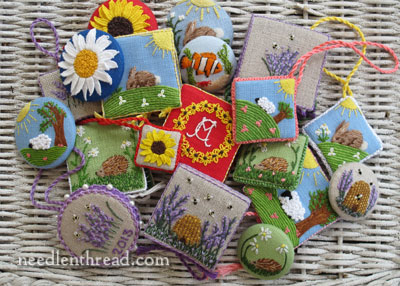
How long has it been since I started making these little embroidered things? I started talking about them last summer – almost a year to the day, today – after I had already been playing around with them for months. And you know, given the fact that these things are little, you’d think that they’d also be quick!
And they are, when it comes to making them. When it comes to putting together an e-book about them, that’s a Whole Nuther Story!
The other day, I had a little family reunion with many of them. It was a regular little party!
July 4, 2013
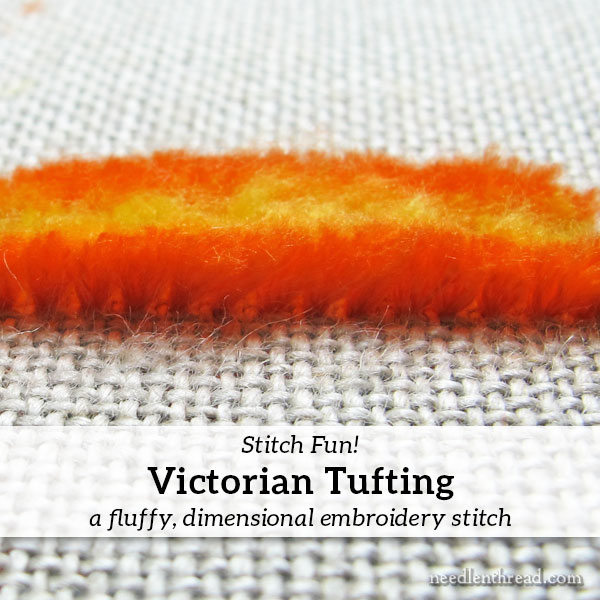
In case you have time off this weekend – and between Fourth of July celebrations for those of us in the States – maybe you can squeeze in some Stitch Fun! This stitch is particularly fun, because it’s fluffy.
When it comes to creating a fluffy finish with your embroidery stitches, there are a few options for stitches that work well. Probably the best known of these is Turkey Work, also known as Ghiordes knot.
Victorian Tufting is another method of working up some fluff on your embroidered surfaces. And in a sense, it’s a little easier than Turkey work, because if you already know one basic embroidery stitch, then you already know how to work Victorian Tufting.
July 3, 2013
Sometimes, when it comes to hand embroidery, equipment just complicates things. When you think about it, does an embroiderer need a lot of equipment? Not really – needles, a hoop, some sharp scissors, and that about covers the basic needs relating to hand embroidery.
Yet I’ve invested in a new piece of equipment, and although originally I had no intention of writing about it, the Inordinate Infatuation I have with it compels me to write about it.
I’m Excessively Fond of it.
And, more to the point, it’s a Really Handy Piece of Equipment, especially if your primary way of transferring embroidery patterns is by tracing.