December 3, 2012
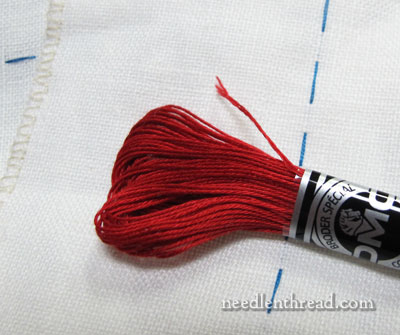
Pull Here. No. Don’t. Aaargh.
We’ve all used them at some point in our needlework lives.
They’re called “pull skeins.” And if you pull in the wrong place, you’ll be pulling your hair out in frustration before too long!


I learned to embroider when I was a kid, when everyone was really into cross stitch (remember the '80s?). Eventually, I migrated to surface embroidery, teaching myself with whatever I could get my hands on...read more
Contact Mary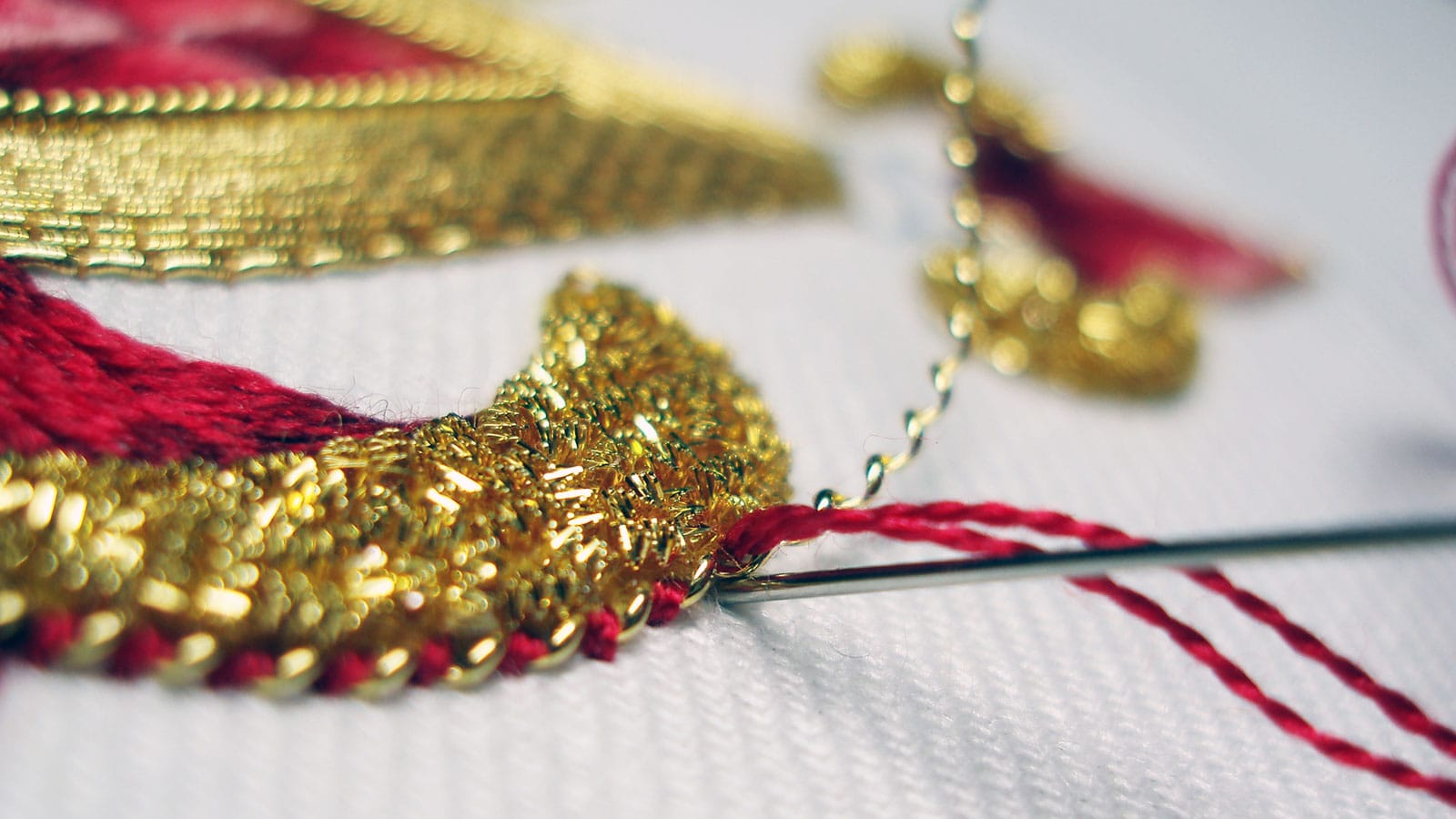
I learned to embroider when I was a kid, when everyone was really into cross stitch (remember the '80s?). Eventually, I migrated to surface embroidery, teaching myself with whatever I could get my hands on...read more
Contact Mary

December 3, 2012
We’ve all used them at some point in our needlework lives.
They’re called “pull skeins.” And if you pull in the wrong place, you’ll be pulling your hair out in frustration before too long!
December 1, 2012
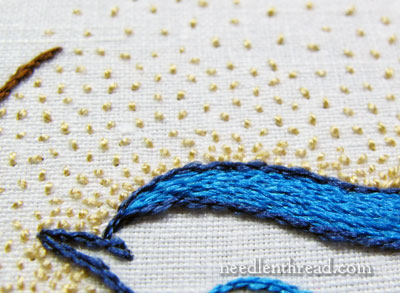
Here’s a little update on the behind-the-scenes project in silk and gold that I’m working on. It’s for publication in a book (2014), and I’ll tell you more about it (and the book – I’m just contributing, not writing it) closer to publication time. When I was asked to contribute a project, at first, I was a bit hesitant. But now that the project is this close to being finished, I’m glad I participated. I’ve learned a lot!
Because the piece is for publication, I can’t really show you the whole thing. But I can show you snippets, and I can even troubleshoot some aspects with you, and discuss different techniques involved. So today, I’ll show you a technique that’s called “stippling” in art, but in embroidery, we just call it seed stitch or seed stitch filling… but if we want to, we can call it stippling, too.
November 30, 2012
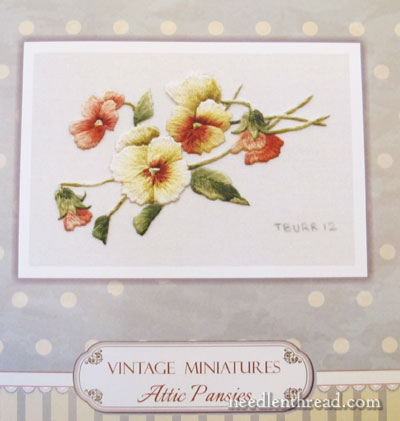
Have you seen Trish Burr’s miniature needlepainting kits yet? Inspired by Victorian vignettes, they’re called Vintage Miniatures, the newest addition to her collection of beautiful needlepainting kits. There are two Vintage Miniatures in the collection so far, but I suspect (and hope!) the collection will expand!
The Vintage Miniatures are a combination of Too Cute for Words and Really Pretty.
(Too Cute for Really Pretty Words? Hmmmm….)
I thought I’d review one “out of the envelope” so that you can see what they’re all about. I’ll show you what’s included, chat a bit about some finishing ideas, and then discuss how to get the kits, and maybe how to save a little money doing so.
November 29, 2012
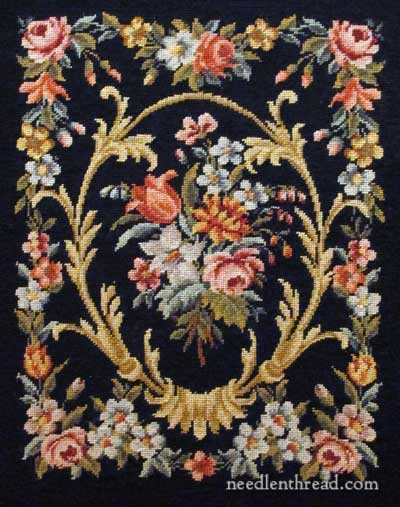
Originating in Germany in the early 1800’s, Berlin wool work spread to England and then to America by the mid-1800’s as a popular form of needlework. It was among the first amateur needlework techniques to become all the rage for the middle class women in Victorian England.
Relying on “point paper” (graph paper) charts made more accessible thanks to innovations in colored printing, and using a soft, thick wool that took dye well (hence, it was available in many colors), Berlin work relied primarily on tent stitch to fill the needleworker’s canvas. Floral designs were popular, and often abundantly lavish – abundant lavishness in decor being something the Victorians managed quite often.
Berlin work began its demise with the advent of the Arts & Crafts Movement, which moved needlework in totally a different direction.
Berlin wool work is the direct predecessor of today’s canvas work and counted cross stitch.
November 28, 2012
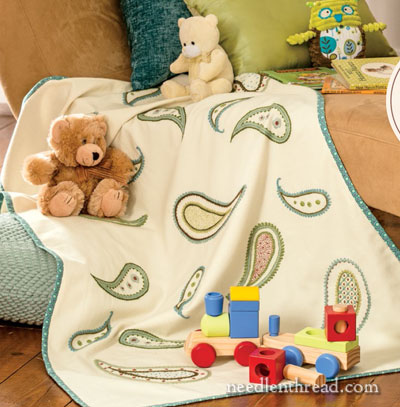
Today, I have the pleasure of announcing the two winners (drawn randomly) of Blissful Beginnings: Embroidered Blankets to Cherish, a beautiful new book by Country Bumpkin featuring a collection of gorgeous hand embroidered blankets and matching accent pieces.
It’s a lovely, lovely book. And the blankets – ahhhh! They’re works of art! And they make me want to snuggle. (There aren’t too many works of art you can say that about, are there?)
November 27, 2012
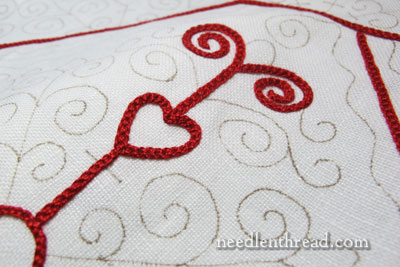
Normally – practically always, as a matter of fact – the embroidery projects I work on are mounted on an embroidery frame or in an embroidery hoop. For some types of embroidery, it’s essential to use a hoop or frame.
Goldwork and silk embroidery (like the Medallion project, this goldwork pomegranate project, this goldwork and silk Agnus Dei project, the little Tudor rose, and so forth) absolutely require that the work is mounted on a taut frame. Crewel embroidery (i.e. this crewel rooster) also benefits from mounting in a frame or hoop.
There are other types of embroidery, though, that don’t necessarily need to be worked in a hoop or frame. The skilled embroiderers of Madeira, for example, worked their delicate and beautiful whitework motifs without a hoop, in their hands, with their worked wrapped around a finger to gauge tension.
And certainly, there are many situations where embroidered linens and the like – adorned with typical surface embroidery stitches – can be easily held and worked in the hand, without the use of a hoop.
Today, let’s chat ourselves up a bit about working in hand, without a hoop.
November 26, 2012
This time of year, I try to avoid getting caught up in the hype that pervades the commercial pre-Christmas season.
Still, I do like a good needlework deal when it comes along, and since needlework shops don’t often have sales, it’s nice to know about them when they happen!
Here are just a few online needlework-related sales going on today. If you happen to know of others, feel free to leave a note in the comment section below.