
Now You See It, Now You Don’t. Now You See It.


Amazon Books

There are several reasons why water-soluble, air-soluble, and “erasable” transfer pens for tracing embroidery designs make me a bit nervous. One reason is that the pens are made of a chemical substance that, in the long run, may affect fabric and threads. I tend to think that anything too chemical-ish is not the best choice to use on a fabric. Another reason is because I don’t trust them on two points: 1. I have witnessed a discoloration of fabric / threads from them; and 2. I have witnessed them re-appear as magically as they disappear.

That being said, on cotton fabric with colored cotton thread (for example, household projects like flour sack towels or pillowcases), I have used them to good effect, without any problems.

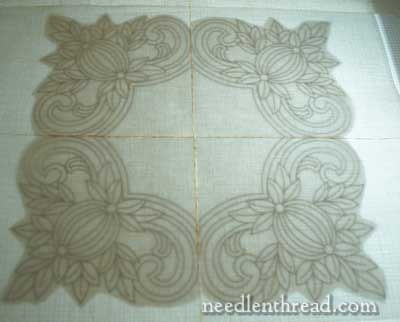
I recently procured an “erasable” water-soluble transfer pen, and I thought I’d give it a try. I was really curious about this “erasable” part! Was it a gimmick? I was also curious about how fine a line the pen would draw. Fine lines, even with marks that will wash away, are important to me in a transfer – the finer the line, the more accurately the line can be followed while stitching.
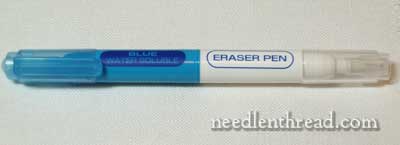
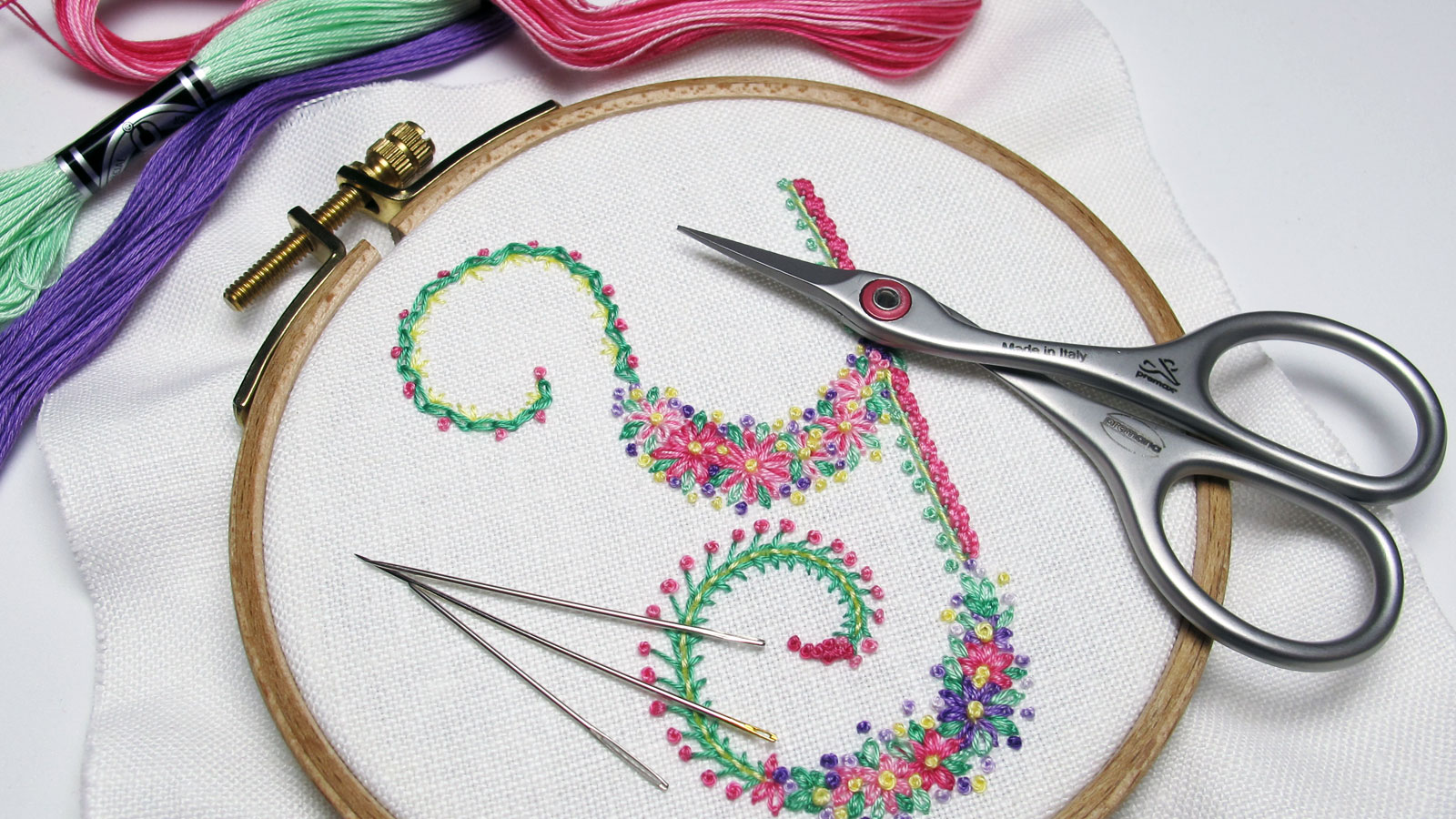
Water-Soluble and Erasable Transfer Pen for Embroidery Designs
Continue reading “Now You See It, Now You Don’t. Now You See It.”

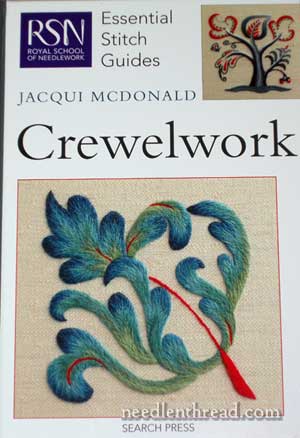
Book Review: RSN Essential Stitch Guide for Crewelwork


The Royal School of Needlework has begun publishing a series of “essential stitch guides” for various needlework techniques. The first two to come out in the series are on crewelwork and blackwork, and it looks as if two more will not be long in coming.

The title of the series indicates exactly what the books are: guides to the essential stitches used in the given technique. Keep in mind that they are not project books – you won’t find any practice projects in them, or anything of that nature. Rather, you’ll find the essential information for getting started (and progressing) in the needlework technique.

Royal School of Needlework Essential Stitch Guide for Crewelwork
Continue reading “Book Review: RSN Essential Stitch Guide for Crewelwork”

Jumble Project: Chain Stitch Swirls in Spun Silk


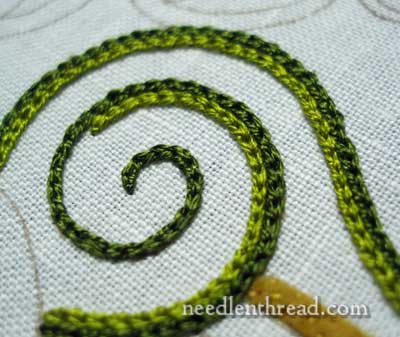
Last week, I showed you a “sneak peek” of the Jacobean Jumble embroidery project that I’m working on. I’ve taken a couple little turns in this project (in a number of ways), and am adjusting things as I go. Today, I thought I’d show you one turn in particular – a chain stitch swirl, worked in Soie d’Alger, which is a spun silk that’s used pretty much the same way you’d use stranded cotton.

Only it’s silk. And so it’s softly shiny, as only silk can be!

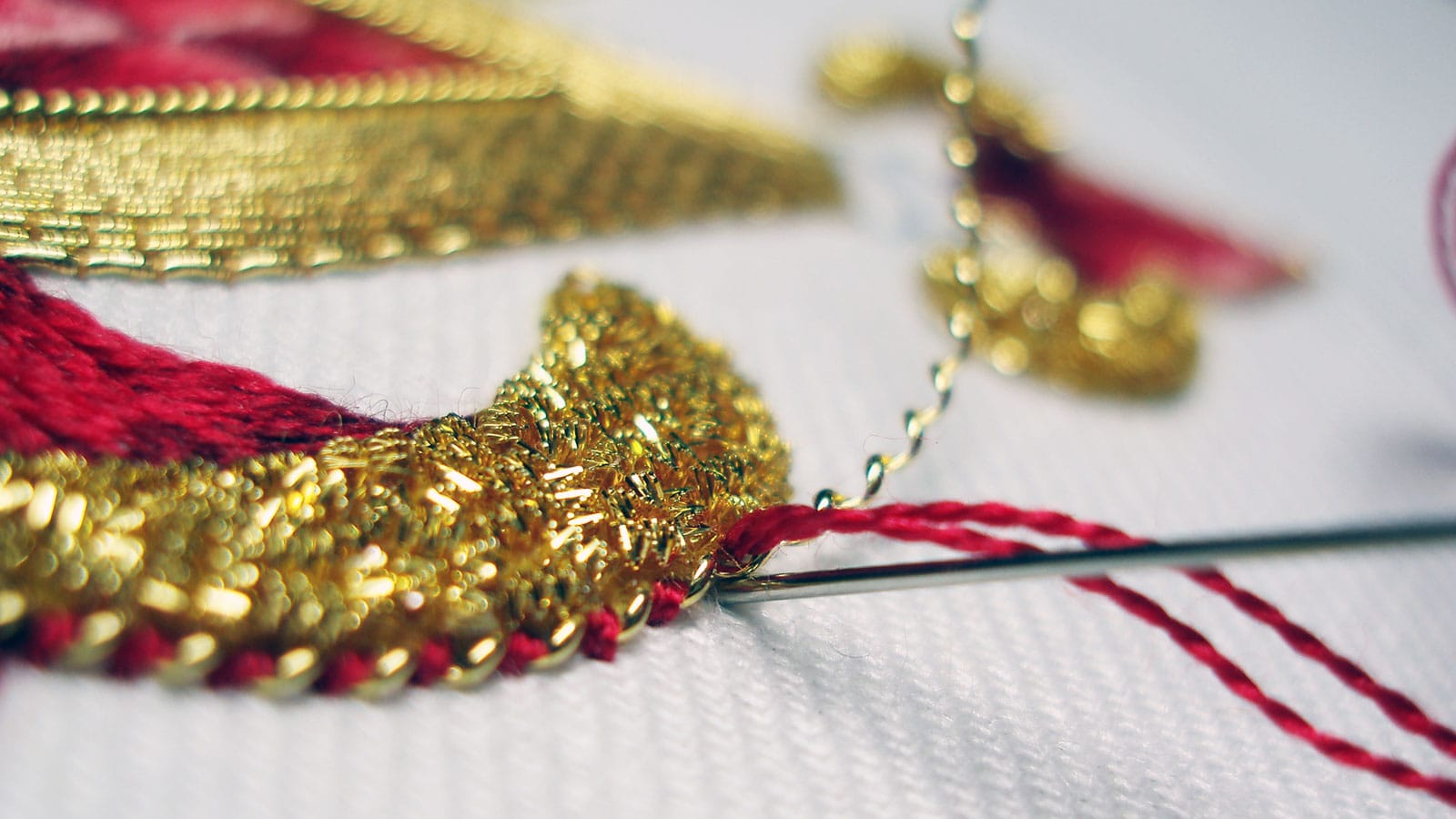
Jacobean Jumble embroidery project: chain stitch swirl worked in silk
Continue reading “Jumble Project: Chain Stitch Swirls in Spun Silk”

Spool Needlearts Quarterly – Winter Issue, 2011


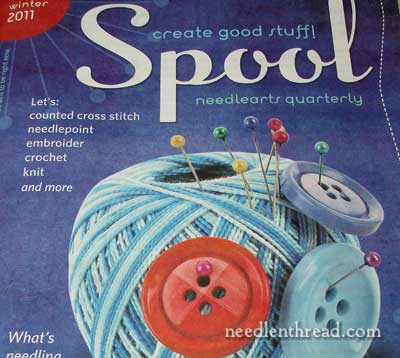
On chilly winter days, there’s nothing better than coming home from work for a lunch, picking up the mail, and finding a needlework magazine just waiting for exploration. A great way to spend a lunch hour – inside, warm, with a cup of tea and something interesting to browse through. That’s how I spent my lunch hour the other day – browsing through the Winter Issue of Spool, a quarterly needlearts magazine.

Last July, De Selby announced the premier of her new needlework magazine called Spool, and since then, two issues have hit the press and arrived in the mailbox. With the first issue, there was a flutter of reviews on various needlework blogs, so I thought I’d hold off a review until the second issue. And I’m glad I did! The second issue is a lot of fun – take a look!

Spool Magazine
Continue reading “Spool Needlearts Quarterly – Winter Issue, 2011”

Another Needlework Tool: One I LOVE and Wouldn’t Be Without


Well, after yesterday’s post about Thimbles, it’s hard to follow up on anything that could generate as much input! I really, really enjoyed reading everyone’s comments. If you haven’t read them yet, do take some time to – you’ll hear all about thimbles in the lives of needleworkers, why they’re liked, why they aren’t, substitutes for thimbles, special memories and stories of thimbles, and so forth! Fun stuff to read! Thank you!

One more little tool post for the week – back to the subject of scissors – and then I’ll leave off tools for a bit.

Maybe… I can’t believe it, but I did buy another little tool just yesterday, when I had to zip into the city after classes, and managed a quick stop at the LNS for some DMC.

Hm. Imagine: You’re walking down the street, collar up against the wind, darkness coming on, and you pause to ask passers-by: “Can you point me to the closest LNS? I need some DMC.” Methinks you’d be suspect to Shady Things.

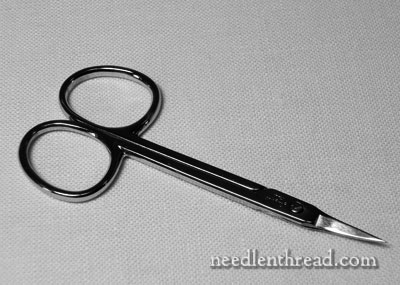
Anyway – that new tool aside, here’s the thing: I love my good scissors. My absolute favorite scissors. They’re sharp, they’re thin-bladed, they’re reliable. They’re just great. But there’s another pair of scissors I wouldn’t be without, and after several months of using them, I consider them essential for my workbox.

Curved Embroidery Scissors
Continue reading “Another Needlework Tool: One I LOVE and Wouldn’t Be Without”

Open Thimbles Saves Fingers!


Who woulda thunk it? I am using a thimble! I have never used a thimble for embroidery in my life – except once, in a trial-and-error-this-thing-is-ridiculous situation.

I’ve always found thimbles awkward and clunky when I’m trying to embroider. My grandmother used to use one, and I suppose that it’s just a matter of getting used to the things before they become second nature. But I’ve never gotten used to them, and I’ve never had much use for them, when I’m doing embroidery. (Hand-sewing is a different story, for a different day.)

Lately, while working with a tiny needle (it’s always the tiny needles that get you!), I developed what seemed to be a permanent hole in the side of my first finger where I habitually push on the eye of the needle as it enters the fabric. In the past, I’ve dealt with this little sink hole (which the needle invariably locates and enters without compunction!) with a dab of superglue. See, my Dad has always sworn by superglue for these types of things. Superglue, in my house, cures all kinds of skin cuts – from chapped and splitting winter skin to paper cuts… to needle holes. Think “Big Fat Greek Wedding” and Windex, only for us, it’s superglue. But it’s not the best thing to put on skin, and it takes forever for the skin to soften up after it’s been superglued.

When hand quilting, I’ve used leather thimbles and they work ok for me. And they aren’t that great when working with finer silk embroidery threads, as the threads tend to catch on them.

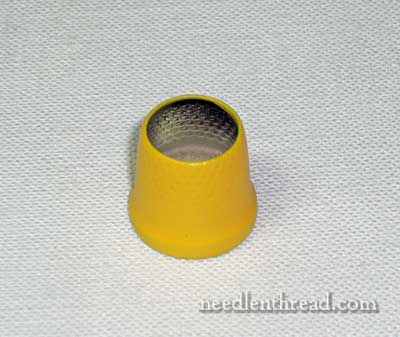
Open Thimble for Embroidering
Continue reading “Open Thimbles Saves Fingers!”